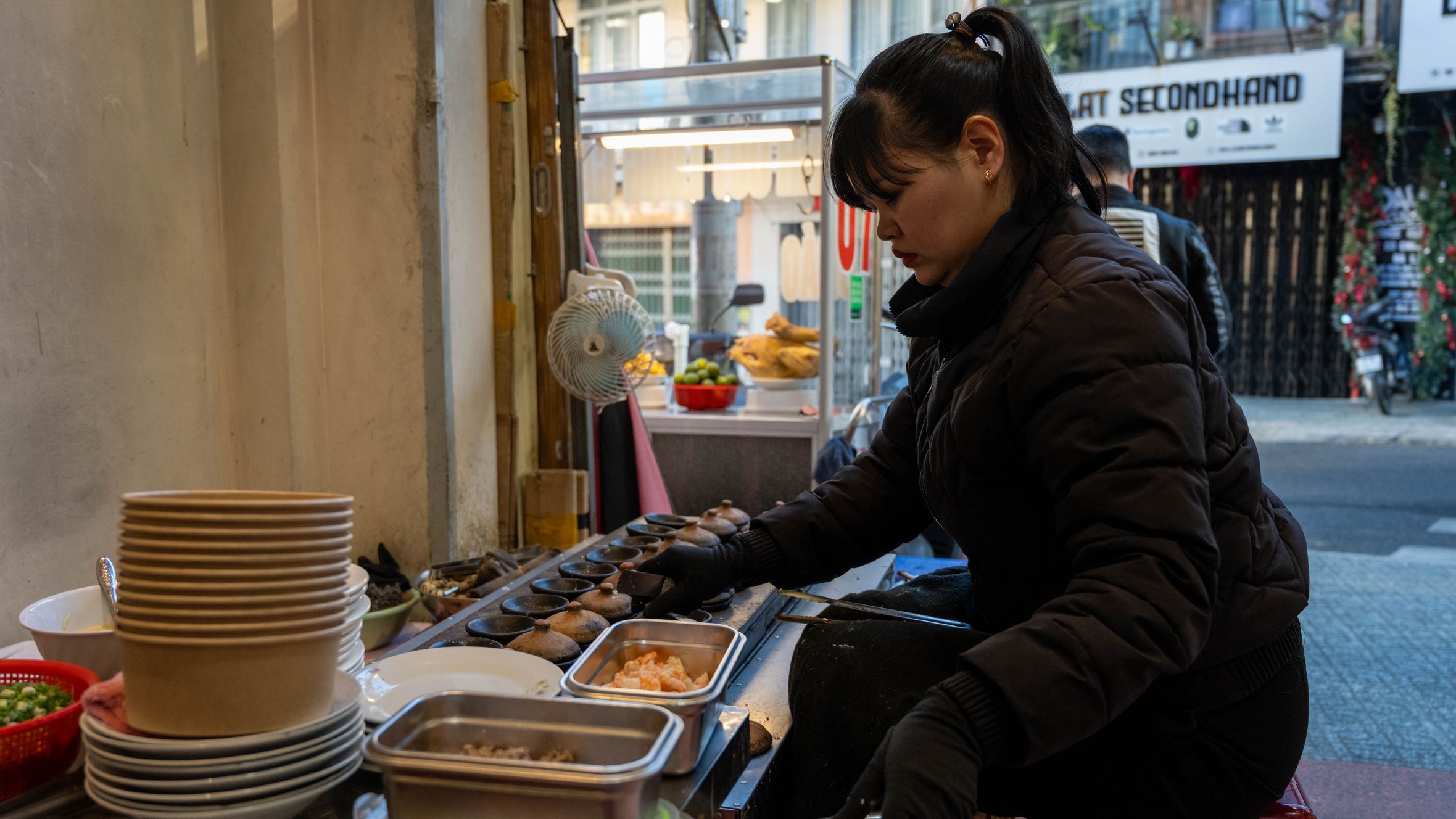
Hue has a reputation for obsessive culinary detail, and "banh nam" — flat steamed rice cakes wrapped in banana leaves, filled with minced shrimp and pork, finished with a slick of scallion oil — is one of the dishes that earns that reputation. It is quiet food, not flashy, but the gap between a mediocre version and a great one is wide enough to matter.
What Makes Hue's Banh Nam Different
The cake itself is thinner than you might expect — nearly translucent when steamed right, with a texture that sits between silky and slightly chewy. The filling leans on dried shrimp and fresh pork in roughly equal measure, seasoned with fish sauce and white pepper. What separates a Hue (후에 / 顺化 / フエ) banh nam from imitations elsewhere is the banana leaf: it has to be fresh enough to perfume the rice, and the fold has to be tight enough that steam does its job evenly. Served cold or at room temperature, it is almost always eaten alongside "banh beo" (steamed rice water flan in small dishes) and "banh loc" (tapioca dumplings with whole shrimp), because in Hue, these three tend to travel as a set.
The dish traces its roots to the royal court cuisine that defined Hue cooking for centuries. That heritage shows up in the precision — portion size, presentation, the ratio of leaf to cake — more than in any exotic ingredient.
The Spots Worth Finding
Quan Banh Nam Ba Do — 11 Nguyen Binh Khiem
This is the name most locals will give you first, and it holds up. Ba Do has been operating out of the same narrow shophouse near the Dong Ba Market area for decades. The banh nam here are small and thin, steamed to order in batches, and the scallion oil is applied generously. A set of three cakes runs around 10,000–12,000 VND. Open from roughly 6:30 AM until sold out, which on weekends means before 10 AM. Arrive early or accept the risk.
Quan Thanh — 11 Dinh Tien Hoang
A slightly larger operation with plastic stools spilling onto the pavement. Thanh does a good job with the fish sauce dipping condiment — more acidic than sweet, which is the correct call. The banana leaf wrapping here is notably fragrant; whoever is sourcing the leaves is doing it right. Banh nam sold individually at 4,000 VND each or in sets of five for 18,000 VND. Open 7 AM to noon, closed Sundays.
Com Hen Ba Cu — Pham Hong Thai Street (near the citadel moat)
Primarily known for "com hen" (baby clam rice), but Ba Cu does a short menu of Hue small cakes on the side that serious eaters should not overlook. The banh nam here has slightly more pork than shrimp in the filling, which makes it denser but also more satisfying as a standalone snack rather than part of a tasting spread. Around 5,000 VND per piece. Open 6 AM–11 AM only.
Banh Nam Co Ngoc — 17/7 Nguyen Cong Tru
This is the kind of spot you walk past twice before you see it — a home kitchen with a folding table pushed to the front gate. Co Ngoc has been making banh nam for over thirty years and has zero interest in tourism. The cakes are made in small quantities each morning, and the fish sauce dip has a noticeably funkier, more fermented quality than most competitors, which is either a feature or a problem depending on your palate. It is a feature. Price is 4,000 VND per cake. No fixed hours — she opens when she opens, usually around 7 AM, and closes when the cakes are gone.
Hanh Restaurant — 11 Pho Duc Chinh
Hanh sits in a more tourist-accessible part of central Hue and markets itself as a royal cuisine restaurant. The banh nam is genuinely good — properly thin, well-seasoned, served on a lacquered tray with presentation that nods toward the court aesthetic. It costs more: expect 25,000–35,000 VND for a mixed plate of banh beo, banh nam, and banh loc. Worth it if you want to eat in a sit-down setting with English menus and air conditioning. Not worth it as your only banh nam stop — the street versions are better for the actual cake.
Skip This Place: The Old Quarter Tourist Cafes
Several cafes along Nguyen Dinh Chieu and the backpacker-facing stretch near Tran Thi Ly Bridge serve banh nam as part of a "Hue royal food tasting platter." The cakes tend to be mass-produced in the morning, refrigerated, and microwaved to order. The banana leaf loses its fragrance completely after refrigeration, and the texture goes gummy. The price is often 50,000–80,000 VND for a platter that is objectively worse than what you get for 20,000 VND at Ba Do or Co Ngoc. These places are selling the idea of Hue food more than the food itself.

Photo by Tuan Vy on Pexels
How to Eat It
Unfold the banana leaf at the table — do not peel it like a wrapper, unfold it flat so the cake stays in one piece. Dip lightly; the fish sauce condiment is meant to accent, not flood. Eat it with the banh beo and banh loc if the shop offers them; the textural contrast is the point. A full set of all three, plus a glass of "ca phe sua da" from the nearest street cart, is a complete Hue breakfast for under 40,000 VND.

Photo by Pew Nguyen on Pexels
Practical Notes
Most banh nam vendors in Hue operate morning-only and are frequently sold out by 10–11 AM. If you are staying near the Citadel or Dong Ba Market, you are already in the right neighborhood — this is where the highest concentration of serious small-cake vendors operates. Hue is compact enough that none of these spots are more than 3–4 km from each other, so a single morning on a rented bicycle covers the whole list.
Last updated · May 26, 2026 · independently researched, never sponsored.