The Waterfront Landmark
Dong Ba Market sprawls across 47,614 square meters on the north bank of the Perfume River, just southeast of the Hue Citadel. Its riverside position isn't accidental—goods once arrived by boat, making it a natural hub. Today, the market is steps from some of Hue's most visited sites: the Citadel, Royal Tombs, and Thien Mu Pagoda are all a short cyclo ride away.
The main entrance faces Tran Hung Dao Street, with the river at the market's back. If you're walking from the Citadel's eastern Hien Nhon Gate, head southeast along the riverbank for about 800 meters—you'll hit it in under ten minutes. The clock tower above the central hall is the easiest visual landmark. Across the road, the Truong Tien Bridge connects the north bank to Hue's southern neighborhoods, so the market sits at a natural crossroads between the old imperial quarter and the city's commercial side.
A Market Rebuilt, Twice
The market's roots run deep. Historical records trace it back to the reign of Emperor Gia Long (early 1800s), when it occupied a spot just outside the Citadel's Eastern Gate. A roofed pavilion called "Quy Gia dinh" stood at its center—so prominent that locals called the whole market by that name.
Then came 1885. During the Battle of Hue Imperial City, the market was razed. Emperor Dong Khanh ordered its rebuilding in 1887. But the Citadel was evolving. In 1899, Emperor Thanh Thai relocated the market to its current riverside site on what was then Truong Tien Road. The new structure had 48 covered stalls and a well—designed for purpose. The old market grounds became a Franco-Vietnamese school, one attended by a young man named Nguyen Tat Thanh, who would later become Ho Chi Minh (호치민 / 胡志明 / ホーチミン).
A century later, in 1967, the market was demolished again for modernization. Work was interrupted by the Tet Offensive (1968), which damaged the incomplete structure. Temporary repairs kept it open. The first major overhaul came in 1987, giving it the layout visitors see today.
That 1987 rebuild produced the two-story concrete hall and surrounding single-story wings that still define the market. The structure is utilitarian, not charming—poured concrete, corrugated roofing, fluorescent tubes. But the bones work. The ground floor handles fresh food, dried goods, and everyday items. The upper floor is mostly textiles, "ao dai" fabric, and tailoring services. The surrounding outdoor alleys push out onto the sidewalks with overflow stalls selling fruit, flowers, and cheap household goods.

Image by Chainwit. via Wikimedia Commons (CC BY-SA)
What You'll Find
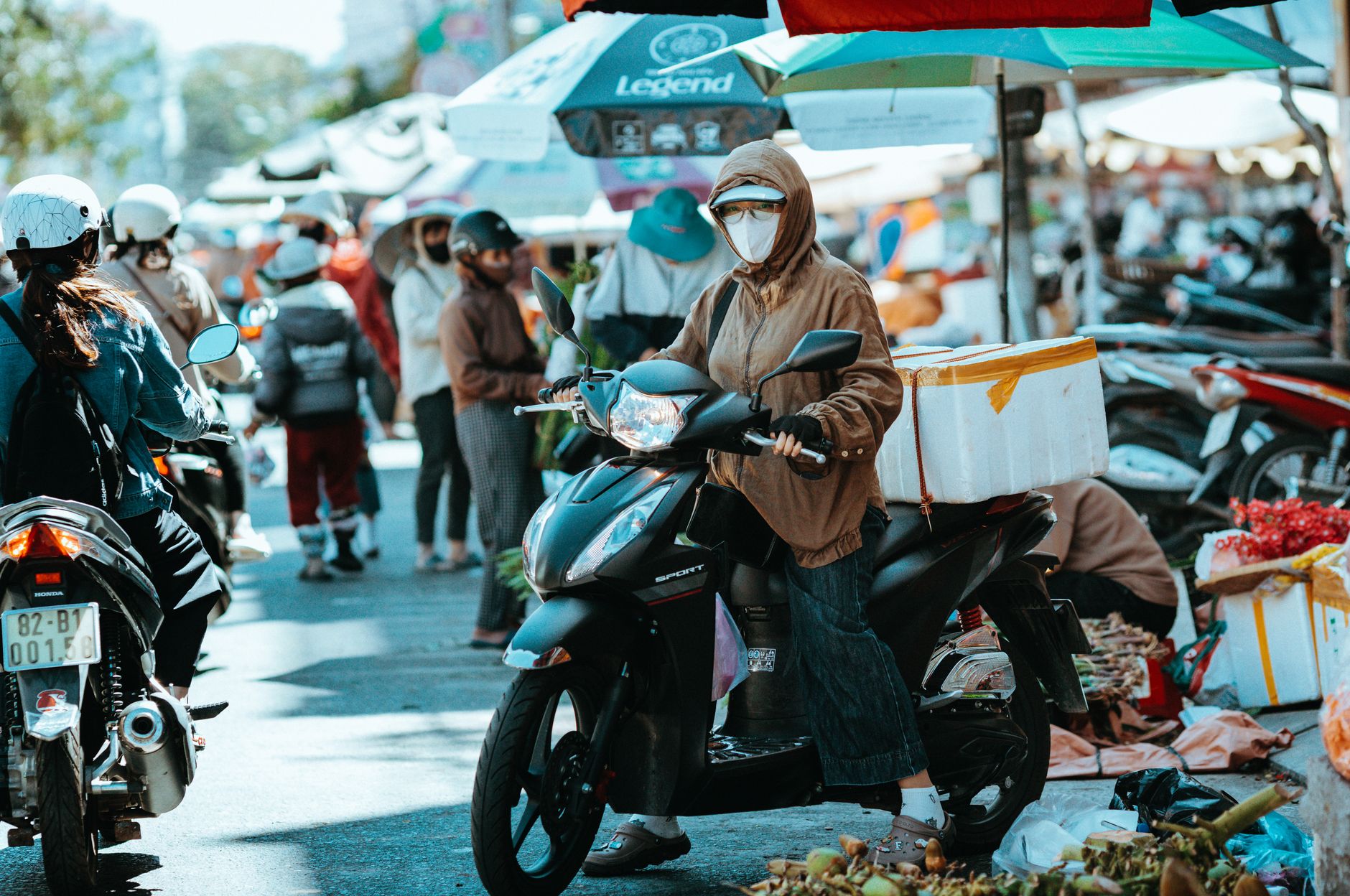
Dong Ba is not a tourist market—it's where Hue residents shop. Early morning is bedlam: vendors hawking fresh "banh chung" (sticky-rice pyramids), fish still glistening, bundles of herbs. By 7 a.m., the energy is peak.
You'll see produce stalls, wet fish and shrimp on ice, dried goods, textiles, shoes, toys, and local handicrafts. Prices are negotiable, especially if you buy in volume. Most goods are cheaper than supermarkets. Quality is variable—come early for the best pick.
The ground floor's northeast corner holds the wet market—fish, shrimp, pork, chicken, and offal laid out on metal trays. Vendors here start before dawn and thin out by 9 a.m. The center of the ground floor stocks dried goods: bags of "me xung" (sesame-peanut candy, a classic Hue (후에 / 顺化 / フエ) gift, roughly 40,000-80,000 VND per box), dried shrimp, chili flakes, "ruoc" (fermented shrimp paste), and "tinh bot nghe" (turmeric starch). These make practical souvenirs if you're heading to Da Nang or Hoi An afterward—light, shelf-stable, and genuinely local.
Upstairs, the textile section is dense. Bolts of silk, synthetic blends, and cotton line both sides of narrow aisles. If you want "ao dai" fabric, this is where Hue locals buy theirs—expect 200,000-500,000 VND per meter for decent silk. Several tailors operate on-site or nearby and can cut a custom "ao dai" within 2-3 days if you provide measurements. Tailoring runs 300,000-600,000 VND on top of fabric cost, depending on complexity.

Image by Chainwit. via Wikimedia Commons (CC BY-SA)
Eating at and Around Dong Ba
The food section is the real reason to visit if you're short on time. Hue has arguably the most distinctive regional cuisine in Vietnam, and the market concentrates it in one sweaty, crowded strip.
Inside the market's food court area, look for:
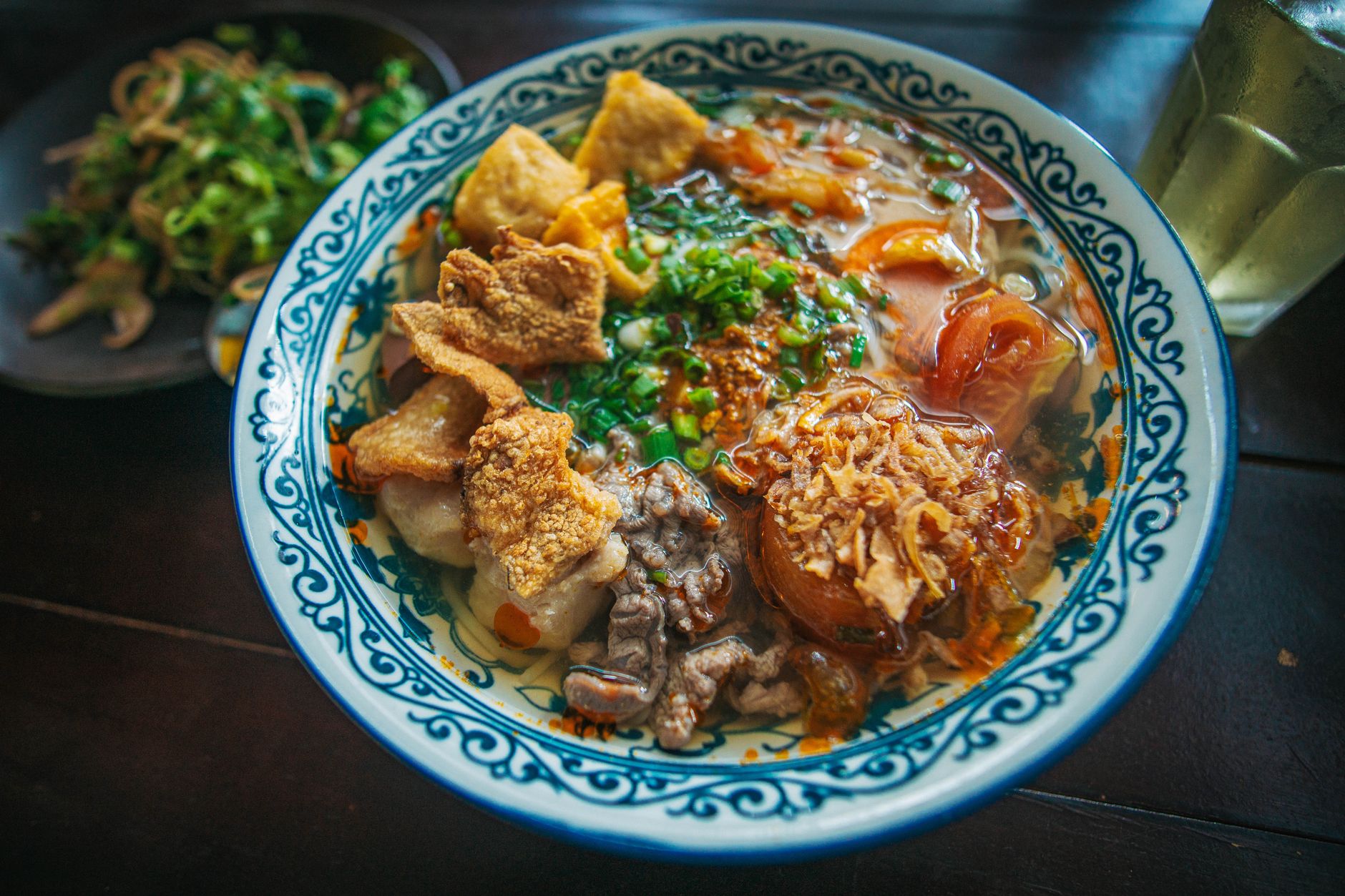
- Bun bo Hue — the city's signature beef-and-pork noodle soup. Vendors inside the market sell bowls for 25,000-35,000 VND, about half the price of sit-down restaurants on the south bank. The broth should be rust-colored from "sa te" (chili-lemongrass oil), slightly funky from shrimp paste, and served with thick round rice noodles. Point at the pot and say "mot to" (one bowl).
- Banh beo, banh nam, banh loc — Hue's trio of steamed rice cakes. "Banh beo" are small, saucer-shaped cakes topped with dried shrimp and scallion oil. "Banh nam" are flat, banana-leaf-wrapped parcels. "Banh loc" are translucent tapioca dumplings stuffed with shrimp and pork. You'll usually get a set of all three for 30,000-50,000 VND. Several stalls near the market's south side specialize in these.
- Che Hue — Hue-style sweet soups and desserts, served in small bowls or glasses. "Che bap" (corn), "che dau xanh" (mung bean), and "che hat sen" (lotus seed, a Hue specialty) run 10,000-15,000 VND each. Some vendors will let you sample.
- Com hen — baby clam rice. Tiny river clams served over cold rice with a pile of herbs, peanuts, crispy pork rinds, and chili. It's distinctly Hue—salty, crunchy, herbal—and costs about 20,000-30,000 VND.
Just outside the market's perimeter, especially along the river side and Tran Hung Dao, you'll find additional street vendors selling "banh mi" for 15,000-20,000 VND and "ca phe" (Vietnamese coffee) from cart vendors for 12,000-15,000 VND. Hue's "banh mi" tends to be lighter and spicier than Saigon's or Hoi An's versions—thinner baguette, more chili sauce, and a filling that leans toward pate and cold cuts rather than grilled meat.
If you want a proper sit-down meal after the market, the cluster of "bun bo Hue" shops along Chi Lang Street (about 1 km southwest along the river) is well-regarded by locals. Bun bo Hue is worth a dedicated article, but the short version: don't skip it when you're in this city.
How to Visit
The market operates from dawn (5 or 6 a.m.) until late afternoon or early evening. Morning visits (before 8 a.m.) give you the freshest stock and the liveliest atmosphere. It closes for a midday lull, then reopens briefly in late afternoon.
Entry is free. Pickpockets are rare but possible in crowds—keep a hand on your bag. The market is wheelchair-unfriendly: narrow aisles, wet floors, steep stairs to some sections.
Hue's city center is compact. From most hotels, Dong Ba is 10-15 minutes by foot or cyclo (50,000 VND). Taxis run ~80,000-120,000 VND. If you're at the Citadel, the market is a 5-minute walk east.
A practical route: start at the Imperial Citadel early (it opens at 7 a.m.), spend 90 minutes there, then walk east to Dong Ba Market for a late breakfast or brunch in the food stalls. From the market, you can grab a taxi south across the river for lunch, or continue to the Tomb of Tu Duc (about 7 km southwest, 100,000-120,000 VND by Grab). The market fits naturally into a half-day Citadel-side itinerary.
Common Mistakes Foreigners Make
Arriving after 10 a.m. — By mid-morning, the fresh food vendors are packing up and the heat inside the concrete hall becomes punishing, especially from April to September. The market is a 6-8 a.m. experience.
Assuming fixed prices — Nothing has a price tag. Vendors will quote higher prices to foreign faces. This is normal, not a scam. Counter-offer at roughly 70% of the first quote for dry goods and souvenirs. For food, prices are generally fair and consistent—don't haggle over a 30,000 VND bowl of noodles.
Skipping the upstairs — Most tourists browse the ground floor and leave. The second floor's textile and "ao dai" section is quieter, more browsable, and has some of the best-value silk in central Vietnam.
Expecting English — Very few vendors speak English beyond numbers. Learn "bao nhieu" (how much?) and "dat qua" (too expensive). Pointing and calculator-screen negotiation work fine.
Confusing Dong Ba with the night market — Hue's separate walking-street night market runs along Vo Thi Sau Street on the south bank. It's a different market entirely, aimed at tourists, with higher prices and different goods. Dong Ba is the daytime local market on the north bank.
Not bringing cash — No vendor here takes cards. Bring small bills. ATMs are along Tran Hung Dao Street, a one-minute walk from the main entrance.
Quick Reference
- Full name: Cho Dong Ba (Dong Ba Market)
- Address: 2 Tran Hung Dao Street, Phu Hoa Ward, Hue City
- Hours: approximately 5:00/6:00 a.m. to 6:00 p.m. daily (busiest before 8 a.m.)
- Entry fee: free
- Size: 47,614 square meters, two stories plus outdoor overflow
- Distance from Citadel (Ngo Mon Gate): ~800 m east, 10-minute walk
- Distance from Truong Tien Bridge: ~200 m north
- Distance from Hue railway station: ~1.5 km, 5-minute taxi
- Distance from Phu Bai Airport: ~15 km, 25-30 minutes by taxi (~250,000 VND)
- Best for: fresh food, Hue street food, dried goods and local snacks as souvenirs, "ao dai" fabric and tailoring
- Payment: cash only (VND), small bills preferred
- Useful phrases: "bao nhieu" (how much?), "mot to" (one bowl), "giam gia" (discount?), "dat qua" (too expensive)
Why It Matters
Dong Ba is not Instagram-friendly. It's not curated. It's a place where the city does its shopping, morning after morning, for 150 years. That persistence—through war, flood, and urban change—is what makes it worth seeing. It's a living market, not a museum.
If you're visiting Hue as part of a wider central Vietnam loop—say, Da Nang to Hoi An to Hue—Dong Ba is worth at least a morning. It anchors the city's north-bank identity the way Ben Thanh Market anchors District 1 in Ho Chi Minh City, though Dong Ba is scrappier, less polished, and more honest about what it is.
Bottom Line
Dong Ba Market is not the prettiest stop on a Hue itinerary, but it might be the most real. Show up before 8 a.m., eat a bowl of bun bo Hue at a plastic stool, buy a box of "me xung" for someone back home, and get a feel for how this city actually runs. The Citadel tells you what Hue was. Dong Ba tells you what it still is.
Last updated · May 29, 2026 · independently researched, never sponsored.