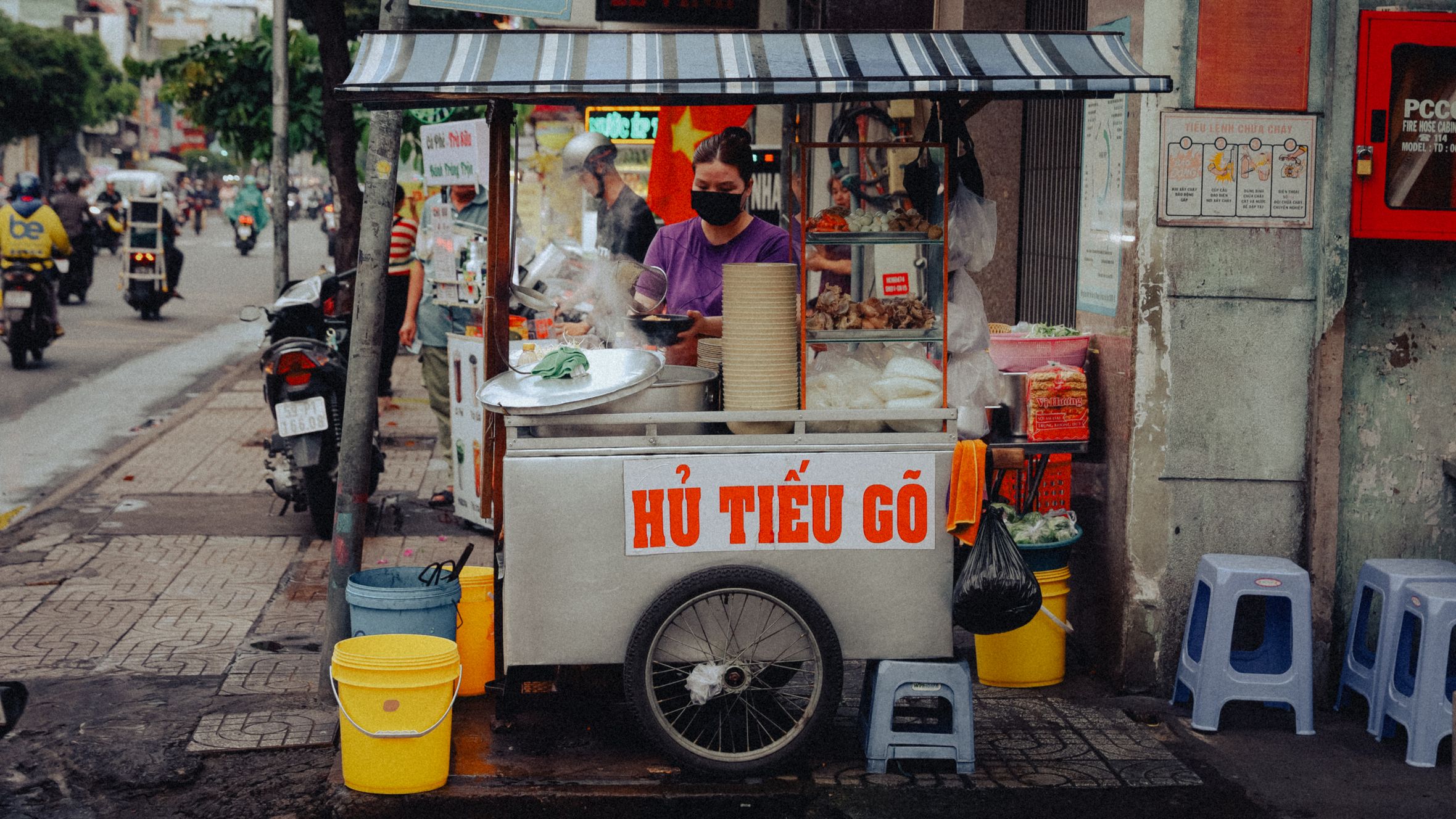
"Hu tieu" is the city's most underrated noodle soup. Unlike "pho", which can feel like a production, hu tieu is humble: a clean pork or seafood broth, paper-thin tapioca noodles, a scatter of pork liver and shrimp, and maybe some greens. Saigon's version skews lighter and more refined than the southern Delta style—less gloss, more precision.
The real dividing line is geography. "Hu tieu (후띠우 / 粿条 / フーティウ) Nam Vang" (Cambodian-style, from Phnom Penh) uses pork blood and offal; "hu tieu clear" or "hu tieu with shrimp and pork" is what you'll find in most Saigon stalls. The city's version tends toward seafood-forward broths and cleaner, less heavy toppings. This is breakfast food—eaten between 5:30 a.m. and 10 a.m., though lunch spots stay open until 1 or 2 p.m.
Hu Tieu An Nam (Binh Thanh District)
If you're after the most consistent bowl in the city, it's here: 287 Nguyen Hue, between two medical clinics, about 200 meters south of the Ben Thanh Market area. One bowl costs 35,000–45,000 VND depending on toppings (shrimp-only vs. pork-and-shrimp combo). The broth is made daily from pork bones and dried shrimp; noodles are fresh. Service is fast, the plastic stools are worn smooth from decades of locals, and the owner—an older woman in her 70s—knows exactly how much pork liver each regular wants. Open 6 a.m. to 1:30 p.m. only. Cash only.
Hu Tieu Thanh Huong (District 1, Dong Khoi area)
A step up in comfort but not in authenticity: 45 Ton That Thiep Street, near the intersection with Pasteur. This is where office workers in the financial district go when they want hu tieu without squatting on a plastic stool. Bowls here are 40,000–50,000 VND. The broth is lighter—some say too refined—but the pork and shrimp quality is excellent, and they top each bowl with crispy "mam tom" (shrimp paste) on the side so you control the funk. They're open 6 a.m. to 11 a.m., and again 4 p.m. to 8 p.m. (lunch closure is firm). No card reader, but they take mobile payment.
Hu Tieu O (Binh Thanh District, Vo Van Tan area)
This is a no-name stall—locals just call it "Hu Tieu O" ("O" means "Grandma" in southern slang). Located on a narrow lane off Vo Van Tan Street, near the intersection with Truong Dinh. Hard to find on Google Maps; easier to ask a taxi to drop you at Vo Van Tan/Truong Dinh intersection and walk. Bowls are 35,000 VND, and the broth is famously light and aromatic—the owner adds a touch of fish sauce infused with garlic and chile. Noodles are hand-pulled daily. Open 5:30 a.m. to 9 a.m. only. Very cash-only.

Photo by Sergey Guk on Pexels
Hu Tieu 99 (District 3, near Tan Dinh Church)
A small storefront (99 Nguyen Hue (후에 / 顺化 / フエ), District 3, not to be confused with the downtown Nguyen Hue street) that's been operating since the 1990s. Bowls: 40,000–45,000 VND. The specialty here is "hu tieu without pork"—pure seafood broth with shrimp, squid, and scallop. It's lighter than the standard pork version and appeals to people who want something more delicate. Open 5:30 a.m. to 11 a.m., closed Sundays. They accept card payments via an old POS machine.
Hu Tieu Tay Ho (District 1, near Tao Duc Lake)
A newer-feeling place (still family-run, opened around 2005) with actual seating at low tables. 127 Tran Quoc Tao, Tay Ho Ward. Bowls here are 45,000–55,000 VND because of location and comfort. The broth has a subtle sweetness from rock sugar and is closer to "hu tieu Nam Vang" style, with more pork liver. It's worth the premium if you want to sit down and linger. Open 6 a.m. to 11:30 a.m., and 4 p.m. to 8 p.m. Accepts card.
What to order and how
Walk up, point at the pot, and say one of these:
- "Mot tia hu tieu tom thit" (one bowl of hu tieu with shrimp and pork) — standard, about 40,000 VND.
- "Mot tia hu tieu tom" (one bowl with shrimp only) — slightly cheaper, cleaner flavor.
- "Mot tia hu tieu sach" (one bowl of clear hu tieu) — just broth, noodles, and maybe a bit of liver. Most austere option.
Most places add toppings by default: a few slices of pork liver, a coil of shrimp, some cilantro or green onion, and sometimes a dollop of "man tom" (shrimp paste). If you don't want something, say "khong can" (don't need).
Ask for "cot nong" (hot broth) or "cot mau" (warm broth, no ice). Hu tieu is not served over ice like pho in summer; it comes hot or at room temperature.
Photo by Sergey Guk on Pexels
Why Saigon's hu tieu is different
Compare a bowl in Saigon to one in the Mekong Delta (Can Tho, for example) and you'll notice: the Delta version is richer, almost creamy from pork blood and more generous offal. Saigon's version is a reaction to that—lighter, more cosmopolitan, influenced by the city's French and Chinese food history. The broth is clearer, the noodles thinner, and the plating is neater. It's the city's breakfast signature.
When to go
Breakfast crowd (6 a.m. to 8 a.m.) is peak. Lines form at the most famous spots, and you'll eat standing or squatting. If you want a seat and can wait, go between 8:30 a.m. and 10 a.m.—less chaos. Most spots close by 11 a.m.; only Tay Ho and a few others reopen for late-afternoon service (4–8 p.m.). Plan your visit around this rhythm.
Practical notes
Bring cash to most stalls, though central-district locations increasingly accept mobile payment. Budget 35,000–55,000 VND per bowl. The best time to try genuine hu tieu is early morning—that's when the broth is freshest and the noodles are most tender. Ordering is straightforward once you know the basic phrases, and locals are patient with fumbled Vietnamese.
Last updated · May 29, 2026 · independently researched, never sponsored.






