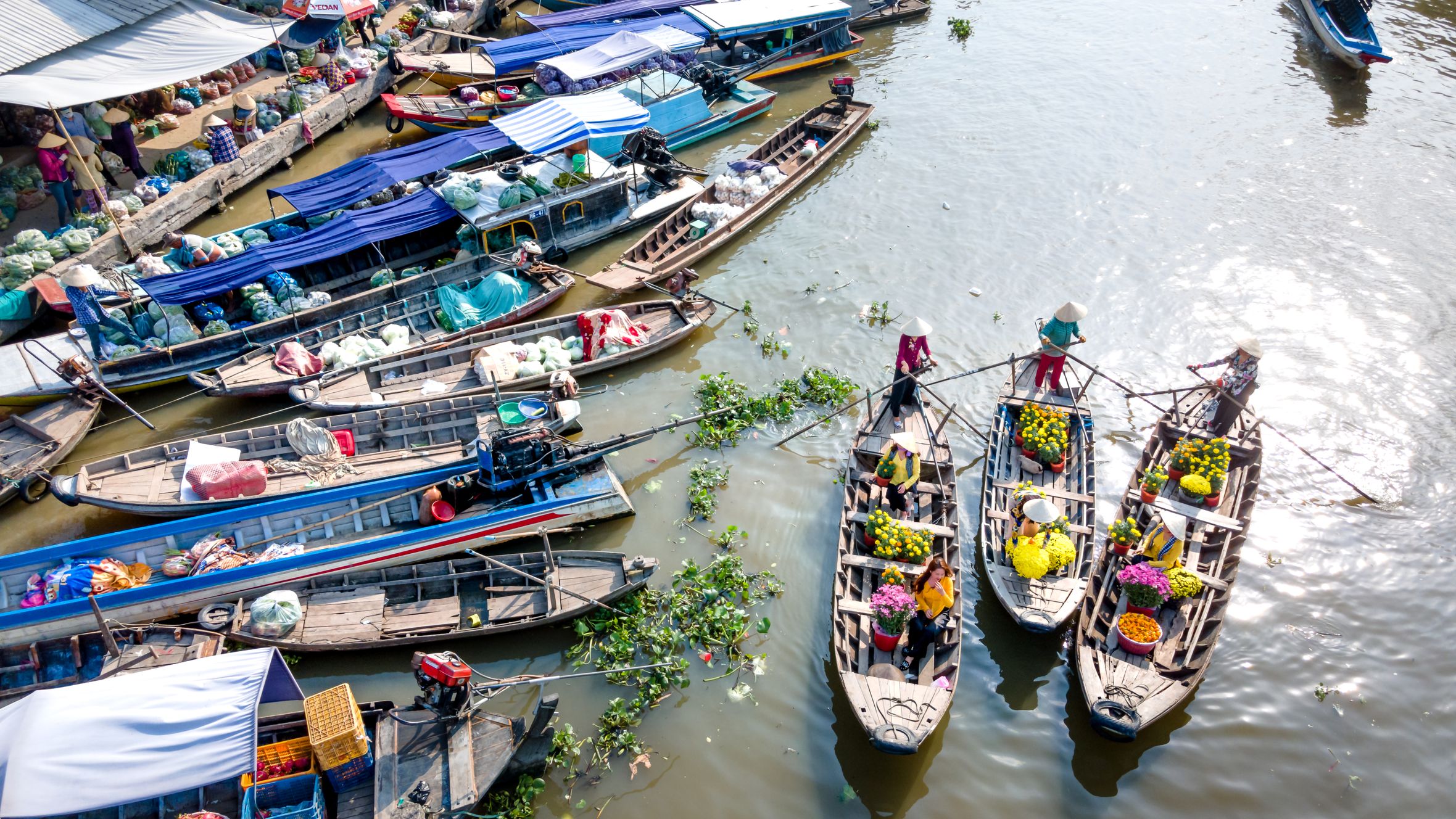
Cho Sat has been a fixture of Hai Phong's commercial life for over a century. Even if you never buy a thing, the market and its surroundings give you a real, unpolished look at how a major Vietnamese port city actually works day to day.
What it is and a bit of history
Cho Sat — the name translates roughly to "Iron Market" — sits in the heart of Hai Phong, close to the Tam Bac River. The original market dates back to the French colonial period, when Hai Phong was being developed as a key northern port. The current building, a large multi-story concrete structure, replaced older market halls and has gone through several renovations over the decades. It's not a photogenic heritage building — think functional, slightly worn, packed with goods floor to ceiling. That's the charm.
For generations, Cho Sat has been where Hai Phong residents buy everything from textiles and household goods to dried seafood and fresh produce. The surrounding streets extend the market's reach with dozens of smaller shops and food stalls spilling onto the sidewalks.
Why travelers go
Hai Phong doesn't see the tourist traffic of Hanoi or Hoi An, which is exactly why Cho Sat feels different from places like Dong Xuan Market or Ben Thanh Market. You won't find souvenir stands aimed at foreigners. This is a working market where locals shop, bargain, and eat. If you want to see everyday Vietnamese commerce without a tourist filter, Cho Sat delivers.
It's also a practical stop if you're passing through Hai Phong on the way to Cat Ba island or Ha Long Bay. Rather than killing time at a café near the ferry terminal, spend an hour or two here and actually see the city.
Best time to visit
The market runs year-round, but mornings are when Cho Sat is at its liveliest — aim for 7:00 to 10:00 AM when the fresh food sections are in full swing and the surrounding street food vendors are serving breakfast crowds.
Season-wise, October through March gives you cooler, drier weather in Hai Phong. Summers (June–August) are hot and humid, and the market's interior doesn't have much air circulation. If you visit during Tet, expect many stalls to close for several days around the holiday, though the weeks leading up to Tet bring a frenzy of shopping that's worth witnessing.
How to get there from Hanoi
Hai Phong is about 120 km east of Hanoi (하노이 / 河内 / ハノイ), and transport options are straightforward.
- Bus: Regular buses leave from Hanoi's Gia Lam or Nuoc Ngam bus stations. The ride takes roughly 2–2.5 hours on the Hanoi–Hai Phong expressway. Tickets run 80,000–120,000 VND depending on the operator.
- Train: Several daily trains connect Hanoi's Long Bien station to Hai Phong. The journey is slower — about 2.5 hours — but more scenic, cutting through the Red River Delta. Tickets start around 75,000 VND for a hard seat.
- Car/motorbike: The Ha Noi–Hai Phong expressway makes this a smooth 1.5–2 hour drive. Expressway tolls add up to about 200,000 VND for a car.
Once in Hai Phong, Cho Sat is centrally located near Tran Hung Dao Street. A taxi from the bus station or train station costs 30,000–50,000 VND. You can also walk from the train station in about 15 minutes.

Photo by HONG SON on Pexels
What to do
Walk the ground floor fresh market
The ground level is where the energy is. Fish still flopping, crabs tied in bundles, piles of herbs sorted by hand. The dried seafood section is particularly notable — Hai Phong is a port city, and the variety of dried shrimp, squid, and fish paste here reflects that. Even if you're not cooking, it's worth walking through just to see the scale of it.
Browse the textile and clothing floors
The upper levels are stacked with fabric, clothing, and household goods. Prices are low by Vietnamese standards, and this is where you'll see local shoppers haggling seriously. It's not curated or pretty — bolts of fabric lean against walls, shoes are piled in bins — but it's genuine retail the way it's been done here for decades.
Explore the surrounding streets
Don't limit yourself to the building. The blocks around Cho Sat form an extended market zone. Tran Phu Street and the lanes near the Tam Bac River are lined with small shops selling everything from tools to traditional medicine ingredients. The street food along these edges is where you'll find some of Hai Phong's best casual eating.
Visit the Tam Bac River waterfront
A short walk from the market brings you to the river, where you can see small boats and get a sense of Hai Phong's relationship with water. It's a good place to decompress after the market's intensity. Early mornings here are particularly quiet and pleasant.
Check out the colonial-era architecture nearby
The streets around Cho Sat still have scattered French-era buildings — faded yellow facades, iron balconies, shuttered windows. None are major tourist sites, but they add context to Hai Phong's history as a colonial port.
Where to eat nearby
Hai Phong has its own food identity, distinct from Hanoi.
- "Banh mi (반미 / 越式法包 / バインミー)" Hai Phong style: The local version uses a pate that's richer and fattier than what you'll find in Saigon or Hoi An, often with a crispy fried filling called "cha" (fried fish or pork cake). Carts near the market sell them for 15,000–25,000 VND.
- "Bun ca" (fish noodle soup): This is Hai Phong's signature bowl — rice noodles in a light, slightly sour broth with fried fish pieces and fresh herbs. Several shops on Hoang Van Thu Street, a short walk from Cho Sat, serve solid versions for 30,000–45,000 VND. It's a lighter, more herbaceous experience than "pho" and worth trying if you haven't had it before.
Pair either with a glass of "bia hoi" from one of the sidewalk spots near the market — Hai Phong's version is as cheap and sessionable as Hanoi's, around 8,000–12,000 VND per glass.
Where to stay
Hai Phong has a decent range of accommodation near the city center.
- Budget: Basic guesthouses and mini-hotels around the market area run 200,000–400,000 VND per night. Don't expect luxury — clean sheets, hot water, Wi-Fi.
- Mid-range: Hotels along Dien Bien Phu or Tran Hung Dao streets offer air-conditioned rooms with breakfast for 500,000–900,000 VND.
- Upper mid-range: A few international-standard hotels near the waterfront charge 1,200,000–2,000,000 VND, with pools and proper restaurants.

Photo by Quang Nguyen Vinh on Pexels
Practical tips locals would tell you
- Bring cash. Almost no vendors at Cho Sat accept cards. ATMs are nearby on Tran Hung Dao Street.
- Bargain, but reasonably. This isn't a tourist market, so prices aren't inflated the way they might be at Ben Thanh Market. A 10–20% reduction is normal; demanding half-price will just get you ignored.
- Watch your belongings. Crowded market, tight aisles, lots of distractions. Keep your phone in a front pocket and bags zipped.
- Wear shoes you don't love. The ground floor gets wet from the fresh food sections, especially in the mornings.
Common mistakes to avoid
- Arriving after noon. By early afternoon, the fresh sections wind down and the energy drops. Morning is the only time worth visiting.
- Expecting a tourist experience. There are no English signs, no information desks, no guided tours. That's the point — but it means you should be comfortable navigating on your own.
- Skipping the surrounding streets. The building itself is only part of the story. The food and smaller shops outside are often more interesting than what's inside.
Practical notes
Cho Sat works best as a morning stop on a day trip from Hanoi, or as part of a longer Hai Phong visit before heading to Cat Ba. Budget about two hours for the market and surrounding area. If you're heading to Ha Long Bay afterward, buses and boats connect from Hai Phong's ports throughout the day.
Last updated · May 29, 2026 · independently researched, never sponsored.






