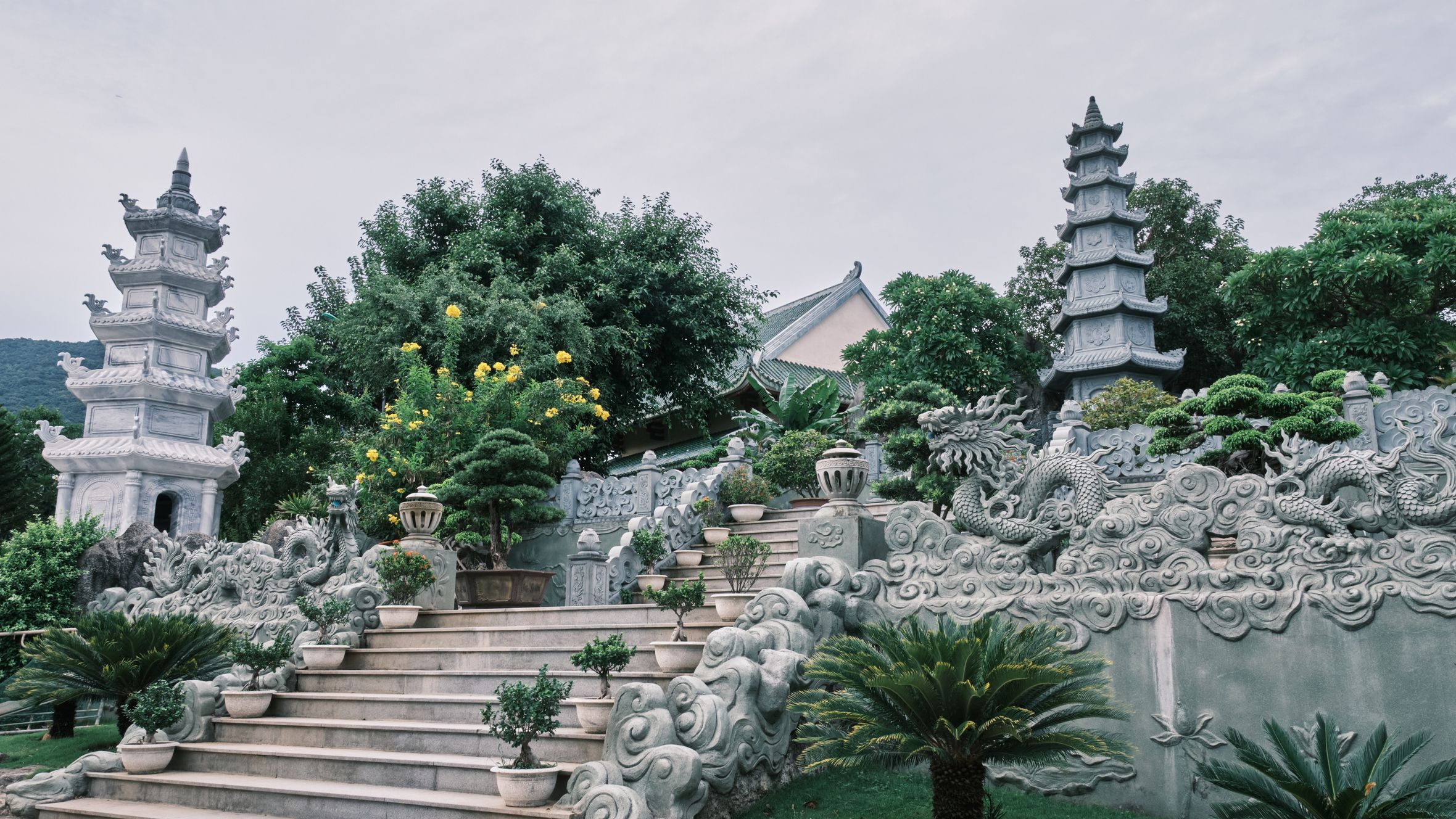
Chua Linh Son is one of Da Lat's oldest Buddhist pagodas, built in 1938 on a low hill about 700 meters from Xuan Huong Lake. It doesn't compete with the big-name temples elsewhere in Vietnam (베트남 / 越南 / ベトナム) for sheer scale, but that's partly the point — this is a working pagoda in a residential neighborhood, and visiting it feels more like stepping into local life than ticking off a landmark.
What it is and how it got here
The pagoda was established during the French colonial period, when Da Lat (달랏 / 大叻 / ダラット) was being developed as a hill station for the colonial administration. A group of Buddhist monks chose this site — a gentle hill along Nguyen Van Troi street — for its elevation and the mature pine trees surrounding it. The main hall has been rebuilt and expanded several times since, but the complex still carries a mid-century feel: low-slung rooflines, weathered ceramic tilework, and a 1.2-ton bronze bell cast in the 1970s that's become one of the pagoda's quiet claims to fame.
The architecture blends Vietnamese Buddhist temple design with some French-influenced structural elements, which is common in Da Lat but still worth noticing. Inside the main hall, a large Sakyamuni Buddha statue sits behind an altar heavy with incense and fruit offerings. The grounds include a Quan Am (Avalokiteshvara) statue garden and several monk residences.
Why travelers go
Chua Linh Son isn't a major tourist draw — and that's exactly why some people prefer it. The pagoda sits in a pocket of Da Lat that most visitors pass through without stopping, between the market area and the more residential streets heading north. You won't find tour buses here. On a weekday morning, you might share the grounds with a handful of older locals doing their prayers and a couple of monks sweeping leaves.
For anyone interested in Buddhist architecture or just wanting a quiet hour away from the Dalat Night Market crowds, it's worth the short walk. The hilltop position gives partial views over the surrounding pine-covered neighborhoods — not panoramic, but enough to remind you that Da Lat earns its reputation as a city built into the trees.
Best time to visit
Da Lat's climate is mild year-round thanks to its 1,500-meter elevation, so there's no bad season. That said:
- November to March is dry season, with cool mornings (15-18°C) and comfortable afternoons. Best months for walking around the grounds without getting caught in rain.
- April to October brings afternoon downpours — usually short but intense. Visit in the morning if you're here during rainy season.
- Tet (January or February, depending on the lunar calendar) is when the pagoda is busiest. Locals come for New Year prayers, and the grounds are decorated with flowers. It's lively but crowded.
- Early morning — around 6:30 to 7:30 AM — is when you'll catch monks chanting, if that interests you.
How to get there
If you're already in Da Lat, Chua Linh Son is centrally located at 120 Nguyen Van Troi, about a 10-minute walk uphill from Da Lat Market or a 5-minute ride from most hotels in the center.
- Walking: From Xuan Huong Lake, head north on Nguyen Van Troi. The pagoda entrance is on the left, marked by a gate and stone steps.
- Xe om (motorbike taxi) or Grab: 15,000-25,000 VND from central Da Lat.
- From Saigon: Buses from Saigon to Da Lat run daily (about 7-8 hours, 200,000-350,000 VND). Phuong Trang and Thanh Buoi are the most reliable operators. Flights from Tan Son Nhat to Lien Khuong Airport take about 50 minutes; from the airport, it's another 30 km into Da Lat city (taxi around 250,000-300,000 VND).

Photo by Tuan Minh on Pexels
What to do
Walk the grounds and the bell tower
The 1.2-ton bronze bell is housed in a separate tower to the right of the main hall. You can usually walk up and see it — the tower is open. The bell is inscribed with Buddhist sutras and was cast by local artisans. Take the stone path that loops behind the main hall through the pine trees; it's shaded and quiet.
Sit in the main hall during morning prayers
If you arrive before 7:30 AM, you may catch the monks' morning chanting session. You're welcome to sit quietly in the back. Remove your shoes, dress modestly (cover shoulders and knees), and don't photograph during prayers without asking.
Visit the Quan Am garden
Behind the main hall, a small garden holds a white Quan Am statue surrounded by bonsai and flower beds. It's a good spot to sit for a few minutes. The monks maintain it carefully, and during Tet / 越南春节 / テト) the garden fills with chrysanthemums and marigolds.
Explore the surrounding neighborhood on foot
The streets around Chua Linh Son — Nguyen Van Troi, Hai Ba Trung, Phan Dinh Phung — are some of Da Lat's most walkable. Old French-era villas sit behind garden walls, and the pine canopy keeps things cool. This is a better window into residential Da Lat than the tourist strip around the lake.
Where to eat nearby
Da Lat has its own food identity, separate from both Saigon street food and Hue's central Vietnamese flavors.
- Banh can — small savory rice cakes cooked in clay molds, served with a dipping broth and scallion oil. Try the vendors along Nguyen Van Troi or Tang Bat Ho street, about a 5-minute walk from the pagoda. A plate runs 30,000-50,000 VND.
- Vietnamese coffee in Da Lat is worth seeking out — the region grows its own arabica and robusta. An Cafe on Nguyen Van Troi or any of the small cafes near the pagoda will do a proper drip "ca phe sua da" for 25,000-35,000 VND.
Where to stay
- Budget: Guesthouses and hostels around Da Lat Market start at 150,000-300,000 VND per night. Basic but clean, and you're walking distance to the pagoda.
- Mid-range: Hotels along Phan Dinh Phung and Bui Thi Xuan run 500,000-1,200,000 VND. Some have lake views.
- Upscale: Ana Mandara Villas and Dalat Palace Heritage Hotel are the established high-end options, from about 2,500,000 VND per night.
Photo by Tuan Minh on Pexels
Practical tips locals would tell you
- Dress code matters. This is an active place of worship. Long pants or a skirt below the knee, and covered shoulders. Staff won't turn you away, but you'll get looks.
- Leave a small donation. There's usually a donation box near the main altar. 20,000-50,000 VND is typical and appreciated — it helps maintain the grounds.
- Shoes off inside. Leave them on the rack by the entrance. Socks are fine.
- Incense is available at the entrance for a small donation if you want to light some at the altar.
Common mistakes to avoid
- Rushing through. Chua Linh Son isn't a 10-minute photo stop. Give yourself at least 45 minutes to walk the grounds, sit in the hall, and explore the garden.
- Coming at midday. The pagoda is exposed to afternoon sun and less pleasant between 11 AM and 2 PM. Morning is better in every way.
- Loud conversations in the main hall. It's a place of prayer. Keep your voice low and your phone on silent.
- Skipping it for bigger attractions. Da Lat's cable car and flower gardens get the tour groups, but Chua Linh Son gives you something those places can't — a genuine, quiet connection to the city's Buddhist roots.
Practical notes
Chua Linh Son is free to enter and open daily from early morning until about 5 PM. There's no ticket booth or guided tour — you simply walk in. Combine it with a morning coffee on Nguyen Van Troi and a walk through the old French quarter streets for a half-day that feels nothing like the usual Da Lat tourist circuit.
Last updated · May 29, 2026 · independently researched, never sponsored.








