Hue has a reputation for refined, ceremonial food — the kind that took years to perfect for imperial kitchens. "Com am phu" is the other side of that city: loud, cheap, and eaten standing up at midnight.
What Is Com Am Phu
The name translates loosely as "Hell Rice" or "Underworld Rice" — "am phu" being the Vietnamese term for the underworld. The dish was born in the 1920s from street vendors who worked the late shift near Dong Ba Market, selling to rickshaw drivers, porters, and anyone else who needed a hot meal after the rest of the city had shut down. The name stuck partly because of the hours and partly because of the theatrical look of the plate: a vivid mess of colour and texture piled over white rice that resembles, in some lights, a chaotic feast from another world.
The components are consistent across stalls: steamed white rice topped with grilled or braised pork slices, a halved boiled egg, small steamed or grilled prawns, pickled mustard greens, shredded banana flower, a ladle of rich pork broth poured table-side, and a scattering of fried shallots. Every vendor has a house version — some add cha lua (pork roll), some lean heavier on the broth — but the visual logic stays the same: maximum colour on a single plate.
It is not a subtle dish. It is the thing you want at 11pm after walking Hue (후에 / 顺化 / フエ)'s riverside for three hours.
Where to Find It
Quan Com Am Phu Ba Do
This is the stall most Hue locals point you toward first. Ba Do (her nickname, not a brand) operates from a stretch of plastic tables on Nguyen Binh Khiem Street, a short walk from Dong Ba Market. She opens around 8pm and runs until the rice runs out, which is usually sometime between midnight and 1am depending on the night. A full plate — rice, pork, egg, prawn, broth — runs 35,000–45,000 VND. Order the pork skin version if it's available; it adds a gelatinous chew that makes the broth absorption better.
The setup is entirely outdoor. Plastic stools, fluorescent light, the occasional motorbike parked half on the table. It is extremely Hue.
Hem 12, Nguyen Du Street
This alley off Nguyen Du, roughly 1.2km from Dong Ba, has three or four com am phu vendors operating side by side from around 9pm onwards. The competition keeps prices sharp — expect 30,000–40,000 VND per plate. The vendor at the far end of the alley adds a thin fish sauce and chilli dipping sauce alongside the broth, which is worth asking for specifically. These stalls often stay open until 2am on weekends.
Near Truong Tien Bridge (South Bank)
A smaller cluster of vendors sets up on the south bank approach to Truong Tien Bridge after 9pm. The location pulls in a younger crowd — students from Hue University of Sciences, couples walking the river. Portions here tend to be slightly smaller and prices fractionally cheaper (around 28,000–35,000 VND), but the rice-to-topping ratio is thinner. Still worth it if you're already on that side of the river.
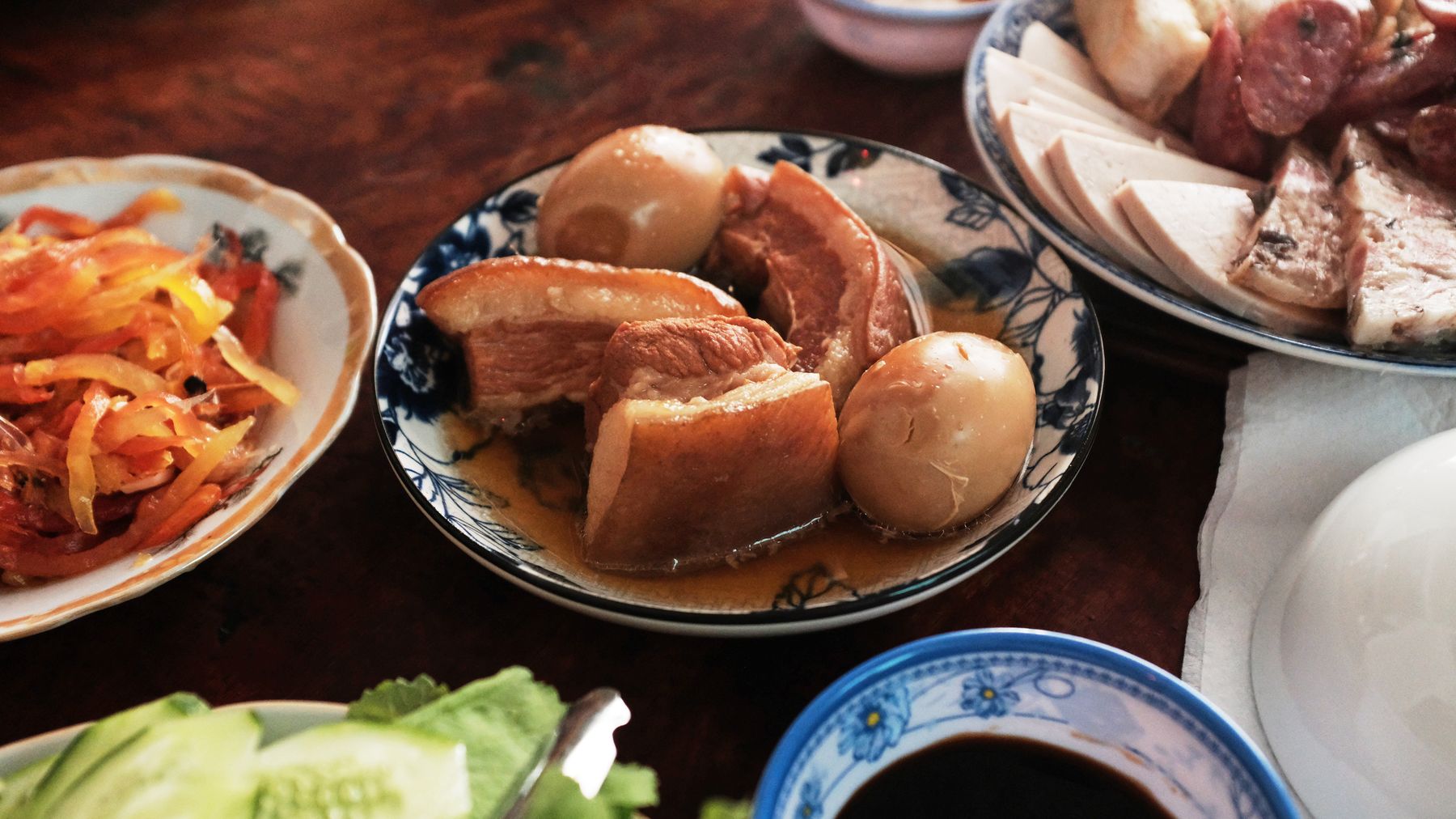
Photo by Nguyen Truong Khang on Pexels
How to Order
Most com am phu stalls don't have menus. You sit down, they bring rice, and you point at what you want on top. Saying "mot dia day du" (one full plate) usually gets you everything. If you want extra broth — and you do want extra broth — say "them nuoc" and they'll ladle more over without charging extra at most places.
Drink options are usually just iced tea (tra da, almost always free or 5,000 VND) or a bottle of Huda, the local Hue beer, for around 15,000–20,000 VND. Huda with com am phu is the correct pairing.

Photo by Tuan Vy on Pexels
Timing and Practical Notes
Com am phu is not a lunch dish. Vendors generally don't open before 7:30pm, and the better ones hit their stride between 9pm and 11pm when everything is freshest and the broth has been running for hours. Go too early and the pork is still cold from prep. Go too late and the prawns are gone.
Hue's food scene rewards patience and wandering. If you're already out after a bowl of "bun bo hue" earlier in the evening or a late walk past the Imperial Citadel, com am phu is the natural end to a night — filling, cheap, and entirely specific to this city.
Practical notes: Most stalls are cash only. Bring small bills; 50,000 VND notes are fine, larger denominations cause friction. The Nguyen Binh Khiem and Nguyen Du spots are both within comfortable walking distance of most guesthouses in Hue's central district.
Last updated · May 26, 2026 · independently researched, never sponsored.