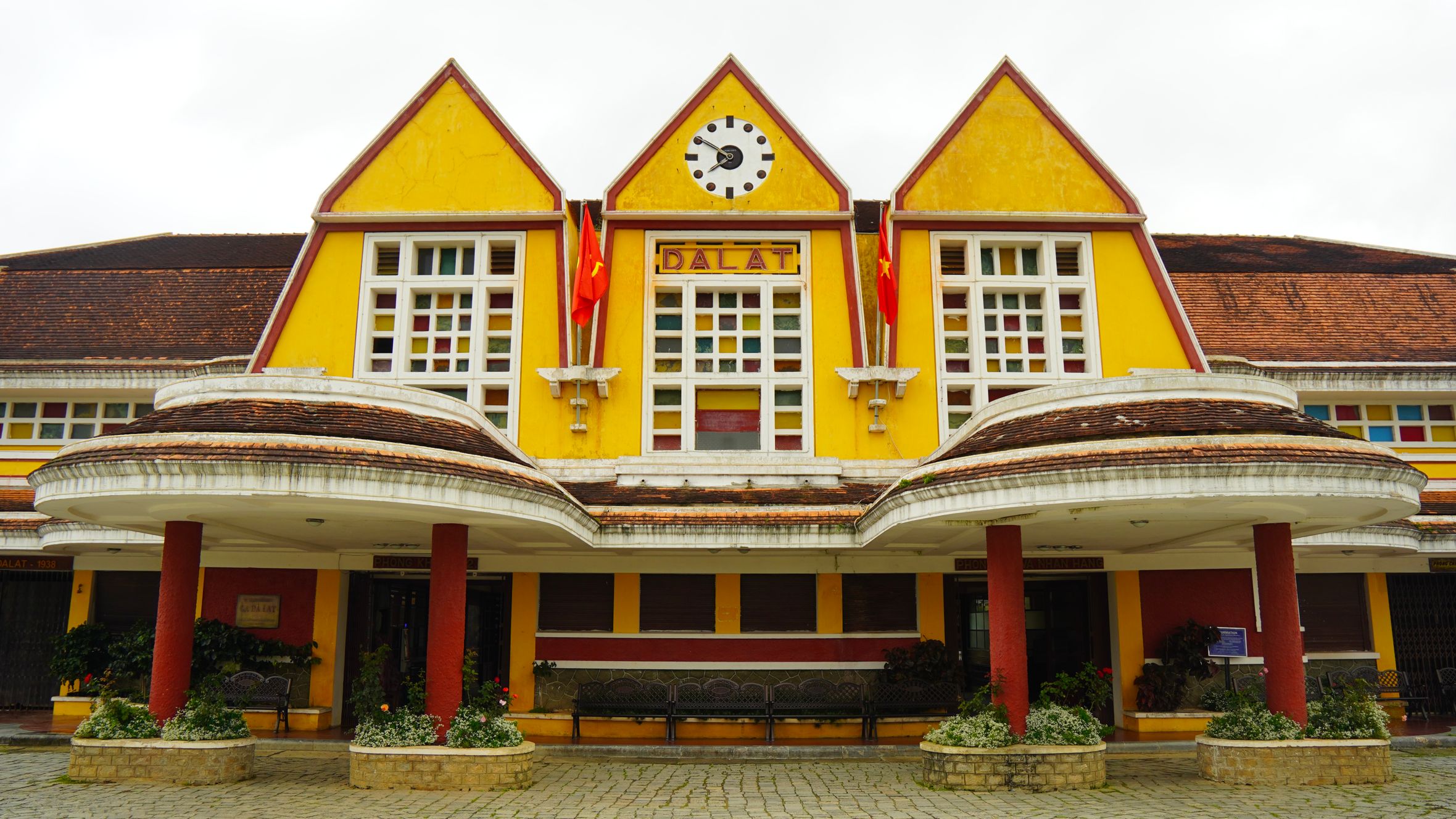
Da Lat's old train station — Ga Da Lat — sits at the foot of a low hill on Quang Trung street, about 500 meters east of the central market. It's one of the last intact French colonial railway buildings in Vietnam (베트남 / 越南 / ベトナム), and on a quiet weekday morning it feels like stepping into a place the rest of the country forgot to demolish.
What it is
Built between 1932 and 1938, Ga Da Lat (달랏 / 大叻 / ダラット) was the terminus of the Thap Cham–Da Lat cog railway, an 84-km line that once connected the highlands to the coastal rail network near Phan Rang. The railway shut down in 1968 during the war, and most of the track was pulled up afterward. What remains is the station building itself — a handsome Art Deco structure with a triple-arched entrance, colored glass windows, and a high-pitched roof styled after the peaks of Lang Biang mountain — plus a 7-km stretch of restored track running to Trai Mat village.
The station earned national heritage status in 2001. A few vintage locomotives sit on the tracks outside, slowly rusting in a photogenic way.
Why travelers go
Two reasons. First, the building. It's one of the best-preserved pieces of colonial architecture in the highlands, and the combination of Art Deco geometry and local roofline influence makes it genuinely distinctive — not just another French building painted yellow. Second, the tourist train. A small diesel locomotive pulls a few carriages along the remaining track through pine forests and vegetable farms to Trai Mat, where you can visit Linh Phuoc Pagoda (a wildly ornate dragon-and-mosaic temple) before catching the return train. It's a short, pleasant ride with a bit of historical weight behind it.
Best time to visit
Da Lat sits at roughly 1,500 meters elevation, so it's cooler than anywhere else in southern Vietnam year-round. The station and train operate daily, but timing matters.
December to March is dry season with clear mornings — the best light for photographs and the most comfortable temperatures (15–24°C). April and May are still good, warmer but not yet rainy. Avoid weekends and Vietnamese public holidays if you can; the station gets packed with domestic tourists during Tet and summer months (June–August), and the train sells out fast.
The train runs roughly five departures per day, starting at 7:45 AM. The earliest departure is the least crowded.
How to get there
Da Lat has no commercial railway connection — the irony of visiting a train station you can't arrive at by train.
From Saigon: The most common route. Buses from Ben Thanh bus station or Mien Dong bus station take 7–8 hours and cost 200,000–350,000 VND depending on the operator. Phuong Trang (FUTA) and Thanh Buoi are reliable. Sleeper buses depart in the evening and arrive early morning. Flights from Tan Son Nhat to Lien Khuong Airport take about 50 minutes; expect 800,000–1,500,000 VND booked in advance on VietJet or Vietnam Airlines. From the airport, it's 30 km to Da Lat city center — a taxi runs about 250,000–300,000 VND.
From Da Nang or Hue: No direct bus. Fly to Lien Khuong (seasonal routes exist) or bus to Nha Trang first, then connect to Da Lat (4 hours by bus, around 150,000 VND).
Within Da Lat: The station is a 10-minute motorbike ride or 2 km walk from Xuan Huong Lake and the central market area. A Grab bike costs 15,000–20,000 VND.

Photo by Tuan Minh on Pexels
What to do
Ride the tourist train to Trai Mat
The main event. The train covers 7 km in about 30 minutes each way, passing through pine groves and small farms. A return ticket costs 150,000 VND per adult. You get 30 minutes at Trai Mat before the return departure. The train needs a minimum number of passengers to run, so showing up early for the first departure improves your odds on quiet days.
Explore Linh Phuoc Pagoda
At the Trai Mat end of the line, this Buddhist temple is covered in thousands of broken ceramic and glass pieces — bottle shards, teacups, plates — assembled into dragons, Buddhas, and ornamental walls. It's overwhelming and genuinely impressive in its detail. Free entry.
Photograph the locomotives
Three or four old engines sit on the tracks beside the station. The oldest is a Japanese-made Toka locomotive from the 1930s. Morning light hits the front of the station best; the locomotives photograph well in the late afternoon when the platform clears out.
Walk the platform and interior
The station's interior is small but well-maintained, with original tile floors and wooden benches. The colored glass windows cast good light in the mornings. The whole visit takes 20–30 minutes if you're not catching the train.
Browse the market stalls outside
Local vendors sell dried fruit, artichoke tea, avocados, and "nem chua" (fermented pork) near the station entrance. Da Lat's strawberries and persimmons are seasonal but worth grabbing if available.
Where to eat nearby
The station area itself is light on restaurants, but you're close to the center of town.
"Banh mi" on Nguyen Van Troi street — Da Lat's version tends to include a fried egg and more greens than the Saigon standard. Several carts along this street sell them for 20,000–30,000 VND. Not the city's most famous food, but solid and quick.
"Banh canh" at Banh Canh Ba Oanh on Phan Dinh Phung street — thick tapioca noodles in a pork-based broth, served with quail eggs and Vietnamese ham. A bowl runs about 40,000 VND. It's a 5-minute ride from the station and consistently good.
Da Lat is also known for its avocado ice cream and soy milk; the central market area (Cho Da Lat) is the best zone for grazing.
Where to stay
Da Lat has accommodation for every budget, concentrated around Xuan Huong Lake and the market.
- Budget: Hostels and guesthouses in the Bui Thi Xuan / Phan Dinh Phung area run 150,000–350,000 VND/night.
- Mid-range: Hotels with views near the lake go for 500,000–1,200,000 VND/night. Plenty of options on Tran Phu street.
- Upper-range: The Ana Mandara Villas and Dalat Palace Heritage Hotel sit in the 2,500,000–5,000,000 VND range and occupy restored French villas — fitting if you're into the colonial architecture theme.

Photo by HONG SON on Pexels
Practical tips
- Bring a light jacket. Even in the warm months, Da Lat mornings at the station can be cool, especially before 8 AM.
- The train does not run on a fixed schedule if passenger numbers are low. Confirm departure times at the ticket window when you arrive.
- Trai Mat village itself is small. Thirty minutes is enough to see the pagoda and walk around. Don't expect a full half-day activity from the round trip.
- If you're visiting on a weekend, buy your train ticket first thing in the morning or the day before.
Common mistakes
- Arriving at midday on a weekend. The station platform becomes a photo backdrop for wedding shoots and tour groups. Come early.
- Expecting a real rail journey. The 7-km ride is pleasant, not dramatic. If you're imagining a mountain pass railway experience, recalibrate — this is a short tourist loop on flat-ish terrain.
- Skipping Trai Mat. Some visitors photograph the station and leave. The train ride is the best part, and Linh Phuoc Pagoda alone justifies the 150,000 VND ticket.
- Not checking the return time. If you miss the return train from Trai Mat, you'll need a motorbike taxi back to town (about 50,000 VND). Not a disaster, but easy to avoid.
Practical notes
Ga Da Lat is open daily from around 7 AM to 5 PM. There's no entrance fee to visit the station itself — you only pay if you ride the train. Budget about 2 hours total for the station visit plus the Trai Mat round trip. It pairs well with a morning at the central market or an afternoon drive up to Lang Biang peak.
Last updated · May 29, 2026 · independently researched, never sponsored.








