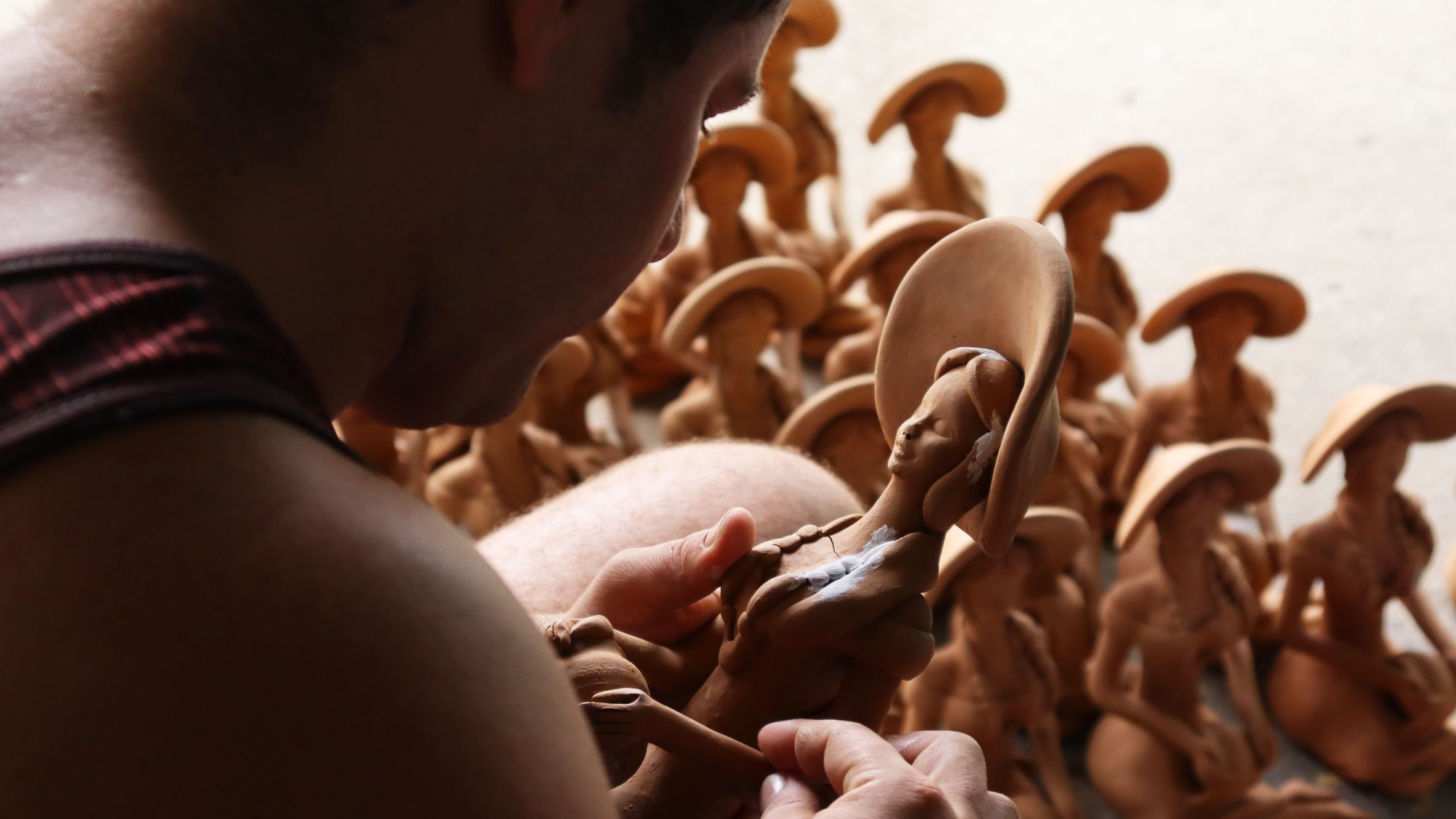
Da Lat has no shortage of quirky attractions, but Khu Du Lich Duong Ham Dat Set (Clay Tunnel Tourist Area) is one of the few that actually delivers on its strange premise: an entire park built almost entirely from local laterite clay, sculpted by hand over more than a decade.
What it is
Located about 5 km from Da Lat's city center along the road toward Trai Mat village, the Clay Tunnel park opened in 2012 and has been expanding ever since. The project was conceived by sculptor Trinh Ba Dung, who wanted to showcase the red-orange laterite clay found throughout the Central Highlands (중부 고원 / 中部高原 / 中部高原). What started as a modest tunnel grew into a 1.2-hectare complex of clay castles, reproductions of Vietnamese landmarks, tunnels you can walk through, and hundreds of detailed sculptures — all made from the same local clay.
The centerpiece is the tunnel system itself: narrow, winding corridors with carved walls depicting scenes from Vietnamese history and daily life. Some sections are tight enough that you'll need to duck. Outside, the grounds are packed with oversized clay models of everything from the One Pillar Pagoda to Tran Quoc Pagoda to international landmarks like the Leaning Tower of Pisa — all rendered in that distinctive red-orange earth tone.
Why travelers go
It's unlike anything else in Da Lat (달랏 / 大叻 / ダラット). The city is famous for its French colonial architecture, flower gardens, and pine forests, but the Clay Tunnel park offers something genuinely different. The craftsmanship is impressive up close — you can see chisel marks, layered textures, and fine details that reveal how much labor went into every wall. It photographs well too. The warm clay tones pop against Da Lat's green hillsides, especially in late afternoon light.
Families with kids tend to enjoy it. There's enough variety to keep children interested for an hour or two, and the tunnels feel like an adventure for younger visitors. For adults, the appeal is more about appreciating the scale of the project and the sheer ambition of building an entire park from clay.
Best time to visit
Da Lat's dry season runs from roughly November through March, and that's the ideal window. The clay structures hold up well in dry weather but can get slippery when wet, and some outdoor sections lose their appeal in heavy rain. Mornings on weekdays are quietest — the park gets busy on weekends and during Vietnamese school holidays, especially around Tet and summer break (June–August). Arrive before 9:00 AM on a weekday and you'll likely have the tunnels mostly to yourself.
How to get there
From central Da Lat, the park is about 5 km east on Ly Tu Trong Street, heading toward Trai Mat. A Grab bike ride costs around 25,000–35,000 VND one way; a Grab car is 40,000–60,000 VND. If you're renting a motorbike (the best way to get around Da Lat, honestly), the ride takes 15 minutes and parking at the park is free.
If you're coming from further afield — say Saigon — the most common route is a 6–7 hour bus from Ben Thanh area (around 250,000–350,000 VND with operators like Thanh Buoi or Phuong Trang). From Da Nang, flights to Lien Khuong Airport take about an hour, and the airport is 30 km south of Da Lat city center.

Photo by Hồng Quang Official on Pexels
What to do inside
Walk the main tunnel system
The tunnels stretch several hundred meters and wind through carved chambers depicting Vietnamese village life, historical scenes, and natural landscapes. Ceiling heights vary — some spots are comfortable, others require a slight crouch. Take your time here. The wall carvings are intricate, and it's easy to miss details if you rush.
See the landmark miniatures
The outdoor area features scaled-down clay replicas of Vietnamese and international sites. The Vietnamese ones are the most interesting — the Hue Imperial Citadel reproduction, the miniature Bai Dinh pagoda complex, and a version of the Temple of Literature are all worth a closer look. The international models feel like an afterthought by comparison.
Climb the castle tower
A multi-story clay castle sits near the park's center, and you can climb to the upper levels for a view over the grounds and surrounding hills. The stairways are narrow and uneven — wear shoes with grip.
Check the sculpture garden
Scattered around the grounds are dozens of standalone clay sculptures: animals, mythical creatures, human figures. Some are genuinely skillful. Others are charmingly rough. The dinosaur section near the back is a hit with kids.
Visit during a sculpting demonstration
Occasionally, artists work on new pieces in an open workshop area near the entrance. There's no fixed schedule, but weekday mornings are your best bet for catching someone at work.
Admission is 60,000 VND for adults and 30,000 VND for children (as of early 2025). Budget about 1.5 to 2 hours for a thorough visit.
Where to eat nearby
The park itself has a small cafe selling drinks and snacks, but nothing worth recommending. Instead, head back toward Da Lat center or continue to Trai Mat village.
In Trai Mat, look for "banh canh" — the thick tapioca-flour noodle soup that's a staple of the Central Highlands. A bowl runs 35,000–50,000 VND at the small shops near Trai Mat station. Back in Da Lat proper, don't skip "banh mi" xiu mai — the city's signature meatball-stuffed baguette, best at Banh Mi Huynh Hoa-style shops around Nguyen Thi Minh Khai Street. A solid bowl of "pho" or a plate of grilled "nem chua" from the night market on Nguyen Thi Minh Khai rounds out a good evening.
Da Lat is also one of the best places in Vietnam to drink "vietnamese coffee". The cool highland climate means sitting outside with a drip filter actually feels pleasant rather than sweaty. Try a spot on Tran Phu Street or around Ho Xuan Huong lake.
Where to stay
Da Lat has accommodation for every budget. Hostels and basic guesthouses near the central market start around 150,000–250,000 VND per night. Mid-range hotels with valley views run 500,000–900,000 VND. If you want something with character, Da Lat has a growing number of boutique homestays in the hills south of the lake — expect 700,000–1,500,000 VND for a double room with breakfast.

Photo by HONG SON on Pexels
Practical tips locals would tell you
- Wear closed-toe shoes. The tunnels have uneven clay floors that get dusty (or muddy after rain). Sandals are a bad call.
- Bring a light jacket. Da Lat sits at 1,500 meters elevation. Even when it's warm outside, the tunnels are noticeably cooler.
- Charge your phone. There are no power outlets inside the park, and the photo opportunities are relentless.
- Combine it with the Trai Mat cog railway. The old narrow-gauge train from Da Lat station to Trai Mat takes about 30 minutes and passes through pine forests. It's a 10-minute motorbike ride from Trai Mat to the Clay Tunnel park — easy to do both in a half-day.
Mistakes to avoid
- Going on a weekend afternoon. The tunnels are narrow. With a crowd, it stops being fun and starts being a shuffle.
- Treating it as a full-day activity. Two hours is plenty. Pair it with Trai Mat, the cog railway, or a coffee stop — don't build your whole Da Lat day around it.
- Touching the sculptures. The clay is durable but not indestructible. Staff will remind you, but it bears repeating: keep your hands off the carvings.
- Skipping the back sections. Most visitors cluster near the entrance and main tunnel. The sculpture garden and castle tower at the rear are less crowded and worth the walk.
Practical notes
The Clay Tunnel park is a solid half-day addition to any Da Lat itinerary, especially if you've already done the Crazy House and flower gardens circuit. It pairs naturally with the Trai Mat cog railway and a long lunch in town. Just pick a dry weekday morning, wear real shoes, and give yourself time to actually look at the details.
Last updated · May 29, 2026 · independently researched, never sponsored.








