
Ganh Yen sits on the coast of Quang Ngai province, about 30 km east of the city center. It's a formation of dark basalt columns — hexagonal, tightly packed, eroded into shelves and pools by the ocean — that resulted from ancient volcanic activity along this stretch of central Vietnam (베트남 / 越南 / ベトナム)'s shoreline. If you've heard of Ganh Da Dia up in Phu Yen, Ganh Yen is its quieter, less-developed cousin.
What it is and why it matters
The basalt columns at Ganh Yen formed from cooled lava flows, likely millions of years ago. As the molten rock contracted, it cracked into geometric columns — mostly hexagons, some pentagons — creating a surface that looks almost engineered. The formation stretches along the shore near Binh Hai commune on the Binh Son coast, partially submerged at high tide.
Unlike Ganh Da Dia, which has paved walkways and a ticket booth, Ganh Yen remains relatively undeveloped. There's no entrance fee as of early 2025, no guardrails, and limited signage. That's part of the appeal — you're walking on raw geology with the South China Sea crashing beside you — but it also means you need to plan a bit more carefully.
Why travelers go
People come here for the rock formations, full stop. The columns are genuinely strange to look at — dark grey-black stone arranged in tight clusters, worn smooth in places, jagged in others, with tidal pools caught between them. Photographers tend to show up around sunrise or late afternoon when the light hits the wet stone at low angles. It's also a good excuse to explore the Quang Ngai coastline, which doesn't appear on most itineraries despite being between Da Nang and Quy Nhon — two cities travelers pass through constantly.
Best time to visit
Aim for March through August. The central coast's dry season runs roughly from this window, and you want calm seas and clear skies for walking on the rocks. September through January brings the northeast monsoon — heavy rain, rough surf, and occasionally flooding on the coastal roads. The rocks become slippery and waves can sweep across the lower formations.
Within that window, April to June is ideal. It's hot (33-36°C most days), but the seas are calm and mornings are reliably clear. Visit at low tide — check a tide chart the night before. At high tide, half the formation disappears underwater.
How to get there
The nearest city hub is Quang Ngai city, about 30 km inland.
From Da Nang (다낭 / 岘港 / ダナン): Take a train from Da Nang station to Quang Ngai station. Reunification Express trains run this route multiple times daily, taking roughly 2.5-3 hours. Tickets cost 80,000-150,000 VND for a hard seat. Alternatively, buses from Da Nang's central bus station take about 3 hours and cost around 100,000-130,000 VND.
From Quang Ngai city to Ganh Yen: You'll need your own wheels or a hired car. Rent a motorbike in the city for 120,000-180,000 VND/day, or arrange a xe om (motorbike taxi) through your hotel — expect to pay around 200,000-250,000 VND round trip with waiting time. The ride takes about 45 minutes heading east through Binh Son district toward the coast. The last few kilometers follow a narrow concrete road through villages; Google Maps handles the route reasonably well.
There's no public bus to the site itself.
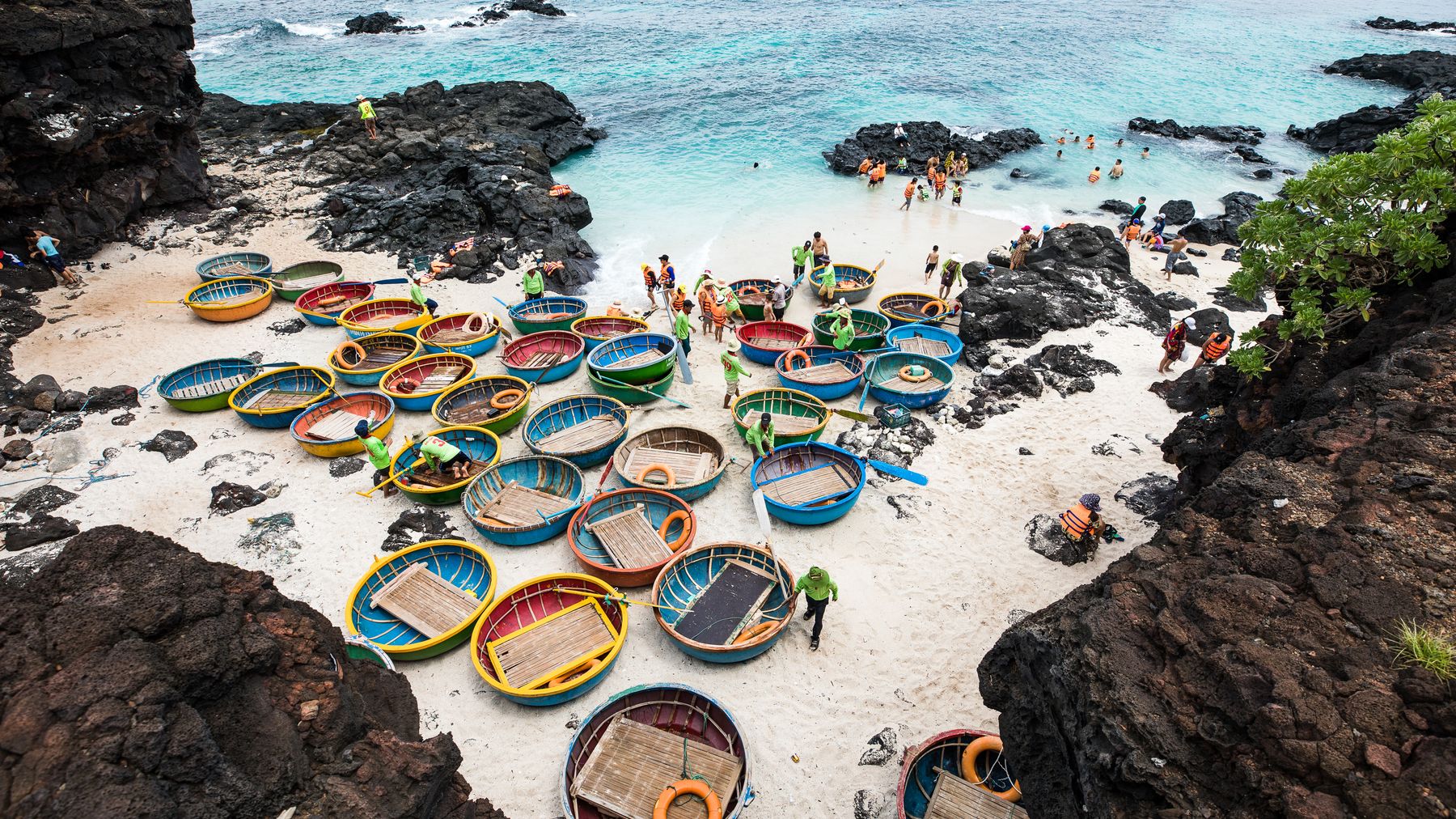
Photo by Son Tung Tran on Pexels
What to do
Walk the basalt columns at low tide
This is the main event. Wear shoes with grip — not flip-flops. The columns closest to the waterline are covered in algae and genuinely treacherous when wet. Spend time in the tidal pools between the columns; small crabs, sea snails, and anemones live in the crevices. Give yourself at least an hour.
Explore the surrounding coastline
The beach flanking Ganh Yen is coarse sand mixed with volcanic pebbles. Walk north along the shore for 15-20 minutes and you'll reach quieter coves where local fishermen pull up their "thung chai" (round basket boats). It's not a swimming beach — the rocks and currents make it unsuitable — but the landscape is worth the walk.
Visit the fishing village
Binh Hai commune is a working fishing village. Early mornings (5:00-6:30 AM), the boats come in and the catch gets sorted right on the sand. Nobody minds if you watch, but ask before photographing people up close. You can buy fresh seafood here for almost nothing — a kilo of shrimp might run 80,000-120,000 VND depending on the catch.
Day-trip to Ly Son Island
If you have an extra day, Sa Ky port is about 20 km south of Ganh Yen. Speed boats to Ly Son Island depart in the morning (around 8:00 AM), cost roughly 160,000 VND one way, and take 30 minutes. Ly Son has its own volcanic geology, garlic fields, and some of the best seafood in central Vietnam.
Where to eat nearby
Don't expect restaurants at Ganh Yen itself. Head back toward Quang Ngai city or stop in Binh Son town.
Quang Ngai is known for a few regional dishes worth tracking down. "Don" is a rice noodle cake unique to the province — thin, chewy sheets of rice batter steamed and served with shrimp, pork, herbs, and a fish-sauce-based dip. Look for it at the Don stalls in Quang Ngai city's central market area. A bowl costs 20,000-30,000 VND.
You'll also find solid "com tam" (broken rice) and fresh seafood at the small restaurants along the coastal road. If you're heading south toward Sa Ky, several family-run places serve grilled fish and "banh xeo" — the central Vietnamese version, thinner and crispier than its Saigon counterpart, stuffed with shrimp and bean sprouts.
Where to stay
Ganh Yen doesn't have accommodation. Stay in Quang Ngai city.
- Budget: Guesthouses and mini-hotels near the train station run 200,000-350,000 VND/night. Basic but clean, with air conditioning and Wi-Fi.
- Mid-range: A few hotels in the city center offer rooms for 500,000-800,000 VND with breakfast included. CEFOOR Hotel and Hung Vuong Hotel are reliable options.
- Homestays near the coast: Occasionally available in Binh Son or near Sa Ky port, but these are informal — ask around locally or check booking apps. Expect 250,000-400,000 VND.

Photo by ㅤ quang vinh ㅤ on Pexels
Practical tips locals would tell you
- Check the tide before you go. This cannot be overstated. At high tide, the formations are submerged and the trip is pointless. Low tide in the morning is your best window.
- Bring water and sunscreen. There's zero shade on the rocks and no vendors nearby.
- Fuel up in Binh Son town. The last reliable petrol station is there; don't assume you'll find fuel closer to the coast.
- Carry cash. Nothing out here takes cards. ATMs are available in Quang Ngai city and Binh Son town.
Common mistakes to avoid
- Wearing sandals on the rocks. The algae-covered basalt is dangerously slick. Closed-toe shoes with rubber soles, every time.
- Arriving after 10:00 AM in summer. The heat on dark volcanic rock is punishing by midday. Start early.
- Expecting infrastructure. There are no toilets, no cafes, no ticket office. Treat it as a nature site, not a managed attraction.
- Skipping Ganh Yen because you already saw Ganh Da Dia. They look different up close. Ganh Yen's columns are more chaotic and less uniform, and the experience of having the place largely to yourself changes things.
Practical notes
Ganh Yen works best as part of a longer Quang Ngai coastal day — combine it with the fishing village, a seafood lunch, and possibly a trip to Ly Son if time allows. The province sits on the main north-south rail and road corridor between Da Nang and Quy Nhon, so slotting in a night or two here doesn't require major route changes. Just bring proper shoes and watch the tides.
Last updated · May 26, 2026 · independently researched, never sponsored.





