After six years of eating my way across Vietnam (베트남 / 越南 / ベトナム) — from 6 AM "pho" stalls on Bat Dan in Hanoi to 11 PM "hu tieu" carts in Saigon's District 4 — I can tell you the single biggest barrier between foreigners and great food here isn't the language. It's not knowing the system. Every food format in Vietnam has its own unwritten protocol, and once you crack it, you eat better, pay less, and stop accidentally ordering tripe.
At a Glance: Quick Reference
- "Cho toi" (cho toy) = "Give me" — your universal ordering opener
- "Khong cay" (khom kai) = Not spicy
- "Mang ve" (mahng veh) = Takeaway
- "Tinh tien" (tin tee-en) = Check please / bill
- "Mot" = one, "Hai" = two, "Ba" = three
- Pointing at what someone else is eating: always acceptable, never rude
- Default portion: one bowl, one plate. Say "hai bat" for two bowls.
- Tipping: not expected at street stalls. 5-10% at sit-down restaurants only if service charge isn't included.
- Free iced tea ("tra da"): standard in the south. In the north, hot tea is the freebie.
- Wet wipes on the table: not free. 2,000-3,000 VND each. Bring your own tissues.
The Five Phrases That Cover 90% of Ordering
You don't need conversational Vietnamese to eat well. You need five constructions and the confidence to use them badly.
1. Cho toi + [item]
This means "give me" and it's how every Vietnamese person orders. At a "banh mi" cart: "Cho toi mot banh mi thit." At a pho (쌀국수 / 越南河粉 / フォー) shop: "Cho toi mot bat pho bo." At a coffee stall: "Cho toi mot ca phe sua da."
The structure is always: Cho toi + quantity + item.
Numbers you'll actually use:
- Mot (one)
- Hai (two)
- Ba (three)
- Bon (four)
- Nam (five)
2. Khong [thing you don't want]
- Khong cay = not spicy
- Khong duong = no sugar (critical for "ca phe sua da" — they add condensed milk AND sugar by default)
- Khong rau = no herbs
- Khong hanh = no onion
- Khong da = no ice
Full sentence at a pho shop: "Cho toi mot bat pho bo, khong rau thom." (One beef pho, no herbs.)
3. Them [thing you want more of]
- Them nuoc = more broth
- Them rau = more herbs/vegetables
- Them ot = more chili
- Them chanh = more lime
4. Mang ve
Takeaway. Works everywhere. Say it after your order and they'll bag everything in plastic faster than you can find your reusable container.
5. Tinh tien
The bill. In street stalls, you often pay when you stand up. In restaurants, say this or make a writing-in-air gesture. Don't wait — no one is bringing the check unprompted at a "bun cha" joint.
How a Com Tam Plate Actually Works
"Com tam" (broken rice) is the default lunch across Saigon and the Mekong Delta. It looks simple — rice with stuff on top — but ordering has a system.
The display case at the front shows your protein and side options. Common choices:
- Suon = grilled pork chop (the default, most popular)
- Bi = shredded pork skin
- Cha = egg meatloaf (steamed pork-egg cake)
- Trung = fried egg or omelette
- Ga = chicken
You combine them. The classic order is "Com suon bi cha" — broken rice with grilled chop, shredded pork skin, and egg cake. That runs 45,000-65,000 VND ($1.80-$2.60) at a sidewalk stall. Add "trung op la" (fried egg) for another 5,000-10,000 VND.
Every plate comes with:
- Pickled daikon and carrot
- A small bowl of fish sauce ("nuoc mam pha")
- Cucumber slices
- A glass of iced tea (free in most southern shops)
The iced tea — "tra da" — is complimentary. It's weak, watery, sometimes barely flavored. That's the point. It's a palate cleanser, not a drink you savor. If it's on the table when you sit down, it's free. If someone hands you a bottled water or a coconut, that's extra.
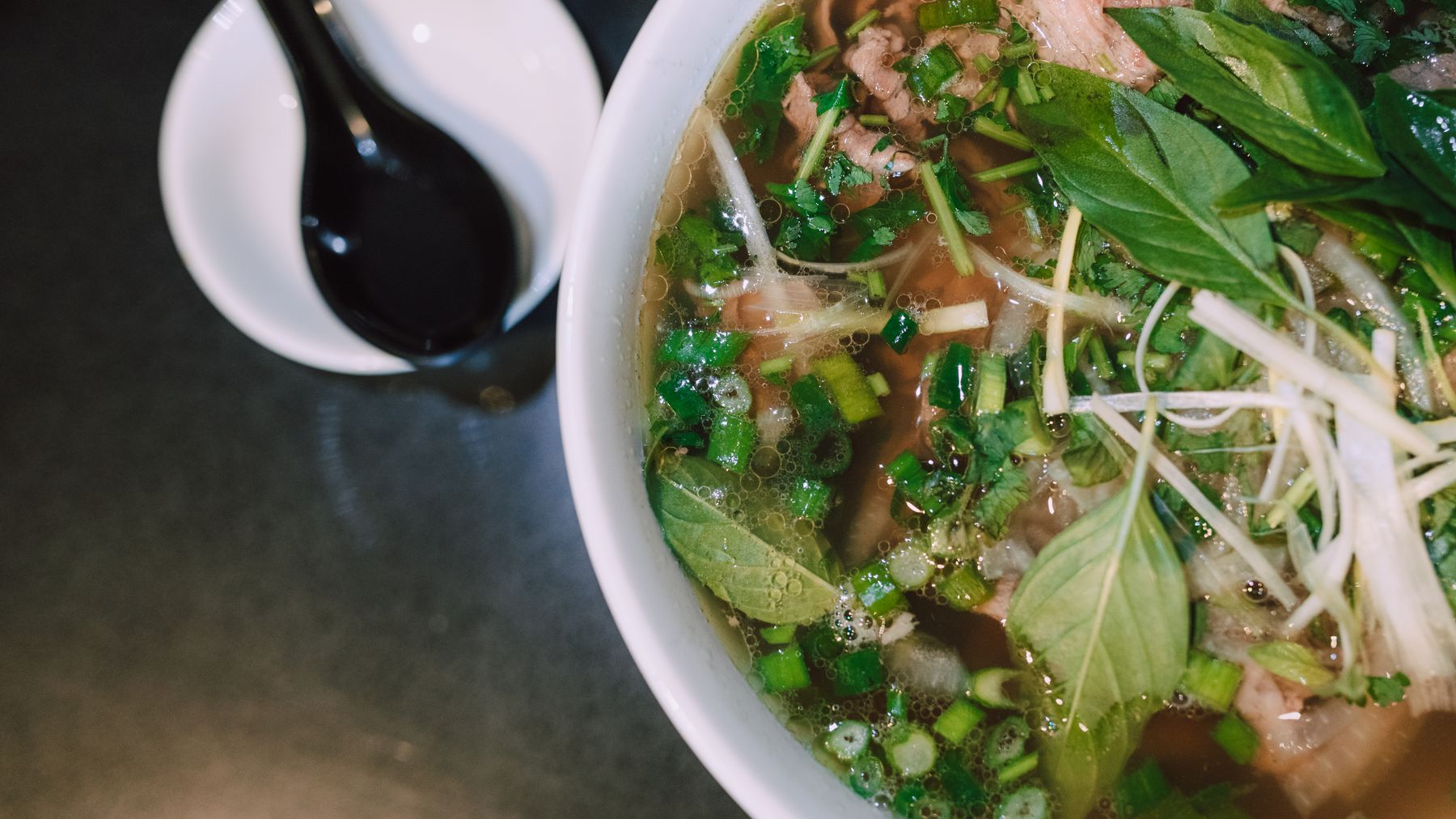
Photo by RDNE Stock project on Pexels
Soup Shop Etiquette: Pho, Bun Bo Hue, Bun Rieu, and Beyond
Soup shops across Vietnam — whether you're eating "pho" in Hanoi, "bun bo Hue" in Hue, or "bun rieu" in any city — follow a shared logic.
The ordering moment
Most shops serve one thing. You walk in, they already know what you want. The only questions are:
- Size: lon (large) or nho (small). Price difference is usually 10,000-15,000 VND.
- Protein variation: For pho — tai (rare beef), chin (well-done beef), nam (flank), gan (tendon), sach (tripe). A safe default: "Cho toi mot bat pho bo tai chin" (one bowl, rare and well-done beef).
- Noodle type: At "bun" shops (rice vermicelli), this is usually fixed. At "hu tieu" stalls in Saigon, you might choose between "hu tieu" (clear tapioca noodles), "mi" (egg noodles), or "hu tieu kho" (dry, no broth).
The condiment table
This is self-serve. Typical spread:
- Fresh herbs (rau thom): basil, sawtooth coriander, perilla, bean sprouts
- Lime wedges
- Sliced chilies in fish sauce
- Hoisin sauce (tuong den) — common with pho in the south, controversial in Hanoi
- Chili sauce (tuong ot) — Sriracha-style, red
In Hanoi's old-school pho shops (Pho Gia Truyen on Bat Dan, Pho Thin on Lo Duc), there are NO condiments. No basil, no hoisin. The broth is the broth. Don't ask for Sriracha — you'll get a look.
Paying
At street-level shops, you pay when you leave. Stand up, walk to the owner (usually near the pot), and say "Tinh tien." Many shops now have QR codes for bank transfer. Cash is always fine — keep small bills (10,000-50,000 VND notes). Breaking a 500,000 VND note at a 40,000 VND pho stall is a headache for everyone.
When to Ask the Price (And When Not To)
This is where foreigners get anxious. The rules are simple:
Ask before ordering:
- Banh mi from a roaming cart (not a fixed stall with a board)
- Fruit from a street vendor with a shoulder pole
- Any situation with no menu and no price board
- Seafood restaurants where you pick live fish/shrimp from a tank (ALWAYS confirm the per-kg price and the weight before they cook it — this is the #1 tourist overcharge spot in Vietnam)
Don't ask (prices are fixed/posted):
- Any restaurant with a menu (paper or wall-mounted)
- Com tam stalls with a price board behind the counter
- Pho shops (one price per size — everyone pays the same)
- Chain banh mi shops (Banh Mi Phuong in Hoi An, Banh Mi Huynh Hoa in Saigon) with posted prices
- "Bia hoi" corners — price per glass is on the wall (typically 7,000-12,000 VND)
The price-check phrase: "Bao nhieu tien?" (bow nyew tee-en) = How much?
If you're in a tourist zone — Bui Vien in Saigon, Ta Hien in Hanoi, An Bang in Hoi An — and there's no posted price, ask first. Not because everyone is scamming you, but because tourist-zone pricing runs 20-50% higher than neighborhood pricing, and knowing before you order is just smart.
The 'Free' Tea, Peanuts, and Wet Wipe Dance
This trips up first-time visitors more than anything else.
What's actually free
- Iced tea (tra da) at com tam stalls, bun shops, and most sidewalk restaurants south of Da Nang: free. Refills: also free.
- Hot tea (tra nong) at pho shops and northern restaurants: usually free.
- Dipping sauce that comes with your order: free.
- Herbs and bean sprouts on the condiment plate at soup shops: free.
- Toothpicks: free.
What's NOT free (even though it's already on your table)
- Wet wipes in plastic packets: 2,000-3,000 VND each. They're placed on every table. If you open one, it's added to your bill. Bring your own tissues.
- Peanuts or roasted cashews in a dish: sometimes free (beer spots), sometimes 20,000-30,000 VND. If it's a bia hoi corner, the peanuts are usually charged. Ask: "Dau phong tinh tien khong?" (Are the peanuts charged?)
- Pickled garlic or pickled chilies in a jar at "bun cha" restaurants: free to use, but if they bring a full separate plate to your table unprompted at a tourist restaurant, it might appear on the bill.
The rule of thumb
If it was on the table before you sat down and everyone else is using it: free. If someone brings it specifically to your table after you sit, without you asking: possibly charged. When in doubt, ask "Mien phi khong?" (free or not?).

Photo by Pham Huan on Pexels
Table Runners, Tipping, and Payment Norms
Vietnam doesn't have a tipping culture at street food level. Here's the breakdown by venue type:
Street stalls and sidewalk restaurants (com binh dan, pho shops, bun cha)
- No tip expected. Zero. Don't leave coins on the table — the owner might chase you down thinking you forgot your change.
- Pay at the counter or to the person who ladled your soup. Not to the person who wiped your table.
Mid-range restaurants (100,000-300,000 VND per person)
- Tip is appreciated but not expected. Rounding up (leave the 10,000-20,000 VND change) is a nice gesture.
- Many now add 5-10% service charge automatically. Check the bill.
High-end restaurants and hotels
- 5-10% service charge is standard on the bill. Additional tipping is your call.
- For exceptional service, 50,000-100,000 VND cash left on the table is generous by local standards.
What about table runners?
In busy com binh dan (everyday rice) restaurants, a "table runner" — often a family member or hired helper — will bus your dishes, wipe the table, pour tea. They're not waitstaff in the Western sense. They're not expecting tips. They might not even notice if you leave one. This is assembly-line eating; everyone's in and out in 15 minutes.
Ordering by Format: Quick Guide by Food Type
Different food types have different ordering conventions. Here's a cheat sheet:
Banh mi carts
Say "Mot banh mi" + filling. Common fillings:
- Thit: the classic — pate, cold cuts, pickled veg, cilantro, chili
- Trung: fried egg
- Ga: chicken
- Cha ca: fish cake
Price: 15,000-35,000 VND for a street cart. 30,000-55,000 VND at a famous shop. They make it in 30-60 seconds. Fastest food in Vietnam.
Bun cha (Hanoi)
You sit down, they bring it. "Bun cha" shops generally serve one thing. The only add-on to know: "Them bun" = extra noodles (usually 5,000 VND for another plate). If you want spring rolls with it — "nem" — just say "Them nem." A full "bun cha" set with nem runs about 60,000-80,000 VND in Hanoi's Old Quarter. Barack Obama and Anthony Bourdain famously ate bun cha at Bun Cha Huong Lien on Le Van Huu in 2016 — it's now called "Bun Cha Obama" and costs 80,000 VND for the set.
Banh xeo (crispy pancake)
"Banh xeo" is ordered by the piece. One is usually enough for a solo diner — they're large in the south (dinner-plate sized) and smaller in the central region. Say "Mot cai banh xeo" and wait 5-7 minutes for it to cook fresh. In Saigon, 40,000-60,000 VND. In Hue or Da Nang, 20,000-35,000 VND for smaller versions.
Goi cuon (fresh spring rolls)
Ordered by the plate (usually two rolls per plate). "Mot dia goi cuon" = one plate of fresh rolls. 30,000-50,000 VND per plate. These are cold, fresh, rice-paper wrapped — not to be confused with "cha gio" (fried spring rolls), which are crunchier and smaller.
Coffee
Vietnamese coffee stalls have their own shorthand:
- Ca phe den = black coffee (hot)
- Ca phe sua = coffee with condensed milk (hot)
- Ca phe sua da = iced coffee with condensed milk (the default order for 80% of Vietnamese)
- Ca phe trung = "egg coffee" (Hanoi specialty — whipped egg yolk on espresso)
- Bac xiu = mostly milk with a little coffee (sweeter, popular in Saigon)
At a street stall: 15,000-25,000 VND. At a cafe (Cong Ca Phe, Highlands): 35,000-55,000 VND. "Egg coffee" at Giang Cafe on Nguyen Huu Huan in Hanoi: 35,000 VND.

Photo by Vuong on Pexels
Common Mistakes Foreigners Make (And How to Avoid Them)
-
Asking for a menu at a one-dish shop. If everyone in the shop is eating the same thing, there is no menu. Sit down, hold up one finger, nod. Done.
-
Pouring fish sauce broth INTO the pho. That small bowl of dipping sauce is for dipping meat slices. Don't dump it into your soup — the broth is already seasoned.
-
Expecting separate checks. Vietnamese groups pay one bill. One person covers it, or they Venmo-equivalent (Momo/ZaloPay) each other later. If you're with Vietnamese friends, offer to pay the whole thing — they'll fight you for it. That's the game.
-
Sitting at the wrong stall's chairs. Sidewalks have multiple vendors with color-coded plastic stools. If you sit on blue stools, you order from the blue-stool vendor. Look at who's serving the table next to you.
-
Not specifying ice preference. Everything comes with ice by default in southern Vietnam — even beer at some bia hoi spots. Say "khong da" immediately if you don't want it.
-
Photographing the cook without buying. Buy first, shoot later. A quick nod or "Chup hinh duoc khong?" (Can I take a photo?) goes far.
-
Leaving without trying "mi quang" in Da Nang or "cao lau" in Hoi An. These are hyper-regional. You cannot get authentic versions outside their home cities. They're not on the tourist trail the way pho is, but they should be.
Reading the Room: How to Know You're in the Right Place
Forget Google reviews. Here's how locals identify good food in Vietnam:
- Turnover. If the pot is being refilled constantly and stools are rotating, the food is fresh and the broth is good.
- Specificity. The best places serve one or two things. A restaurant with a 10-page menu covering pho, banh mi, pizza, and smoothies is a tourist trap.
- The 11:30-12:30 rush. If a shop is packed at noon with office workers in uniform or xe om drivers, that's your signal.
- Plastic stools, not air conditioning. Vietnam's greatest food is served at knee height. If you're sitting in AC and using a cloth napkin, you're paying for atmosphere, not flavor.
- Morning-only shops. Many of the best "pho" and "banh cuon" (steamed rice rolls) shops open at 6 AM and close by 9-10 AM. If a pho shop is open at 2 PM, it's probably not the best pho in town.
The exception: Saigon runs late. You can find excellent "bun thang" at midnight in District 3, solid "banh canh" crab in District 4 at 1 AM. The south doesn't sleep.
Final Note
Ordering food in Vietnam isn't about perfect pronunciation. It's about understanding the format. Know what kind of shop you're in, how many things they serve, where you pay, and what's free. Master five phrases, keep small bills, point confidently, and eat what the room is eating. That's the whole system — and it unlocks the best food you'll eat anywhere in Southeast Asia.
Last updated · May 29, 2026 · independently researched, never sponsored.