Hue has a food reputation that precedes it — royal cuisine, elaborate presentation, fiercely regional pride. But the places that actually define how this city eats every day have no QR codes, no TripAdvisor bubbles, and often no signage at all.
Why the Best Stalls Are Invisible
Hue (후에 / 顺化 / フエ)'s food culture is intensely neighborhood-based. A woman who has been selling "banh canh" from the same corner of Cho An Cuu market since 1987 doesn't need a Google Business profile. Her customers live within 400 meters of her pot. She sells out by 9am and goes home. If you're not in the loop, you walk right past her.
This is true across the city. The stalls worth finding tend to cluster around wet markets, down residential side streets (called "hem" in Vietnamese), and at the mouths of lanes that dead-end into the Huong River. No tourist foot traffic, no incentive to advertise, no reviews — just food that has been refined by decades of repeat customers who will absolutely tell her if something tastes off.
How to Actually Find These Places
Ask at your guesthouse — specifically
Don't ask "where's good food nearby?" You'll get the name of a restaurant that pays a referral fee. Instead ask: "Where do the xe om drivers eat breakfast?" or "Where does your family buy banh?" That specificity forces a real answer. Guesthouse staff who grew up in Hue will often give you a hand-drawn map to their mother's preferred "bun bo Hue" vendor before you finish your coffee.
Follow the plastic stools
In Hue, the presence of very small plastic stools on a sidewalk at 6:30am is a more reliable food signal than any star rating. If there are six stools, a single gas burner, and a woman who doesn't look up when you approach — sit down. Point at what the person next to you is eating. This works about 90% of the time.
Work the market perimeter
The inside of Dong Ba Market gets tourist traffic. The perimeter — specifically the north and west sides along the lanes feeding toward the river — does not. This is where vendors who cook one thing and one thing only set up before 7am. You'll find "banh uot" (fresh steamed rice sheets) served with a dab of shrimp paste and a pile of herbs, priced around 15,000–20,000 VND a portion. No menu. You either know what it is or you ask the person beside you.

Photo by Pew Nguyen on Pexels
What to Look For and Order
Banh beo, com hen, and the small-bowl logic
Hue's most iconic small dishes — "banh beo" (steamed rice cakes with dried shrimp), "com hen" (baby clam rice), and "banh nam" (flat steamed rice dumplings in banana leaf) — are the things no-name stalls do best. These aren't restaurant dishes. They're home-cook dishes that happen to be sold on the street. A proper banh beo stall will have the cakes steamed fresh in ceramic dishes, not reheated. If the dish is warm to the touch and slightly translucent at the edges, it's fresh.
Com hen deserves special attention. Hue's version uses tiny clams from Con Hen island in the Huong River, mixed with cold rice, peanuts, sesame, and a stack of raw herbs. It's deliberately not hot — that's correct, not a mistake. A bowl runs 20,000–30,000 VND at a market stall. If it's priced higher and served on a plate with decorative garnish, you're at a tourist restaurant.
Bun bo Hue — the neighborhood version
Every neighborhood in Hue has its own "bun bo Hue (분보후에 / 顺化牛肉粉 / ブンボーフエ)" vendor, and regulars are fiercely loyal to their local pot. The broth should be deep red from annatto and lemongrass, with a clean heat that builds slowly — not the flat, slightly sweet version that gets adjusted for outside palates. The no-name stalls don't adjust. You get the real thing: pork hock, sliced beef, cubes of congealed pork blood, and a heap of banana blossom shreds on the side. A large bowl is typically 35,000–50,000 VND.
Che — Hue's dessert obsession
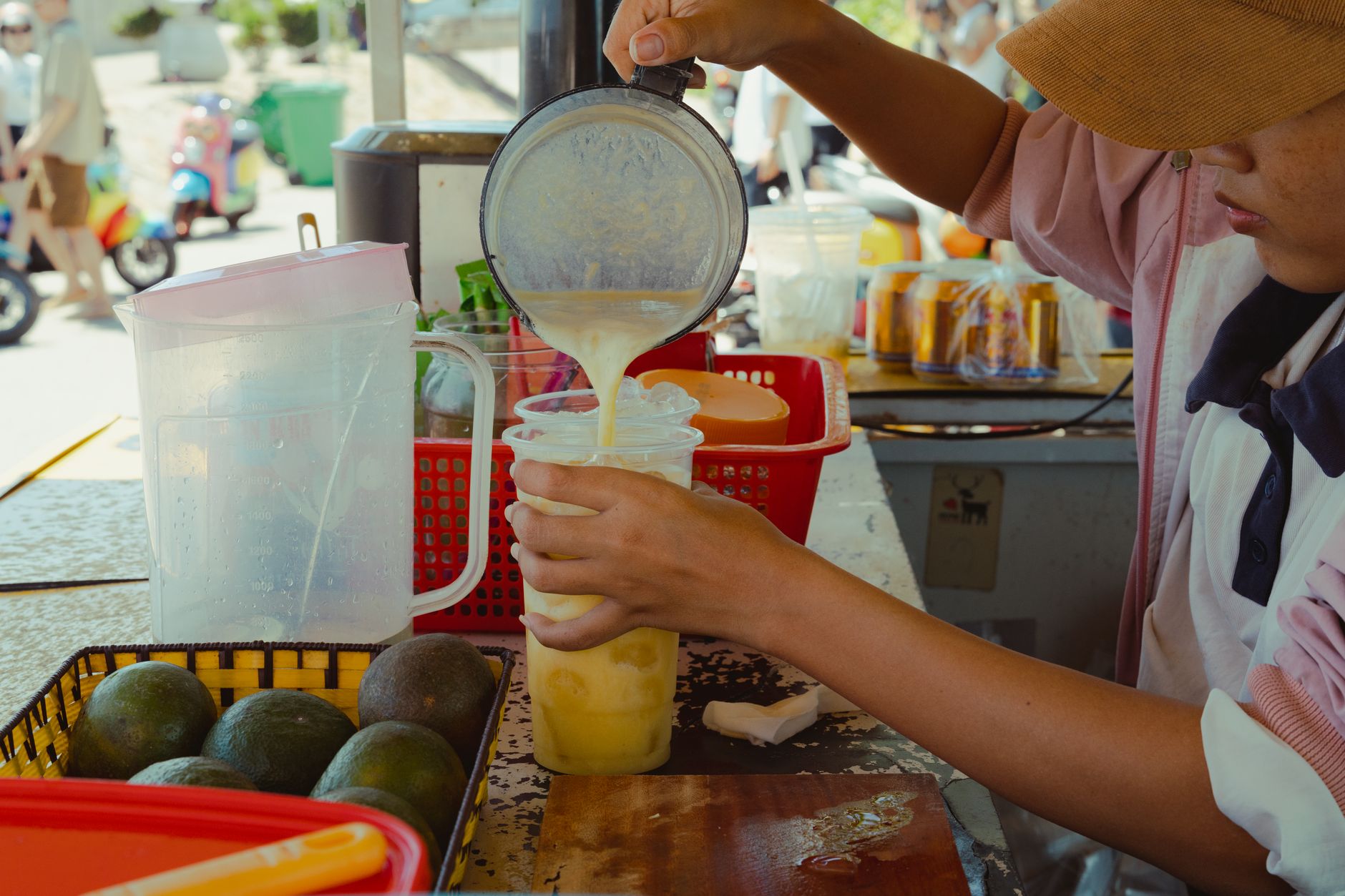
"Che" (sweet dessert soups and puddings) is where Hue gets genuinely baroque. Stalls around the Citadel's west gate and near Truong Tien Bridge sell multi-layered che with mung bean, lotus seed, pandan jelly, and condensed milk, assembled to order in a glass. A serving costs 15,000–25,000 VND. These vendors have been at the same spot for years — look for the woman with the insulated container and a handwritten chalk price board.

Photo by Tuan Vy on Pexels
What to Expect (Practically Speaking)
Cash only, always. Bring small bills — 10,000 and 20,000 VND notes. Most of these vendors can't break a 200,000 VND note at 7am and will politely wave you off if you can't pay exact.
Language is genuinely minimal. You don't need to speak Vietnamese to eat at these stalls — pointing, sitting down, and holding up fingers for quantity covers most situations. A simple "mot" (one) or "hai" (two) goes a long way. Smiling and not rushing the transaction is more important than vocabulary.
Timings are non-negotiable. Morning stalls are gone by 9–10am. Evening stalls start appearing around 5pm near the markets. If you show up at noon looking for banh beo at a market-corner stall, you've already missed it.
Practical Notes
The Citadel district, An Cuu, and the lanes around Cho Truong Tien are the most productive zones for this kind of eating. Budget 80,000–150,000 VND for a full morning of grazing across three or four stalls. Go hungry, go early, and resist the urge to photograph everything before you eat — it marks you as a tourist and occasionally makes vendors uncomfortable.
Last updated · May 26, 2026 · independently researched, never sponsored.