Khai Dinh's mausoleum—officially the Ung Mausoleum—sits on Chau Chu mountain near Hue. Completed in 1931 after eleven years of construction, it stands as the last major tomb built by a Nguyen emperor and the most visibly Western-influenced. In 1993, it was designated a UNESCO World Heritage Site as part of the Complex of Hue Monuments.
Why This Tomb Feels Different
Khai Dinh's tomb breaks the mold of earlier Nguyen dynasty mausoleums. It's smaller and denser, packed with ornament. Where other royal tombs rely on wood and brick, this one uses reinforced concrete, steel, and slate—materials chosen to project permanence and power. The architect's hand is French colonial; the vocabulary is Vietnamese and Chinese.
Khai Dinh (r. 1916–1925) visited France before commissioning his tomb, and European aesthetics shaped the design he approved. Construction began in September 1920. He died five years later, in 1925, before the mausoleum was finished. His son and successor, Bao Dai, oversaw completion in 1931.
The site covers a much smaller footprint than the sprawling complexes of Tu Duc or Minh Mang—roughly 117 steps from base to summit, compressed onto a single hillside. That compression is the point. Every square meter carries decoration. Where Tu Duc's tomb spreads across lakes and pine groves (a contemplative poet-emperor's retreat), Khai Dinh's punches upward, vertical and dense, more cathedral than garden. If you visit the Tomb of Tu Duc on the same day, the contrast is almost jarring.
The Approach and Guardian Figures
You enter via a grand staircase to the first terrace. A triple-arched memorial gateway stands here, its surfaces carved with two five-clawed dragons contending over a flaming pearl. Wrought iron gates—forged in France—secure the entrance.
Beyond the gateway lies a salutation court lined with stone figures in double rows: officers, attendants, celestial animals. This practice derives from Chinese geomancy; the statues guard the grave and guide the emperor's spirit. Khai Dinh's tomb has more figures and finer detail than earlier Nguyen tombs, squeezed into tighter space.
Look closely at the mandarins. Unlike the generic figures at other Nguyen tombs, these have individualized faces and period-appropriate uniforms—some in French-style military dress, others in traditional court robes. The horses are stocky, modeled on the Annamite breed. The elephants wear ceremonial blankets with tasseled edges. All carved from local Thanh Hoa stone, now darkened with nearly a century of monsoon rain and lichen.
At the far end stands a two-tiered octagonal stele pavilion ("nha bia")—concrete, arched columns, Western in style. Its side panels display the Chinese character for longevity, surrounded by bats (symbols of blessing). Inside, a stone stele bears Khai Dinh's biography in Classical Chinese, attributed to Bao Dai. Flanking the pavilion are two tall obelisk-like columns topped with stupas.

Image by Andrew from Vancouver, Canada via Wikimedia Commons (CC BY-SA)
Thien Dinh Palace: The Heart
The uppermost terrace holds the Thien Dinh Palace, the main structure. Five interconnected halls with grayish-white exteriors face outward through five arched entrances—the number five echoing Confucian cosmology. Geometric patterns of swastikas, dragons, and longevity symbols tile the stone. Four-character phrases from Confucius's Analects are carved into the panels.
Inside, color saturates every surface. The ceiling features nine dragons, originally painted by the royal artist Phan Van Tanh. Walls shimmer with inlaid glass and porcelain. The left hall displays Khai Dinh's possessions: photographs, gifts from the French government (silver and porcelain dinner sets, bejeweled belts, swords, ornaments), and a 160 cm bronze statue of him in martial regalia, sword in hand.
At the center is the altar room, "Khai Thanh Palace," with three sets of doors leading to a crypt and worship space. A second bronze statue—of Khai Dinh seated in traditional imperial robes, cast in Marseille—occupies the rear temple room. His grave and personal altar rest here.
The Glass and Porcelain Mosaics
What stops most visitors mid-step is the mosaic work inside Thien Dinh Palace. Artisans spent years embedding broken glass, porcelain shards, and beer-bottle fragments into wet cement to create murals covering walls, columns, and ceilings. The technique is called "khảm sành sứ" in Vietnamese—a method used in Hue's pagodas but never at this scale before.
The materials came from everywhere: Japanese beer bottles, French wine bottles, Chinese porcelain bowls. Some pieces were deliberately broken to size; others were sourced from household waste. The result is a surface that shifts color depending on the light—blue-green in morning sun, deep amber in late afternoon. Photographs rarely capture the effect accurately because flash flattens the translucency.
Panels depict the Four Seasons, the Eight Precious Objects, bamboo groves, and pine trees. One ceiling section shows cranes carrying scrolls across cloud banks. Another frames a full-body dragon in gold and cobalt fragments no larger than a fingernail. The craftsmanship took dedicated teams of Hue (후에 / 顺化 / フエ) artisans working continuously from 1925 to 1931.

Image by Erwin Verbruggen from Amsterdam, The Netherlands via Wikimedia Commons (CC BY-SA)
Visiting
The tomb is open to the public. The site rewards slow walking: each terrace reveals a different architectural language, and the layering of Vietnamese, Chinese, and French design becomes clearer as you ascend. Allow 1–2 hours. Steep stairs and uneven stone paths require steady footing.
Getting there: The tomb sits about 10 km south of Hue's city center, in Chau Chu village, Huong Thuy district. From the central Imperial Citadel area, it's a 20-minute drive or a 30-minute motorbike ride along the Perfume River road. Most visitors combine it with Tu Duc's tomb (3 km away) and Minh Mang's tomb (a further 4 km). A xe om (motorbike taxi) from the city center runs around 80,000–100,000 VND one way; a Grab car is typically 60,000–90,000 VND.
Tickets: 150,000 VND per adult (as of 2024). Children under 7 enter free. A combination ticket covering multiple Hue monuments is available at 530,000 VND and includes the Imperial Citadel, Khai Dinh Tomb, Tu Duc Tomb, and Minh Mang Tomb—worth it if you plan to see three or more sites.
Hours: 7:00 AM – 5:30 PM daily (summer); 7:00 AM – 5:00 PM (winter, roughly November–March). Arrive early—by 7:30 AM—to photograph the staircase and courtyard without tour groups. The big buses from Da Nang typically arrive between 9:00 and 11:00 AM.
Common Mistakes and What Surprises Foreigners
- Rushing through. Many tour groups allocate 30 minutes. That's barely enough to climb the stairs and glance at the interior. The mosaic detail alone deserves 20 minutes of close looking. Budget a full hour minimum.
- Skipping the side panels. Visitors walk straight up the central staircase and miss the carved bas-reliefs on the balustrades—clouds, waves, dragons, lotuses—that tell you more about the design program than anything inside.
- Wearing slippery shoes. The slate steps get dangerously slick after rain. Hue receives heavy rainfall from September through December. Sandals with no grip are a bad idea here.
- Expecting color on the outside. First-time visitors sometimes feel underwhelmed by the grey concrete exterior. The spectacle is entirely inside Thien Dinh Palace. Don't judge the site from the courtyard alone.
- Confusing Khai Dinh with Bao Dai. Bao Dai was his son—Vietnam (베트남 / 越南 / ベトナム)'s last emperor. The bronze statue in court robes is Khai Dinh, not Bao Dai. Guides sometimes blur the two.
- Not bringing water. There's no shade on the staircase and limited vendor access at the top. In summer months (May–August), temperatures in Hue easily hit 37–39°C. Carry a bottle.
Combining With Other Hue Sites
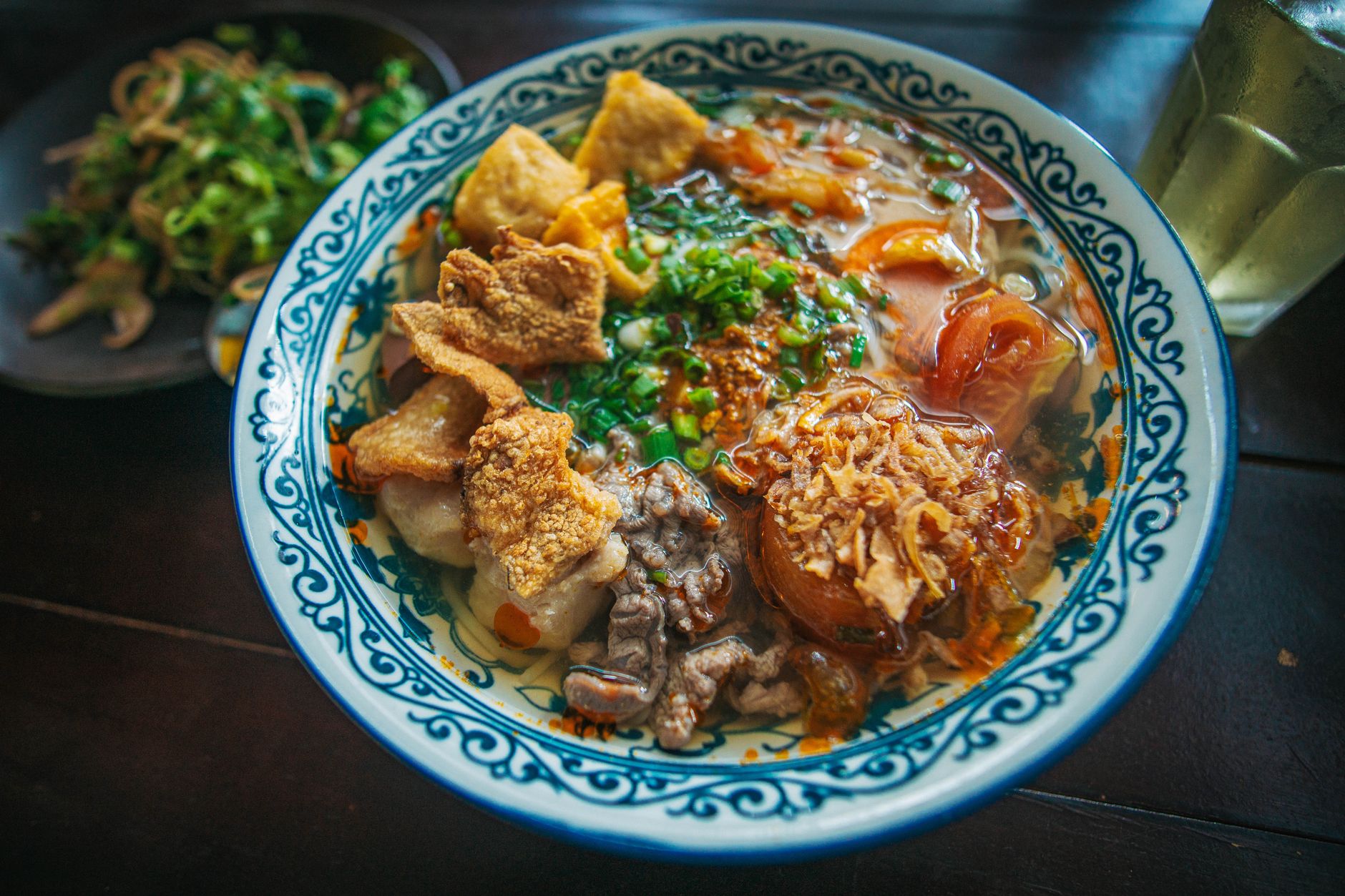
A logical half-day route: start at Khai Dinh (early, before heat), drive 3 km to Tu Duc's tomb, then continue to Minh Mang if energy allows. By noon you'll want lunch—head back toward Hue's south bank for "bun bo Hue" (the city's signature spicy beef noodle soup) at a local shop along Nguyen Du or Le Loi streets. A bowl runs 35,000–50,000 VND.
If you're spending a full day on Hue's heritage sites, the afternoon works well for the Imperial Citadel and Dong Ba Market, where you can pick up conical hats, dried shrimp paste, and "me xung" (sesame candy). Evening: cross the river for "com hen" (baby clam rice) on Truong Dinh street—a Hue specialty you won't find easily in Hanoi or Ho Chi Minh City.
For travelers coming from Da Nang or Hoi An, the drive to Hue takes about 2–2.5 hours via the Hai Van Pass coastal road (stunning views, heavy truck traffic) or 1.5 hours through the tunnel. Day-tripping is possible but tight; an overnight in Hue lets you see the tombs without rushing.
Quick Reference
- Full name: Ung Mausoleum (Lang Khai Dinh)
- Location: Chau Chu mountain, Huong Thuy district, 10 km south of Hue center
- Built: 1920–1931
- Emperor: Khai Dinh (12th Nguyen dynasty emperor, r. 1916–1925)
- Ticket: 150,000 VND (adult); combo ticket 530,000 VND
- Hours: 7:00 AM – 5:30 PM (summer) / 7:00 AM – 5:00 PM (winter)
- Time needed: 1–2 hours
- Accessibility: 117 steep stone steps; not wheelchair accessible
- Best light for photos: early morning (7:00–8:30 AM) or late afternoon (3:30–5:00 PM)
- Nearest food: vendors at parking lot sell water, fruit, instant coffee; proper restaurants back in Hue center
- UNESCO status: Part of Complex of Hue Monuments (1993)
Frequently Asked Questions
How long does it take to climb from base to summit at Khai Dinh's Tomb?
The mausoleum is compact by Nguyen dynasty standards, compressed onto a single hillside accessible via roughly 117 steps from base to summit. Because every level is densely decorated — guardian figures, carved gateways, the stele pavilion, and finally Thien Dinh Palace — most visitors spend more time examining detail than walking distance. Budget accordingly if combining with the Tomb of Tu Duc on the same day.
What materials make Khai Dinh's Tomb different from other Nguyen dynasty mausoleums?
Unlike earlier royal tombs that rely on wood and brick, Khai Dinh's mausoleum uses reinforced concrete, steel, and slate — materials chosen to project permanence and power. The design reflects French colonial influence alongside Vietnamese and Chinese architectural vocabulary. Wrought iron gates were forged in France. The guardian figures were carved from local Thanh Hoa stone, now darkened after nearly a century of monsoon rain and lichen.
When was construction on Khai Dinh's Tomb started and completed?
Construction began in September 1920 and was completed in 1931 — an eleven-year process. Emperor Khai Dinh, who reigned from 1916 to 1925, died before its completion. His son and successor, Bao Dai, oversaw the final years of work. The tomb was later designated a UNESCO World Heritage Site in 1993 as part of the Complex of Hue Monuments.
Bottom Line
Khai Dinh's mausoleum stands as a fragment of a particular moment in Vietnamese history—the Nguyen dynasty in its final phase, filtered through colonial patronage and an emperor's ambition to leave something that fused both worlds. It's not the largest or most peaceful of Hue's royal tombs, but it's the most visually intense. Walk slowly, look up at the ceilings, and give your eyes time to adjust to the dark interior. The mosaics repay every minute you spend with them.
Last updated · May 21, 2026 · independently researched, never sponsored.