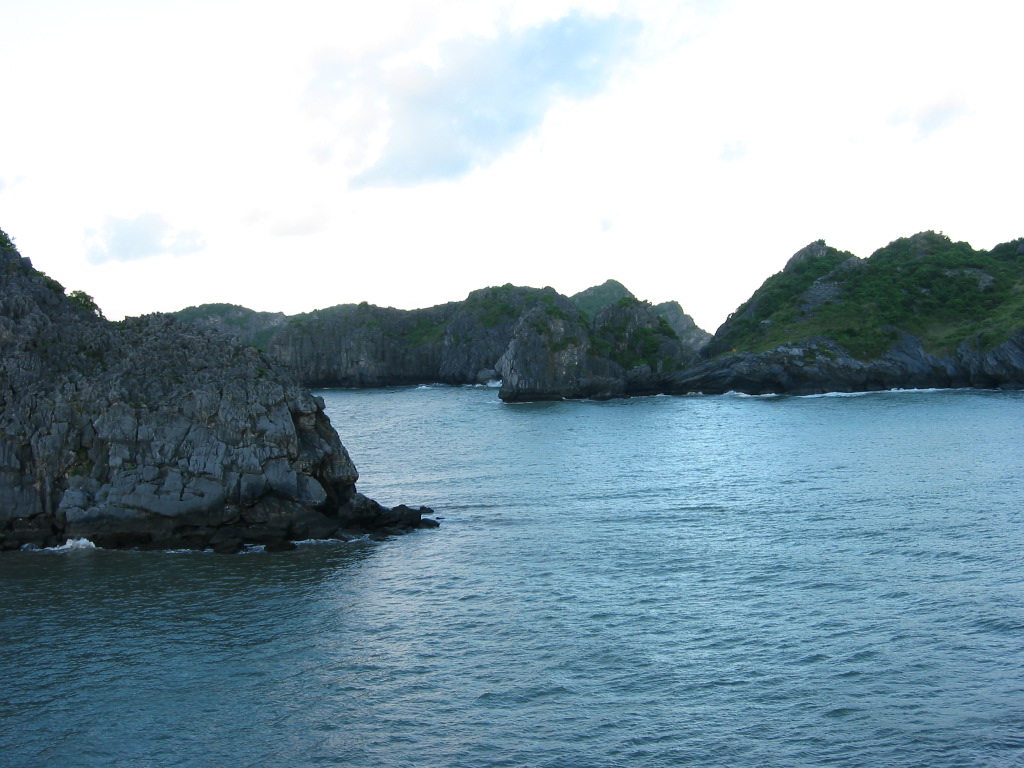
Lan Ha Bay sits in the shadow of its famous neighbor, Ha Long Bay—which means it's far less crowded and easier to navigate on your own terms.
Located about 30 kilometers south of Hai Phong city, the bay sprawls across 7,000 hectares of limestone karst landscape. It's technically part of the Cat Ba Archipelago, and more than 5,400 hectares are protected as Cat Ba National Park, a UNESCO biosphere reserve. The 400-odd islands and islets here range from exposed rock peaks to fully vegetated landmasses, arranged in the bay's distinctive crescent shape.
The Landscape
What makes Lan Ha different from Ha Long isn't geology—it's density and atmosphere. You get the same jagged limestone formations and emerald water. But the bay stays quieter. There are 139 named sandy beaches scattered throughout. Some, like Ang Vem, Cat Dua, and Ben Beo, sit wedged between cliff walls and feel genuinely remote. Most tourists hitting northern Vietnam (베트남 / 越南 / ベトナム) aim straight for Ha Long; Lan Ha gets the overflow or the travelers who read ahead and choose it on purpose.
The karst here are slightly less dramatic than Ha Long's most famous formations, but they're close enough that boat tours sometimes link the two bays (this became possible in 2025 with new tourism routes). If you want to photograph pristine limestone without 2,000 other tourists in the frame, Lan Ha is the play.
Water color shifts through the day depending on cloud cover and tide. Mornings tend toward deep green; by midday, with full sun, the shallows near the beaches turn almost turquoise. The tidal range is modest—about 2 to 3 meters—so beaches don't disappear at high tide the way they do in some Thai island systems. That consistency is part of why kayaking works so well here: you can plan a route and not worry about a lagoon entrance being underwater two hours later.
What to Do
Kayaking is the main draw. The calm waters make it manageable even for beginners. You paddle into hidden lagoons, duck through cave openings, and weave between islands that would be impossible to navigate on a larger tour boat. Most outfitters operate from Ben Beo port on Cat Ba Island.
You can also:
- Swim at any of those 139 beaches. The water is clear and the swimming season runs roughly May through September, though it's swimmable year-round if you can tolerate cooler temps.
- Tour floating villages to see how local fishing families live. These aren't theme parks—they're actual settlements, though tourism has changed them.
- Rock climbing at designated spots within the bay (some routes require permits).
- Take a half-day or multi-day cruise, including yacht options if your budget stretches.
Note: kayaking was temporarily suspended in 2024 while new safety and environmental regulations were drawn up. Check current rules before booking.
For rock climbing specifically, the area around Cat Ba Island and the bay's karst walls has become one of northern Vietnam's more established climbing spots. Routes range from beginner-friendly 5a to challenging 7b+ on the French grading scale. A few local operators based in Cat Ba town rent gear and arrange guides—expect to pay around 600,000 to 1,200,000 VND for a half-day guided session. Deep-water soloing (climbing above water with no rope, falling into the bay if you slip) draws a niche crowd between June and August when the water is warmest.

Image by Christophe95 via Wikimedia Commons (CC BY-SA)
Getting There
You'll need to base yourself on Cat Ba Island first. From Hanoi, take a bus or drive to Cat Ba (about 3.5 hours). The island has its own national park, town center (Cat Ba town), and port at Ben Beo, where tour boats launch.
From Ben Beo, boat tours to Lan Ha take 30–45 minutes depending on destination. Tour operators handle transport, guides, and equipment. Prices range from around 800,000–2,500,000 VND per person depending on tour length and yacht class.
The most common route from Hanoi is a shuttle bus to Got ferry terminal in Hai Phong (about 2.5 hours, 200,000–350,000 VND), then a 30-minute speedboat to Cat Ba. Some operators run combined bus-boat packages for around 350,000–450,000 VND one way, door to door. If you are already in Hai Phong—maybe after eating your way through the city's famous "banh da cua" (crab noodle soup) stalls near Tam Bac Lake—the speedboat from Got terminal runs multiple departures daily, typically 8:00 a.m. to 3:00 p.m.
An alternative is the car ferry from Dinh Vu port in Hai Phong directly to Cat Ba. This route takes about an hour and is useful if you are bringing a motorbike (ferry ticket around 80,000 VND for a bike, 200,000 VND for a car). Once on Cat Ba, the ride from the ferry landing at Gia Luan down to Cat Ba town is about 30 kilometers on a winding mountain road that cuts through the national park—scenic, but slow going if you are behind a truck.

Image by Christophe95 via Wikimedia Commons (CC BY-SA)
When to Go
Best: May through September (calm water, warm). Avoid November to March if you're kayaking—winter seas get choppy and visibility drops.
The bay has hosted high-profile visitors (the King and Queen of Belgium visited in 2025), and in 2022 CNN listed it among Asia's top destinations. That bump in international media has brought more tourism, but compared to Ha Long, it remains manageable.
June through August is peak season, and weekends get noticeably busier—Vietnamese domestic tourists from Hanoi (하노이 / 河内 / ハノイ) and Hai Phong come down for the weekend. If you have flexibility, go midweek. Tuesday through Thursday on the water feels like a different bay entirely. September is an underrated window: water is still warm, the summer rush has faded, and prices on Cat Ba Island drop by 20 to 30 percent at most guesthouses.
October is a gamble. You might get a string of perfect days, or you might get the tail end of typhoon season with grey skies and swells that cancel boat departures. December through February brings fog that can actually be beautiful for photography—the karst peaks half-dissolved in mist—but kayaking in 15-degree water with a cold wind is nobody's idea of fun.
What to Eat on Cat Ba
You will eat most of your meals on Cat Ba Island, and the food scene is small but focused. Cat Ba town's waterfront strip along the harbor has a row of seafood restaurants where you pick your fish, crab, or squid from tanks out front. Expect to pay 150,000–350,000 VND per kilogram depending on the species. Mantis shrimp ("tom tit") is the local specialty—steamed with salt and lime, it is one of the best things you can eat in northern Vietnam. Grilled squid ("muc nuong") is another reliable order, usually 80,000–120,000 VND per plate.
For breakfast, look for "pho" or "bun" stalls in the market area behind the main strip. A bowl runs 30,000–50,000 VND. The island also has decent "banh mi" from a couple of street carts near the harbor—nothing as elaborate as what you would find in Hoi An or Saigon, but solid and cheap at 20,000–30,000 VND.
Coffee on Cat Ba is straightforward "ca phe sua da"—strong dark roast over ice with condensed milk—served at small cafes near the waterfront. Do not expect the specialty coffee culture of Da Lat or the egg coffee scene in Hanoi's Old Quarter. This is a fishing town; the coffee is functional and good enough.
If you are on an overnight cruise in Lan Ha Bay itself, meals are included. Quality varies hugely by operator. Budget junk boats serve basic rice-and-fish meals. The higher-end boats (1,500,000 VND and up per night) often feature spring rolls ("goi cuon"), grilled prawns, morning glory stir-fry, and surprisingly decent "com tam" (broken rice) plates.
Common Mistakes and What Surprises Foreigners
Booking a Ha Long Bay cruise and expecting Lan Ha Bay. Many cruise operators based in Ha Long City market "Ha Long Bay and Lan Ha Bay" itineraries, but some barely dip into Lan Ha waters. If Lan Ha is your priority, book from Cat Ba Island directly or confirm the exact route before paying. Ask which specific lagoons and beaches the boat visits.
Underestimating the Cat Ba transit. The bus-plus-ferry combo from Hanoi is reliable, but it is not fast. Budget a full half-day. Travelers who arrive in Hanoi on a morning flight and try to reach Cat Ba the same afternoon often end up stressed and miss the last ferry. Better to spend a night in Hanoi—walk around the Old Quarter, eat some "bun cha" at a sidewalk place, drink a "bia hoi" on Ta Hien Street—then leave for Cat Ba early the next morning.
Assuming you can kayak independently. In Ha Long Bay, independent kayaking has been restricted for years. Lan Ha's rules have also tightened. As of the 2024 regulation changes, most kayaking must be done through a licensed operator. Bringing your own kayak or renting one and going solo is not straightforward—you may need a permit, and enforcement varies by season. Check with your accommodation on Cat Ba for the current situation.
Packing for the wrong season. Foreigners arriving in December expecting tropical beach weather are caught off guard by grey, drizzly conditions and water temperatures around 16 to 18 degrees Celsius. Northern Vietnam has a real winter. If you are visiting in the cooler months, Da Nang or Phu Quoc may be better beach options while you save Lan Ha Bay for a summer trip.
Haggling too aggressively for boat tours. Prices from Ben Beo are fairly standardized. The operators know what their neighbors charge. Trying to negotiate a 2,000,000 VND day trip down to 800,000 VND just means you end up on a boat with a broken motor and no life jackets. A reasonable negotiation is 10 to 15 percent off the quoted price, especially if you are booking for two or more people.
Littering in the lagoons. This is not a mistake tourists make deliberately, but it matters. The enclosed lagoons are fragile ecosystems. Plastic bottles, sunscreen runoff, and food wrappers accumulate fast in windless water. Bring a dry bag for your trash and carry it back to the boat.
Quick Reference
- Location: 30 km south of Hai Phong, accessible via Cat Ba Island
- Area: 7,000 hectares, 400+ islands and islets
- Best months: May to September (warm, calm); September for fewer crowds
- Avoid: December to February for water activities (cold, choppy)
- Base town: Cat Ba town, Cat Ba Island
- Main port: Ben Beo harbor
- Day tour price: 800,000–2,500,000 VND per person
- Overnight cruise: 1,500,000–5,000,000 VND per person per night
- Kayak rental (guided): typically included in tours, or 200,000–400,000 VND for a 2-hour standalone session
- Transit from Hanoi: 3.5–4 hours (bus + ferry), 350,000–450,000 VND one way
- Useful Vietnamese phrases: "Cho toi thue thuyen kayak" (I'd like to rent a kayak), "Bao nhieu tien mot nguoi?" (How much per person?), "May gio tau chay?" (What time does the boat leave?)
The Trade-Off
Lan Ha isn't "undiscovered" anymore, but it's genuinely less developed than Ha Long. You won't find the cluster of massive cruise terminals or the carnival atmosphere. What you get instead is actual kayaking, actual swimming, actual quiet—at least between the hours of 8 a.m. and 4 p.m. when the day-trippers clear out.
If you're building a northern Vietnam itinerary, combine both bays. Ha Long gives you the iconic karst; Lan Ha gives you the experience of being alone on the water. Pair it with time on Cat Ba Island itself—hike through the national park, eat mantis shrimp on the waterfront, ride a motorbike over the island's central ridge road—and you have a three- or four-day stretch that rivals anything in Ninh Binh or Ha Giang for sheer northern Vietnam atmosphere.
Final Note
Lan Ha Bay is not a budget Ha Long knockoff. It is a different experience of the same geological system—slower, smaller-scale, and more physical if you are kayaking and climbing rather than standing on a cruise deck. The trade-off for fewer amenities is fewer people, and in a part of Vietnam where overtourism is a real and growing problem, that trade-off is worth making deliberately.
Last updated · May 29, 2026 · independently researched, never sponsored.