What it is
Mang Thit is a district in Vinh Long province where families have been firing clay into bricks and roof tiles for over a century. The village sits along the Co Chien River — one of the Mekong's many branches — and at its peak, more than a thousand kilns lined both banks. Today, several hundred remain active, their tapered chimneys rising like a brick-red skyline above the coconut palms.
This isn't a museum or a themed attraction. It's a working production zone. Barges pull up loaded with clay from upriver, workers shape it by hand or with simple presses, and the kilns burn for days at a time. The whole area smells like warm earth. If you've spent a few days floating through the Delta's orchards and floating markets, Mang Thit offers something completely different — craft industry at a scale that's hard to find elsewhere in southern Vietnam (베트남 / 越南 / ベトナム).
Why travelers go
The kilns photograph well, especially in the late afternoon when the light catches the smoke and dust. But the real draw is watching a centuries-old trade that's under genuine pressure from modern construction materials. Production has dropped significantly over the past decade, and some families have converted their kilns into homestays or cafes. You're seeing something in transition — not preserved in amber, not yet gone.
It's also one of the few places in the Mekong Delta (메콩 델타 / 湄公河三角洲 / メコンデルタ) where the landscape is vertical. The chimneys, the stacked bricks drying in rows, the arched kiln openings — it all breaks the flat-river-and-rice-paddy pattern you get used to down south.
Best time to visit
November through April is ideal. The dry season means the unpaved roads between kilns aren't muddy, and the barges are running full loads of clay. Kilns fire year-round, but production peaks before Tet when construction demand spikes — visiting in December or January, you'll see the most activity.
Avoid the heaviest rain months (September–October) unless you don't mind slippery paths and overcast skies. The kilns still operate, but getting around on two wheels becomes less pleasant.
How to get there
From Saigon, Vinh Long city is about 135 km southwest — roughly 2.5 to 3 hours by car or bus. Buses from Mien Tay station run frequently; expect to pay around 80,000–120,000 VND for a seat. Futa and Thanh Buoi both cover this route.
From Vinh Long city center, Mang Thit district is another 15–20 km south along the Co Chien River. A Grab car costs around 100,000–150,000 VND one way. If you're on a motorbike, follow QL53 south and turn off toward the river — you'll start seeing chimneys before any signage.
If you're coming from Can Tho (about 60 km), the drive takes roughly 1.5 hours via QL54. Some travelers combine Mang Thit with a morning visit to Cai Rang floating market before heading northeast.

Photo by Swastik Arora on Pexels
What to do
Walk through the active kilns
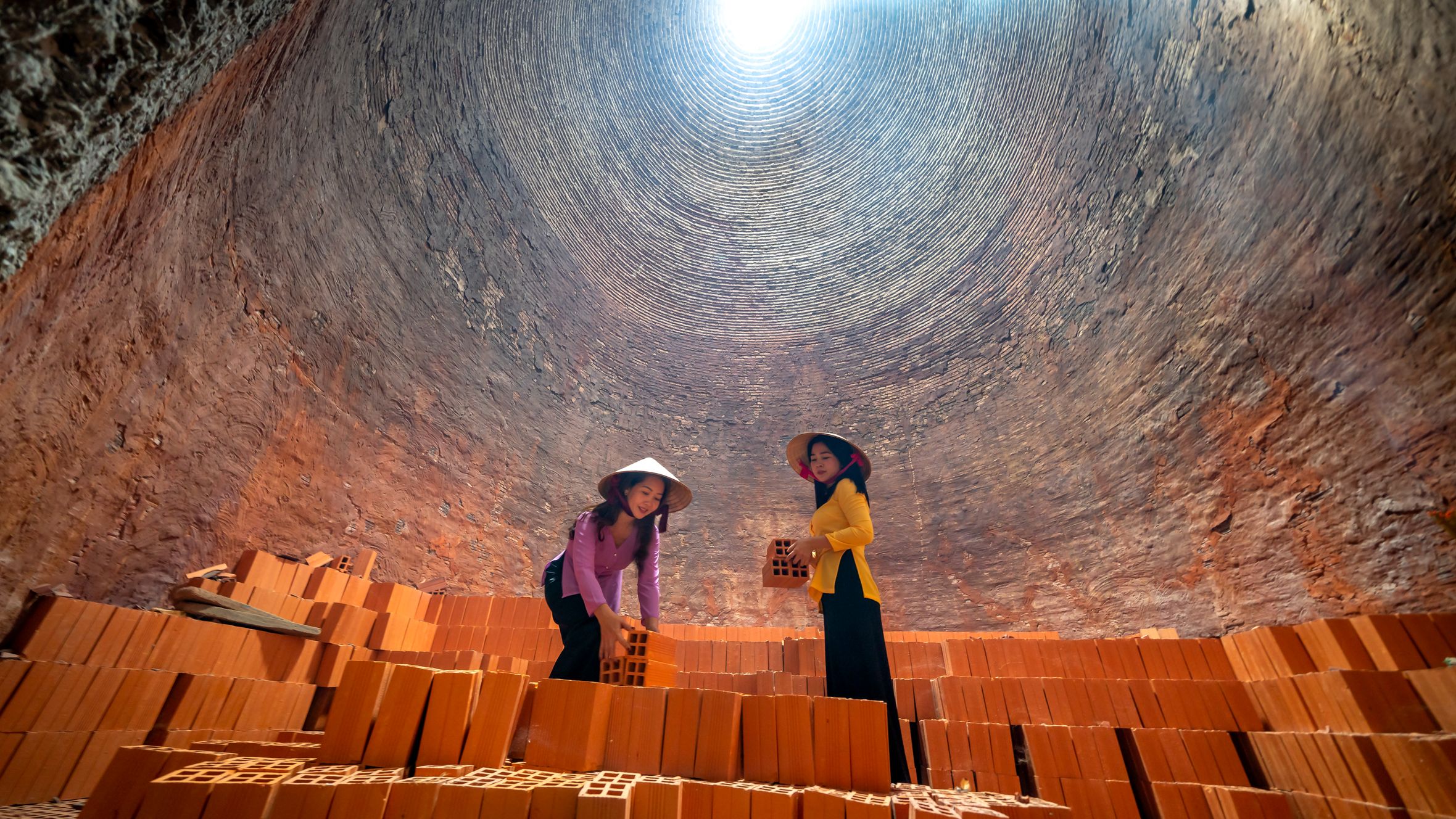
Most kiln owners are fine with visitors walking around, as long as you stay out of the way during loading and unloading. The traditional kilns are dome-shaped, built from — naturally — their own bricks. Step inside a cool one and look up at the blackened vault. Each firing takes three to five days and burns rice husks or wood. Ask a worker to show you the different stages: raw clay, pressed bricks, dried bricks, fired product. The color shift from grey to terracotta is surprisingly dramatic.
Take a boat along the Co Chien River
Hiring a small boat (around 200,000–400,000 VND for an hour, negotiable) lets you see the kiln district from the water, which is how it was designed to work — clay arrives by river, finished bricks leave by river. The view of dozens of chimneys reflected in brown water is the image most people come for.
Visit a converted kiln cafe or homestay
A handful of families have turned decommissioned kilns into atmospheric little spaces. Some serve coffee and coconut water inside the arched chambers. It sounds gimmicky, but the architecture actually works — the thick brick walls stay cool even in midday heat. These spots also tend to have the best-maintained grounds for photography.
Try your hand at shaping clay
A few workshops offer informal demonstrations where you can press bricks or shape small tiles. This isn't a polished pottery class — it's rough, quick, and your results will look amateur. That's the point. You'll understand why machine-pressed bricks took over.
Cycle the back roads
Rent a bicycle in Vinh Long city (most guesthouses have them for 50,000–80,000 VND per day) and ride south. The roads between kilns pass through rice fields, fruit orchards, and small hamlets. It's flat, manageable even in the heat if you start early, and you'll pass things no tour bus stops for — a woman making "banh trang" on a charcoal stove, kids fishing with hand lines off a footbridge.
Where to eat nearby
Vinh Long city has the best variety. Look for "hu tieu" — the southern noodle soup that's lighter and sweeter than its northern cousins. Hu tieu My Tho style is common here, served with pork, shrimp, and a clear broth. A bowl runs 30,000–45,000 VND at any market stall.
Also worth seeking out: "banh xeo" made Mekong Delta–style, which means oversized, stuffed with bean sprouts and river shrimp, and eaten wrapped in herbs and mustard greens rather than lettuce. Quan Banh Xeo on Pham Thai Buong street in Vinh Long city does a reliable version for around 25,000–40,000 VND per crepe.
If you're in the area around Can Tho, a bowl of "bun rieu" — crab-and-tomato noodle soup — makes a solid breakfast before the drive.
Where to stay
Vinh Long city has a range of guesthouses and mid-range hotels. Budget rooms start around 200,000–350,000 VND per night. The Phuong Hoang Hotel and Cuu Long Hotel are both clean, central, and under 500,000 VND.
For something more atmospheric, a few homestays operate in the Mang Thit area itself — some inside converted kiln properties. Expect basic rooms, mosquito nets, and river views for 250,000–400,000 VND. Book ahead if visiting on weekends, as domestic tourists from Saigon have started discovering this area.

Photo by teerayoot manochat on Pexels
Practical tips locals would tell you
- Wear closed shoes, not sandals. Broken brick fragments are everywhere, and kiln floors get hot.
- Bring a scarf or bandana. The dust near active kilns is fine clay particulate — not dangerous for a short visit, but annoying if you're breathing it for hours.
- Go early morning or late afternoon. Midday heat plus kiln radiant heat equals misery.
- Cash only. There are no ATMs in the kiln area itself. Withdraw in Vinh Long city before heading out.
- If you want to buy bricks or tiles as souvenirs, negotiate directly with kiln workers. Small decorative tiles cost almost nothing — 5,000–10,000 VND each — but they're heavy.
Common mistakes to avoid
Don't show up expecting a curated tourist experience. There's no visitor center, no ticket booth, no English signage. That's what makes it good, but it means you need to be comfortable navigating on your own or with a Vietnamese-speaking guide.
Don't touch kilns that are mid-firing. The exterior walls reach temperatures that will burn skin on contact. If smoke is coming from a kiln, keep your distance.
Don't assume the village will look the same in five years. Economic pressure is real — many families are switching to other work, and some kilns are being demolished. If this interests you, go sooner.
Practical notes
Mang Thit works best as a half-day trip from Vinh Long city, or as a stop on a longer Mekong Delta loop that includes Can Tho and the floating markets. Budget a full morning or afternoon to do it properly. It pairs well with a day exploring Vinh Long's river islands and fruit orchards — a bit of industry to balance all that tropical green.
Last updated · May 29, 2026 · independently researched, never sponsored.