"Lon quay" — roasted suckling pig — sits at the center of every important table in northern Vietnam (베트남 / 越南 / ベトナム)'s upland provinces, yet it barely registers on the average tourist's radar. That's partly because it's not street food. It's occasion food, and understanding the occasion is half the reason to seek it out.
What Lon Quay Actually Is
The name is straightforward: lon means pig, quay means roasted on a spit. A whole piglet — typically between 6 and 10 kg, ideally slaughtered the same morning — is gutted, seasoned inside and out, then rotated slowly over charcoal or wood fire for anywhere from two to four hours depending on size. The result is mahogany-lacquered skin that shatters like thin glass when you tap it, and meat underneath that stays juicy without being fatty.
What separates lon quay from generic roast pork across Southeast Asia is the spicing profile and the cultural weight behind it. This is not a casual dish.
The Northern Provinces and Their Claim
Lang Son and Cao Bang are the two provinces most associated with the canonical version, and if you've eaten lon quay anywhere else in Vietnam, there's a decent chance the restaurant owner or the recipe traces back to one of them.
In these provinces — home to large Tay, Nung, and Kinh communities — lon quay has been a fixture of weddings, Tet celebrations, and communal feasts for generations. The specific spice blend used in Lang Son typically involves ginger, lemongrass, galangal, five-spice, and locally sourced mac khen (a Sichuan pepper relative grown in the northern highlands). The pig is rubbed inside the cavity, sometimes stuffed with lemongrass stalks and ginger, then the exterior skin is brushed repeatedly with a mix of honey, rice wine, and annatto oil during roasting to build that lacquered finish.
Cao Bang's version tends to run slightly leaner, reflecting the smaller free-range pigs raised in hillside villages, and some households there rub the skin with a paste of fermented shrimp before the final rotation over fire — a regional twist that adds a quiet umami depth without announcing itself.
Both provinces have a long tradition of serving lon quay at important life events: weddings typically feature a whole roasted pig delivered to the bride's family as part of the betrothal gifts ("dam cuoi" ceremony), alongside "banh chung" and other ritual foods. Refusing or diminishing the pig is not an option you want to exercise.
Festival Context
Outside of weddings, lon quay appears reliably during Tet (뗏 (베트남 설날) / 越南春节 / テト) and the Hung Kings Festival, when family altars across the north receive a full spread of ceremonial dishes. In village settings, a communal lon quay might be sourced weeks in advance — families who raise their own pigs know from early on which animal is headed for the spit.
In urban Hanoi, the dish migrated south with families from Lang Son and Cao Bang, and you'll now find dedicated lon quay shops clustered in neighborhoods like Cau Giay and Long Bien. In Saigon, it's rarer in its pure form but appears in northern-style restaurants and at Vietnamese-Chinese roast meat shops where the technique crosses over with Cantonese roast pork traditions.

Photo by Chuot Anhls on Pexels
Regional Variants Worth Knowing
Lang Son Style
The benchmark. Mac khen in the spice rub, skin basted with honey and rice wine, served with "mam gung" (ginger fish sauce) and fresh herbs. The skin is the point — if it's not crackling audibly when cut, it's not ready.
Cao Bang Style
Leaner meat, slightly more restrained spicing, sometimes incorporates fermented shrimp paste under the skin. Less honey in the baste, so the color is darker and the flavor more savory than sweet.
Hanoi Adaptation
Urban lon quay shops in Hanoi often skip mac khen (harder to source fresh in the city) and lean heavier on five-spice. The pigs tend to be larger — up to 15 kg — because they're feeding restaurant crowds, not village feasts. Quality varies sharply. The best shops still source from highland farms.
Southern Interpretation
In Saigon and the Mekong Delta, lon quay blends with Cantonese "siu yuk" influence. The skin technique is similar but the seasoning skews sweeter, with more star anise and less galangal. It's a different dish in spirit, even if the appearance is close.
How to Order
At a dedicated lon quay shop, you typically don't order by the portion — you order by the kilogram or half-pig. Expect to pay 250,000–400,000 VND per kg depending on the province and quality of the pig. A table of six to eight people can handle a 5–6 kg half-pig comfortably.
Always ask: "Da co san chua?" (Is it ready yet?) — good lon quay is roasted to order or in small batches through the day, and arriving at 11am or 5:30pm puts you ahead of the crowd and the dry leftover slices that appear later.
The standard accompaniments: fresh rice paper ("banh trang"), cucumber, green banana, star fruit, a pile of fresh herbs, and mam gung on the side. You wrap everything together — crisp skin, tender meat, herb, a slice of sour fruit — and the contrast is the whole point.
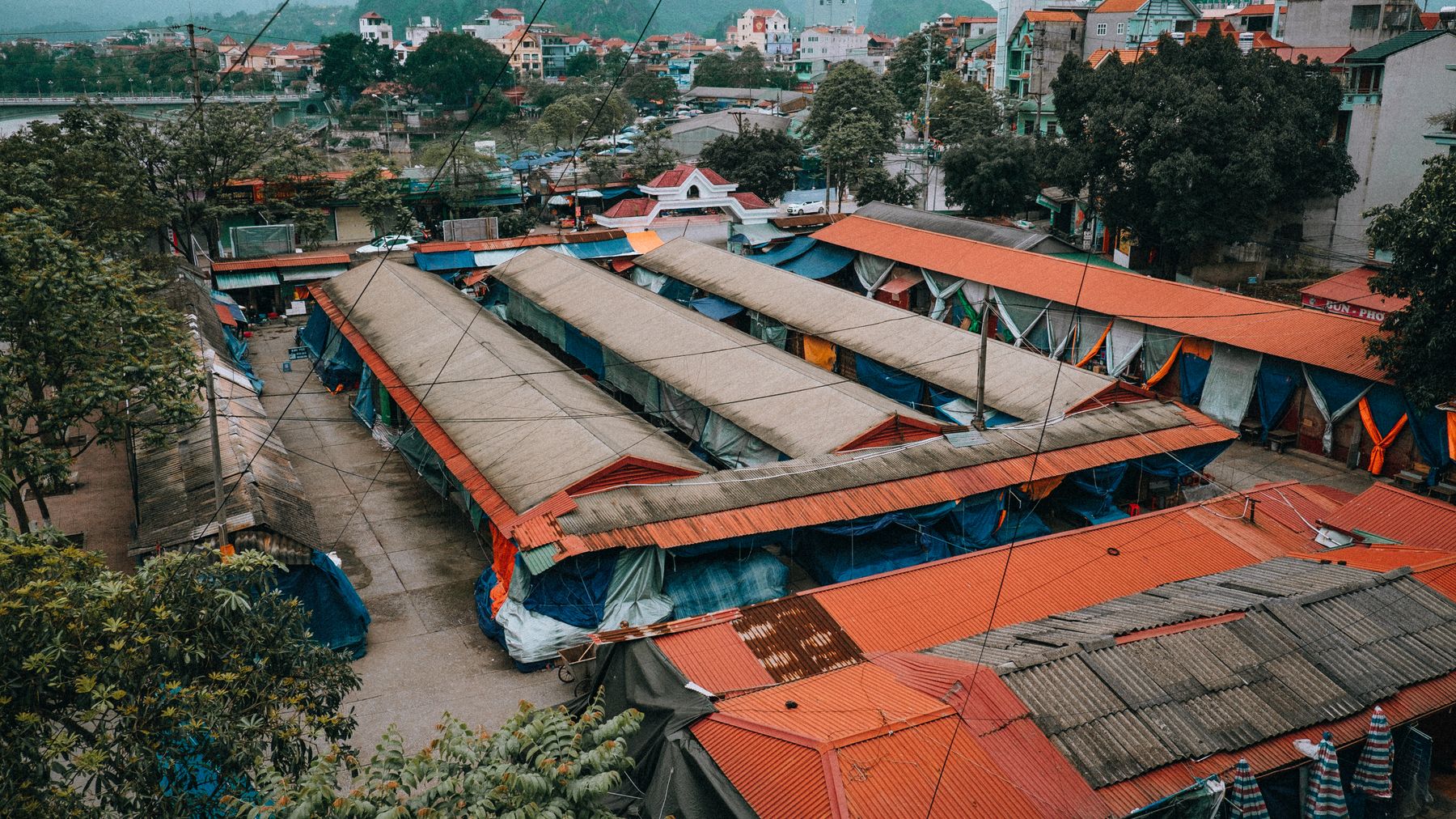
Photo by Chuot Anhls on Pexels
Where to Try the Canonical Version
Lang Son town, Lang Son Province — The city's Dong Kinh Market area has several lon quay stalls open from mid-morning. The pigs here are raised locally, the mac khen is fresh, and the price per kg is lower than anywhere else you'll find it. If you're making the drive up from Hanoi (about 155 km on Highway 1B), this alone justifies the trip.
Lon Quay Lang Son — Hang Khay area, Hanoi — Several shops around the Old Quarter and Hoan Kiem fringe serve Lang Son-style lon quay daily. The 36-street area around Hang Be has a few reliable spots that source weekly from the north. Worth checking reviews on Google Maps before you go, as quality rotates.
Bac Kinh Roast — District 10, Saigon — For the southern interpretation, this style of northern-meets-Cantonese roast house does a credible lon quay that tilts sweeter but still cracks properly. Good entry point if you're in Saigon and not making it north anytime soon.
Practical Notes
Lon quay is not an everyday dish and most shops sell out by early afternoon — arriving after 1pm is a gamble. If you're traveling to Lang Son or Cao Bang, call ahead to confirm a whole pig is available; during Tet and wedding season (typically February–April and August–October), supply gets tight fast. Budget 300,000–380,000 VND per kg as a reasonable baseline outside of peak periods.
Last updated · May 29, 2026 · independently researched, never sponsored.