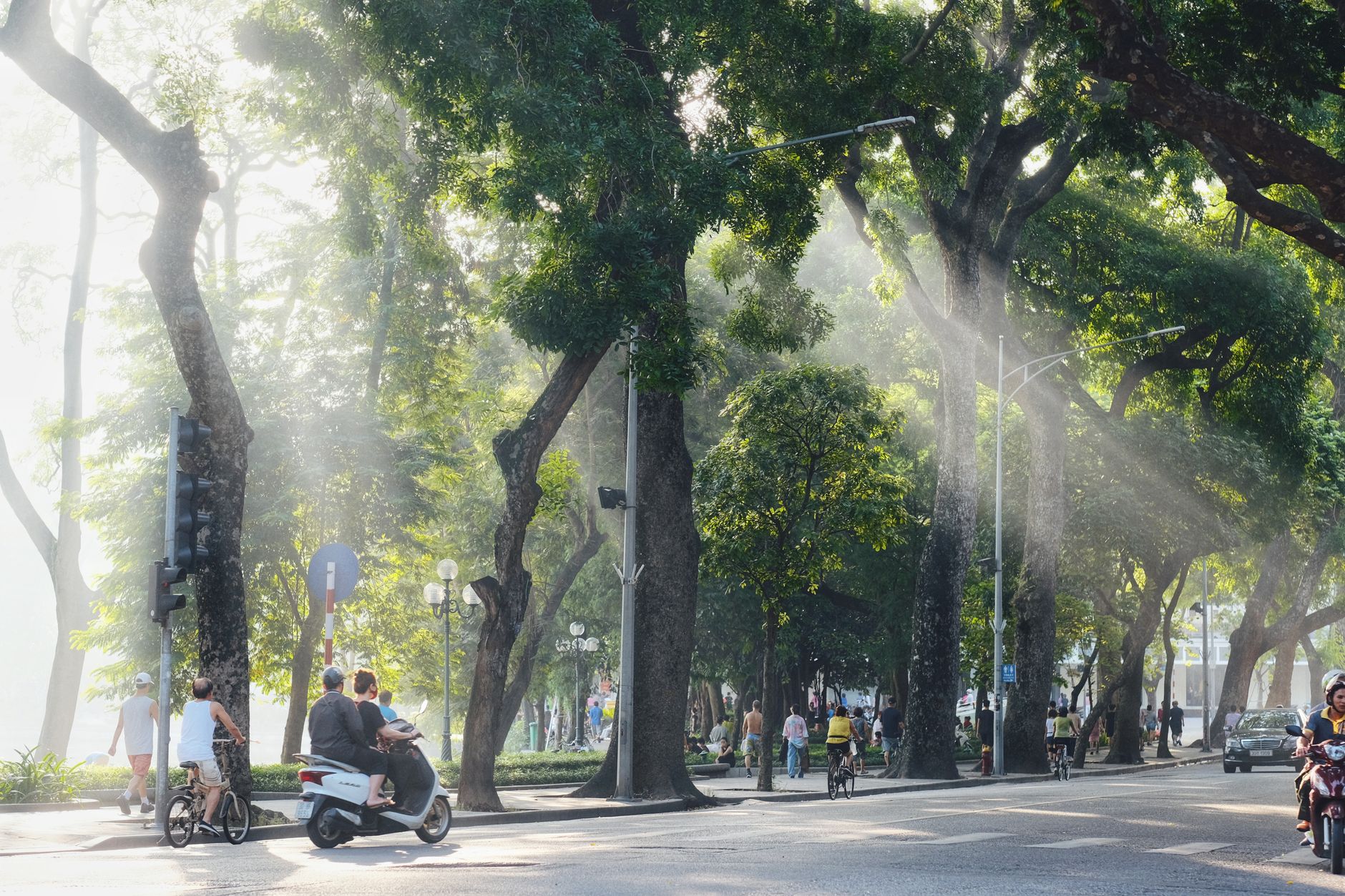
Cao Bang City isn't a tourist draw by itself. But if you're heading into the northeastern mountains—to Ban Gioc waterfall, Phong Nam Valley, or the border regions—you'll pass through or use it as a jumping-off point. The city sits on the Bang Giang river about 30 km from the Guangxi frontier, population around 73,500, and serves as the capital of Cao Bang province.
The Practicalities
The city center has the basics: modest hotels, motorbike rental, a few restaurants. The President Ho Chi Minh (호치민 / 胡志明 / ホーチミン) Monument Square is the main public gathering space. Kim Dong Walking Street runs along the river and is pleasant for an evening stroll. Road 3/10 is the main commercial drag. Nothing fancy—this is a working provincial capital, not a tourist resort.
Budget hotels around the central market area run 200,000-400,000 VND per night for a clean room with air conditioning and hot water. A handful of mid-range options along the river push up to 500,000-700,000 VND. Don't expect international booking platforms to have much listed—walk-ins work fine, and prices are negotiable outside of national holidays. For food, "com binh dan" (everyday rice meals) at local eateries cost 30,000-50,000 VND. A bowl of "pho" at a street stall near the market is about 25,000-35,000 VND. There's a Vietcombank and an Agribank with ATMs on the main road, both accepting international cards, though withdrawal fees apply.
Transport in and out: buses from Hanoi (5-6 hours), or rent a motorbike if you're comfortable on northern roads. The main bus station is on the southern edge of town; tickets to Hanoi run around 200,000-250,000 VND. There's also a daily bus to Lang Son (about 4 hours, 150,000 VND), which connects you to the northeast loop if you're working your way through Ha Giang or the broader northern circuit. Local buses don't reach the valley attractions; you'll need private transport. Motorbike rental in town costs roughly 150,000-200,000 VND per day for a Honda Wave or similar semi-automatic.
History Worth Knowing
The name Cao Bang means "high plateau," which is accurate—you're in mountainous terrain. The region has a long strategic history. In the 16th century, it was a stronghold for the Mac dynasty during their final collapse. The 19th century brought resistance against the Nguyen government. During the French colonial period, Cao Bang was a frontier garrison town.
In 1950, the Viet Minh won a major battle here against the French Army, a turning point in the First Indochina War. That history is visible in the city's monuments. If you're the type who visits Cu Chi Tunnels near Saigon for the war history, the Cao Bang region adds another layer—this is where the independence movement built its early infrastructure in mountain caves and jungle camps. Pac Bo Cave, about 50 km north of the city, is the most visited historical site in the province. It's a modest cave by a stream, significant for its wartime role, and the surrounding forest is worth a walk. Entry is around 20,000 VND.

Image by No machine-readable author provided. Ajarnmike assumed (base via Wikimedia Commons (CC BY-SA)
Nearby: Burning Grass Hill (Doi Co Chay)
Located near Thanh Nhat town in Ha Lang district, about 6-7 km from town. The access road is mostly concrete—passable by motorbike—but the final 3 km to Ba Quang Grass Hill is rough and steep. High-clearance vehicles or experienced riders recommended. The payoff: panoramic views of rolling grassland and karst peaks. Go in the dry season (October-March); the "burning grass" effect (seasonal grass browning) happens in late autumn.

Image by Phó Nháy (talk) 18:56, 19 October 2013 (UTC) via Wikimedia Commons (CC BY-SA)
Nearby: Phong Nam Valley (Thung Lung Phong Nam)
About 65-70 km southeast of Cao Bang City (1.5-2 hours by car or motorbike), in Trung Khanh District. A scenic valley with homestays in villages like Na Chang and Na Tong. The road is winding but drivable. If you want views, hike to Phi Pha Viewpoint (30-45 minutes up); the panorama is worth the climb.
Accommodation is basic—homestays only, no hotels. Expect to pay 150,000-300,000 VND per night, meals included if you arrange it with the host family. Bring cash; there are no ATMs in the valley. Motorbike riders: the roads are fine, but slow down on the bends. The valley is also a reasonable staging point for Ban Gioc waterfall, which is another 20-25 km further east along increasingly scenic roads.
What to Eat in Cao Bang
Cao Bang has its own regional dishes, and they're distinct from what you'll find in Hanoi or Da Nang. The signature noodle here is "pho (쌀국수 / 越南河粉 / フォー) chua" (sour pho)—cold rice noodles tossed with roasted pork, peanuts, herbs, and a tangy broth ladled over the top. It's nothing like the steaming bowl of pho you get in Hanoi. Look for it at small stalls near the central market; a plate costs around 25,000-30,000 VND.
"Banh cuon" in Cao Bang is also different from the Hanoi version. The rice sheets are thicker, filled with minced pork and wood ear mushroom, and served with a lighter dipping sauce. Try it for breakfast—most "banh cuon" stalls open around 6:00 and sell out by 9:00. There's a well-known cluster of stalls on the road leading to the market.
For something heartier, "roasted duck" (vit quay) is a Cao Bang specialty, rubbed with "mac khen" (a local peppercorn from the highlands) and roasted over wood fire. A portion for two runs 200,000-300,000 VND at local restaurants. Pair it with sticky rice and dipping salt mixed with more "mac khen"—the numbing, citrusy flavor is specific to the northern mountains.
If you're arriving late and just need something quick, "bun rieu" (crab noodle soup) and "banh mi" are available at street carts around Kim Dong Walking Street until about 21:00. Vietnamese coffee is easy to find too—small cafes along the river serve "ca phe sua da" (iced milk coffee) for 15,000-20,000 VND. Don't expect specialty roasters; this is instant or basic drip, but it does the job.
Common Mistakes Visitors Make
Trying to day-trip Ban Gioc from Hanoi. It's technically possible but brutal—at least 5-6 hours each way by bus, plus transfer time. You'll spend 12 hours on the road for maybe 2 hours at the waterfall. Stay in Cao Bang City or Trung Khanh instead and give yourself two days minimum.
Not carrying cash. Outside the city, card payment barely exists. ATMs disappear once you leave the main road. Withdraw enough VND in Cao Bang City to cover fuel, food, homestays, and entry tickets for however many days you'll be in the province.
Underestimating the roads. The route from Hanoi to Cao Bang (National Highway 3) is paved and mostly fine. But secondary roads to places like Phong Nam, Doi Co Chay, and the smaller valleys are a different story—narrow, steep, and sometimes unpaved. If you're not experienced on a motorbike, hire a local driver (around 400,000-500,000 VND per day including bike) or arrange a car through your hotel.
Skipping the city entirely. Some travelers rush straight through to Ban Gioc and miss the fact that Cao Bang City itself is a decent place to spend a half-day. Walk along the river at dusk, eat "pho chua" at the market, stock up on supplies. It's not Hoi An or Da Lat—there's no old town to photograph—but the low-key atmosphere is part of the northern experience.
Visiting in the wrong season. July and August bring heavy rain and occasional flooding that can close mountain roads for days. The sweet spot is September through November (dry, cool, the rice terraces turn gold) or March through May (warming up, green valleys, fewer tourists). Winter months—December through February—are cold at altitude. Temperatures in Cao Bang drop to 5-10°C at night, and fog can limit visibility on mountain passes.
Quick Reference
- Location: Cao Bang province, northeast Vietnam, roughly 270 km north of Hanoi
- Population: ~73,500 (city), ~530,000 (province)
- Altitude: ~180 meters
- Best months: September-November, March-May
- Budget hotel: 200,000-400,000 VND/night
- Motorbike rental: 150,000-200,000 VND/day
- Bus from Hanoi: 5-6 hours, 200,000-250,000 VND
- ATMs: Vietcombank, Agribank on main road (withdraw before leaving the city)
- Key phrase for food: "Cho toi mot phan pho chua" — Give me one serving of sour pho
- Key phrase for directions: "Ban Gioc o dau?" — Where is Ban Gioc?
- Fuel: Fill up in the city. Gas stations thin out quickly in rural areas.
- SIM/data: Viettel has the best coverage in the northern mountains. Buy a SIM in Hanoi or at the Cao Bang bus station.
Getting Your Bearings
Cao Bang City itself is small and walkable. The Bang Giang river cuts through the center. You can cover the main streets in a couple of hours. If you're staying a night or two, use it to acclimatize to the altitude (around 180 meters) and to stock up on food, water, and fuel before heading into the surrounding mountains.
The province is known for Ban Gioc waterfall (the border's second-highest), limestone landscapes, and quiet hiking. Cao Bang City is the nerve center—buses, motorbike rental, ATMs, restaurants. Not glamorous, but functional and real. From here, the northeast loop connects through to Ha Giang if you're doing the full northern circuit—a ride that also passes through Lang Son and Bac Kan, adding context to just how remote and rugged this corner of Vietnam is.
How Cao Bang Fits a Northern Vietnam Itinerary
Most travelers doing the north start or end in Hanoi. The classic Ha Giang loop gets most of the attention, and fairly so—it's spectacular riding. But Cao Bang province is the quieter counterpart, and combining the two makes for a more complete trip.
A practical route: Hanoi to Cao Bang (bus or bike, day one), Cao Bang to Ban Gioc and Phong Nam (day two and three), then west through Bao Lac to Ha Giang (day four). From Ha Giang, you ride the famous loop—Dong Van, Meo Vac, Ma Pi Leng pass—before returning to Hanoi. Total: 7-10 days depending on pace. This is demanding riding, but it covers the best of the northeast without backtracking.
If you're not on a motorbike, some tour operators in Hanoi run combined Cao Bang-Ha Giang trips by car or minivan. Expect to pay 8,000,000-12,000,000 VND for a 5-7 day guided tour including accommodation and meals. Book through your hotel or a Hanoi-based travel agency in the Old Quarter rather than online platforms—you'll get better prices and more flexibility.
For those with less time, a focused 3-day trip—Hanoi to Cao Bang, Cao Bang to Ban Gioc and back, return to Hanoi—is manageable and still rewarding. You won't see everything, but you'll get the waterfall, the valley, and a feel for the northeastern mountains that most visitors to Vietnam never experience. Pair it with a few days exploring Ninh Binh or Sapa and you've covered a serious cross-section of northern Vietnam's landscapes.
Final Note
Cao Bang City is not the destination—it's the door. What's behind it, in every direction, is limestone country that rewards anyone willing to deal with winding roads and basic accommodation. Come with enough cash, a full tank, and reasonable expectations for comfort, and the northeast will give you something the more polished circuits don't: the feeling of being genuinely off the main trail.
Last updated · May 29, 2026 · independently researched, never sponsored.