Perched on Cu Lao Mountain, overlooking Nha Trang (냐짱 / 芽庄 / ニャチャン), the Po Nagar Cham Towers are among Vietnam's most historically layered sites. Founded before 781, this temple complex was the spiritual heart of the medieval Cham kingdom of Kauthara — a Hindu civilization that ruled this stretch of coast for centuries before Vietnamese expansion southward.
If you visit, you're walking through a story of conquest, theft, faith, and cultural translation. The towers aren't grand or sprawling. They're compact, intimate, damaged by time and history. But that's exactly what makes them worth the trip.
A Temple Built and Rebuilt
The earliest documented record of Po Nagar comes from a stele dated 781. King Satyavarman had just reclaimed the "Ha-Ra Bridge" area from foreign occupation and ordered the temple restored after it had been devastated — likely by raiders.
Yet restoration wasn't the end of trouble. Another inscription records a robbery: foreign corsairs, described in archaic Cham language as men with "food more horrible than cadavers, completely black and gaunt," sailed in and looted the temple's treasures — including a jeweled "mukhalinga", a symbolic representation of the Hindu god Shiva. King Satyavarman chased them to sea but never recovered the stolen treasure. By 784, he'd commissioned a replacement linga, restoring the sacred image.
This pattern — making offerings, surviving raids, rebuilding — repeated for centuries. A stele from 918 records King Indravarman III ordering a golden statue of the goddess Bhagavati. In 950, the Khmer king Rajendravarman II conquered the temple and carried off the gold. By 965, the Cham king Jaya Indravarman I had replaced it with a stone version.
Kings continued to enrich the complex. In 1050, King Jaya Paramesvaravarman I donated land, slaves, jewelry, and precious metals. In 1084, after reunifying Champa, King Paramabhodisattva made "rich offerings." Each donation was a political and spiritual act — a king's way of saying: I control this territory. The goddess is with us.
The Goddess and Her Names
The towers are dedicated to Yan Po Nagar — in Sanskrit texts, identified with the Hindu goddesses Bhagavati and Durga (the buffalo-demon slayer). The Cham worshipped her as the protector of the country.
When the Vietnamese occupied Champa in the 17th century, they didn't destroy the temple. Instead, they renamed it. Yan Po Nagar became "Thien Y Thanh Mau" — a Vietnamese mother-goddess figure. Over time, local legends grew around the site, weaving Cham and Vietnamese mythology together.
This religious syncretism is visible in the art. The main stone statue of Yan Po Nagar sits inside the central temple — 1.2 meters tall, cross-legged, with ten hands holding symbolic objects (lotus, sword, shield). Above the entrance, a carved pediment shows Durga standing on a buffalo, holding a hatchet and lotus. This sculpture style dates to the late 10th or early 11th century — the refined Tra Kieu period of Cham art.
You'll notice incense smoke drifting through the main tower most mornings. Vietnamese worshippers, many of them local women, light bundles of incense and place fruit offerings at the base of the statue. The Cham community also maintains a presence here, particularly during the annual Kate Festival (usually September or October on the Cham calendar), when traditional music, prayer, and processions fill the complex. If your timing lines up, attending Kate at Po Nagar is one of the most genuine cultural experiences in southern Vietnam (베트남 / 越南 / ベトナム).

Image by Dongsonvmvn at Vietnamese Wikipedia via Wikimedia Commons (CC BY-SA)*
What You'll See
The Po Nagar complex sits on a hill with three levels. The highest level holds the main tower — about 25 meters tall, built from brick and stone, with a porch and inner sanctum. The tower's weathered surface tells you immediately: this is old, and it's been fought over.
Inside the main temple, you'll find the stone goddess statue and various Hindu religious sculptures. Outside, you can see the pediment with the Durga carving. The views from the hilltop sweep across Nha Trang — the city sprawls below, modern Vietnam spreading in all directions. The contrast is intentional-feeling: ancient brick temple, modern concrete city.
Beyond the main tower, three smaller towers stand in a row. The Northwest Tower is dedicated to Shiva's son Ganesh. The South Tower, the smallest, honors Sandhaka (a local Cham deity). The Central Tower was originally dedicated to the god Cri Cambhu. Each has its own small sanctum, though the interiors are simpler than the main tower. Budget about five to ten minutes for each secondary tower — the carvings above their doorways are worth a close look.
The lowest terrace, closest to the river, once held a "mandapa" — a pillared meditation hall where pilgrims gathered before ascending. Only the column bases survive today, but they give you a sense of the original processional route: arrive by river, purify at the hall, climb the stone steps, enter the goddess's presence.
The site is well-maintained and easily accessible from central Nha Trang (about 2 km north, on the far side of the Xom Bong Bridge along 2 Thang 4 Street). Entrance is cheap (around 30,000 VND). English-language signage is limited, so if you want deep historical context, either arrive with this article or hire a local guide.

Image by Nguyen Dong Son at Vietnamese Wikipedia via Wikimedia Commons (CC BY-SA)
Practical Visit Details
Getting there: From Nha Trang's tourist strip along Tran Phu, head north across the Xom Bong Bridge. The towers are immediately visible on the hill to your left. A taxi from the beach area costs around 30,000-50,000 VND. Grab works well here. If you're on a rented motorbike, there's a small parking lot at the base (5,000 VND for bikes).
Hours and entry: The complex opens daily from roughly 6:00 AM to 6:00 PM. Ticket price is 30,000 VND for adults. There's a small office at the gate where you buy tickets — no online booking needed.
Time needed: Most visitors spend 30 to 45 minutes. If you read every inscription panel and linger at the viewpoints, an hour is comfortable. There's little shade on the upper terrace, so morning visits (before 9 AM) or late afternoon (after 3:30 PM) are more pleasant.
Dress code: This is an active religious site. Shoulders and knees should be covered. If you arrive in a tank top or short shorts, attendants at the entrance will lend you a colored robe to drape over your clothes — free of charge, but it slows you down. Save yourself the hassle and dress appropriately.
Guides: Freelance guides sometimes wait near the entrance and offer tours for 100,000-200,000 VND. Quality varies. A better option is to arrange a guide through your hotel or a Nha Trang tour operator — some bundle Po Nagar with the nearby Long Son Pagoda and Nha Trang Cathedral for a half-day culture loop.
Eating and Drinking Nearby
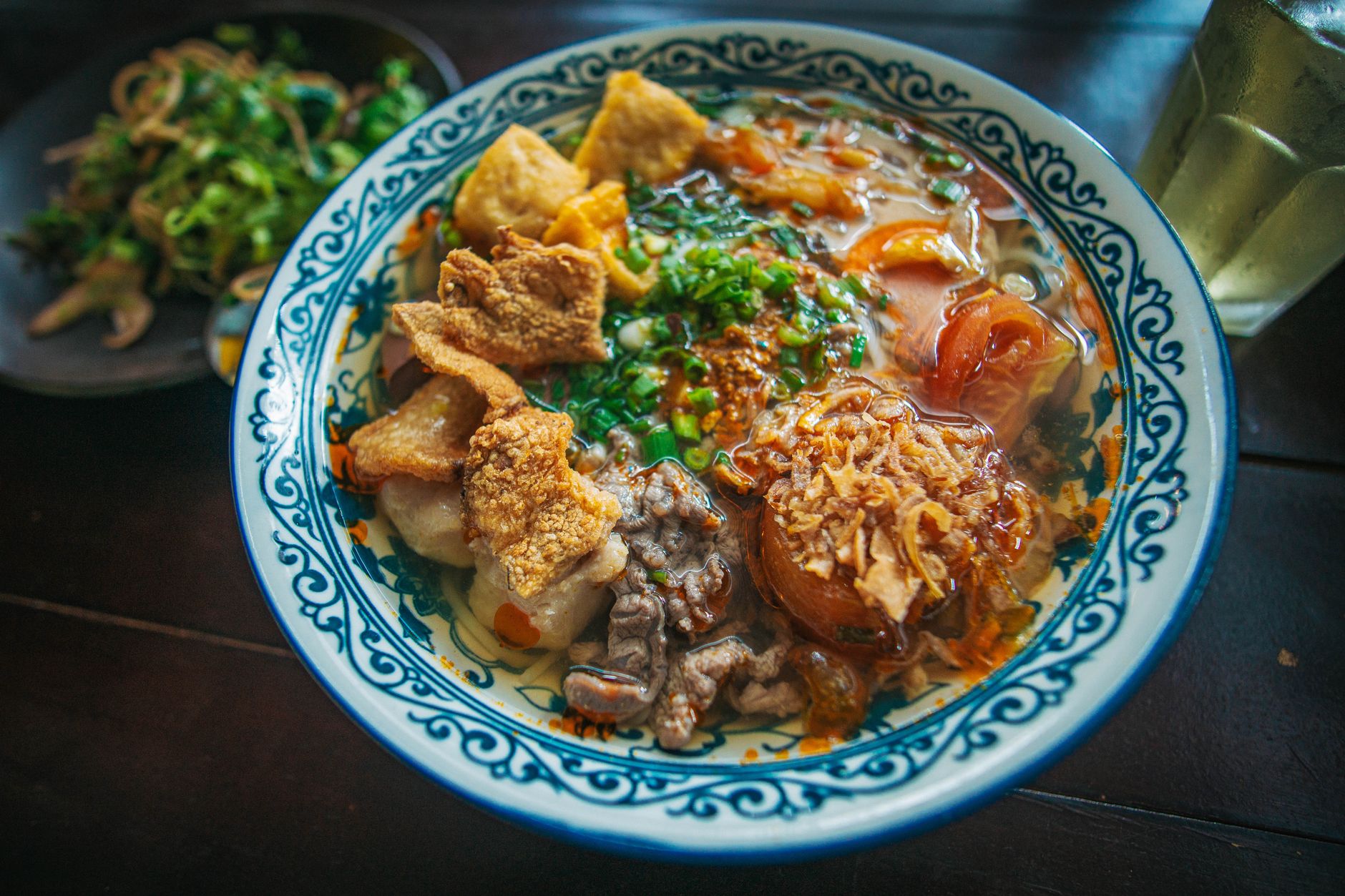
Po Nagar sits in a workaday Vietnamese neighborhood, not a polished tourist zone, which means the food options nearby are local and cheap. On the streets around 2 Thang 4 and the base of the bridge, you'll find "com tam" (broken rice) stalls serving pork chop, egg, and pickled vegetables over rice for 35,000-50,000 VND. In the mornings, look for "bun cha ca" — Nha Trang's signature fish cake noodle soup, available at small shophouses within a few hundred meters of the site.
For coffee, the neighborhood has a scattering of local "ca phe" shops where iced milk coffee ("ca phe sua da") runs 15,000-25,000 VND. Don't expect English menus. Point at what someone else is drinking or say "ca phe sua da" — that gets you sorted.
If you'd rather eat in the tourist district, cross back over the Xom Bong Bridge and head south along Tran Phu. You'll be back in banh-mi-and-smoothie territory within ten minutes.
Po Nagar in Context: Other Cham Sites in Vietnam
Po Nagar isn't the only surviving Cham tower complex, though it's one of the most accessible. If this kind of history interests you, plan stops at a few others:
- My Son Sanctuary (about 470 km north, near Hoi An): The largest Cham temple complex in Vietnam, a UNESCO World Heritage site. More ruined than Po Nagar — American bombing during the war destroyed several towers — but the forest setting and sheer scale are impressive. Most visitors reach it as a half-day trip from Hoi An or Da Nang.
- Po Klong Garai (about 105 km south, near Phan Rang): Three well-preserved brick towers on a granite hill. Less visited than Po Nagar, which means fewer crowds and a quieter atmosphere. This is where the Kate Festival is celebrated most elaborately.
- Cham Museum in Da Nang: If you want to see the sculpture and carvings that have been removed from tower sites for preservation, the Cham Museum holds the largest collection of Cham artifacts in the world. It's small but dense — plan about an hour.
Together, these sites trace the Cham civilization along the central Vietnamese coast from Da Nang down through Nha Trang to Phan Rang. You could link them into a multi-day road trip, stopping in Hoi An and Hue along the way for food, beaches, and the Imperial Citadel.
Common Mistakes and What Surprises Foreigners
Rushing through. Many visitors arrive on a bus tour, snap photos of the main tower, and leave in fifteen minutes. The secondary towers, the mandapa ruins, and the riverside stairway all get skipped. Slow down.
Ignoring the lower terrace. The pillar bases of the old meditation hall are easy to miss — they're on the flat area before the main staircase. They're not dramatic, but they help you picture how the complex originally functioned as a pilgrimage route.
Expecting Angkor. Po Nagar is small. Four towers, a hilltop, and some stelae. If you arrive expecting a sprawling ruin complex, you'll be disappointed. Adjust your expectations: this is a neighborhood temple that happens to be 1,200 years old, not a tourist mega-site.
Not covering up. The robe-lending system works, but it's awkward. Just wear a t-shirt and pants or a knee-length skirt.
Skipping the context. Without background, Po Nagar looks like a cluster of old brick towers. With context — the Cham civilization, the raids, the goddess, the religious conversion — it becomes one of the most layered historical sites between Hue and Saigon. Read before you go.
Confusing it with Vinpearl. I've met tourists in Nha Trang who thought Po Nagar was "that tower thing near the cable car." The Vinpearl cable car terminal is nearby, but the two have nothing to do with each other. Po Nagar predates the amusement park by about twelve centuries.
Quick Reference
- Full name: Thap Ba Po Nagar (Po Nagar Cham Towers)
- Location: 2 Thang 4 Street, Vinh Phuoc Ward, Nha Trang, Khanh Hoa Province
- Distance from Nha Trang beach strip: ~2 km north
- Founded: Before 781 CE
- Deity: Yan Po Nagar (Bhagavati / Durga); later syncretized as Thien Y Thanh Mau
- Main tower height: ~25 meters
- Number of surviving towers: 4 (of an original 7-8)
- Entry fee: ~30,000 VND
- Hours: ~6:00 AM - 6:00 PM daily
- Time needed: 30-60 minutes
- Dress code: Cover shoulders and knees (robes available at the gate)
- Best time to visit: Early morning or late afternoon to avoid midday heat
- Parking: Motorbike lot at the base, ~5,000 VND
- Annual festival: Kate Festival (September/October, Cham calendar)
Why It Matters
Po Nagar matters because it's a monument to a lost civilization — the Cham kingdom, which once controlled central Vietnam and much of Cambodia. By the 15th century, Vietnamese kingdoms had pushed south and absorbed Cham territory. The Cham people were displaced or assimilated. Their kingdoms vanished.
But their temples remained. Po Nagar is one of the few places in Vietnam where you can stand inside a Hindu temple and feel the weight of that older history. It's not a museum piece — it's a still-active spiritual site where both Vietnamese and Cham-descended visitors come to pray and make offerings. The goddess still has worshippers.
If you're in Nha Trang for more than a beach day, make the trip. Bring water. The climb to the hilltop is short but can be steep. Go early to beat crowds and heat. And spend some time on top, looking down at the modern city, thinking about the empire that once ruled this land.
Bottom Line
Po Nagar won't take your whole day, and it shouldn't. It's a one-hour stop that reframes everything else you see in Nha Trang — the beach hotels, the seafood restaurants, the Russian-language signs — as very, very recent history. Twelve centuries of worship, war, and reinvention sit on that hilltop. Pay the 30,000 VND, cover your knees, and climb the stairs.
Last updated · May 29, 2026 · independently researched, never sponsored.