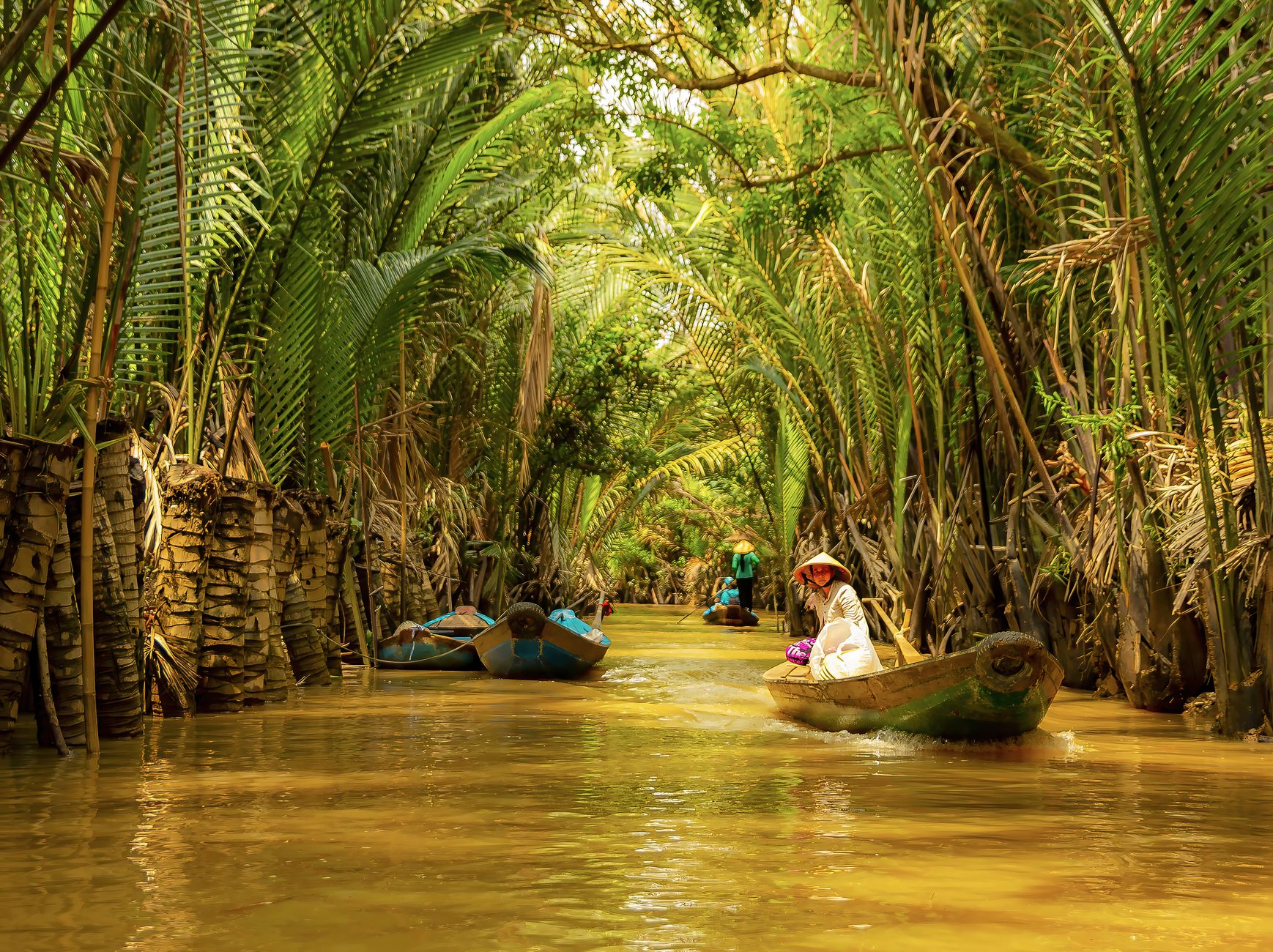
Rung U Minh Ha is one of the largest remaining melaleuca swamp forests in Southeast Asia, sprawling across roughly 8,500 hectares of waterlogged peatland in Ca Mau province. It's not the kind of place that makes Instagram reels go viral, but if you're interested in the Mekong Delta (메콩 델타 / 湄公河三角洲 / メコンデルタ) beyond floating markets and rice paddies, this forest is worth the detour.
What it is and why it matters
U Minh Ha (Lower U Minh) sits in the southwest corner of Ca Mau, about 30 km from Ca Mau city center. The forest is dominated by "tram" — melaleuca cajuputi trees — growing out of a thick peat layer that's been building up for thousands of years. During the war, this swamp served as a base for resistance fighters precisely because it was so difficult to penetrate. Parts of the forest were burned and sprayed with defoliants, but it has regenerated significantly since the 1970s.
Today it's a national park and a Ramsar wetland site. The ecosystem here is genuinely unusual: acidic blackwater channels wind through dense stands of paperbark trees, and the whole thing floods seasonally, creating a landscape that feels more primordial than scenic.
Why travelers go
Most people visiting Ca Mau are already off the standard tourist circuit — you're not going to bump into tour groups here. Rung U Minh Ha draws a particular kind of traveler: birdwatchers tracking species like the lesser adjutant stork and grey-headed fish eagle, photographers who want that moody canopy-and-dark-water shot, and people who simply want to see what the Mekong Delta looked like before it was drained and farmed.
It's also a genuine working forest. Local families harvest honey from wild bee colonies in the melaleuca canopy — a tradition that's been going on for generations. If you time it right, you can watch this happen.
Best time to visit
The sweet spot is December through April, the dry season in the south. Water levels are lower, trails are more accessible, and the mosquito situation is merely annoying rather than brutal. The honey harvesting season peaks around March to June, so late March and April give you the overlap of decent weather and a chance to see honey collectors at work.
Avoid September and October if you can — the forest floods deeply, and access to interior sections gets restricted. The upside of the wet season is better birdwatching, but you'll need a boat for almost everything.
How to get there
From Saigon, the most practical route is a bus to Ca Mau city. Phuong Trang (FUTA) runs daily sleeper buses from the Western Bus Station (Ben Xe Mien Tay) — roughly 8-9 hours, around 200,000-250,000 VND. Alternatively, fly from Tan Son Nhat to Ca Mau airport (Vietnam (베트남 / 越南 / ベトナム) Airlines operates this route), about 1 hour, tickets usually 800,000-1,500,000 VND depending on how early you book.
From Ca Mau city center to the national park entrance, it's about 30 km south along Provincial Road 1. A xe om (motorbike taxi) costs around 80,000-120,000 VND one way, or you can rent a motorbike in Ca Mau for 120,000-150,000 VND per day and ride yourself. The road is paved and flat — classic delta driving.
If you're coming from Can Tho, budget about 4-5 hours by bus (around 120,000 VND) to reach Ca Mau first.

Photo by Flint Huynh on Pexels
What to do
Paddle through the melaleuca canopy
The main activity here. You board a small wooden boat — usually a "xuong" punted by a local guide — and wind through narrow channels under a dense tunnel of melaleuca. The water is tea-dark from tannins leaching out of the peat. A two-hour boat tour runs around 150,000-200,000 VND per person. Go early morning for the best light and birdsong.
Watch wild honey harvesting
If you visit between March and June, park staff can arrange for you to join or observe "gac keo" — the traditional method of hanging wooden boards in the canopy to attract wild bee swarms, then harvesting the comb. It's a quiet, skilled process. The honey itself is dark, fragrant, and tastes distinctly of melaleuca blossoms. You can buy a bottle at the park for around 200,000-300,000 VND per liter.
Walk the elevated boardwalk
A raised wooden walkway runs through a section of the forest interior, giving you a ground-level view of the peat floor, root systems, and whatever wildlife is moving through — monitor lizards, water snakes, and various wading birds are common. The boardwalk loop takes about 30-45 minutes.
Fish for snakehead with locals
Some homestay operators near the park boundary offer fishing trips in the surrounding canals. You're going after "ca loc" (snakehead fish) using traditional line-and-hook methods. It's low-key and social rather than sporting. Your catch usually ends up grilled over charcoal for lunch.
Visit the peat fire memorial area
A section of the park documents the devastating 2002 peat fire that burned through thousands of hectares. It's a sobering look at how fragile this ecosystem is — peat fires burn underground and can smolder for months.
Where to eat nearby
The food situation around U Minh Ha is simple but good. Look for:
- Lau mam — a pungent fermented fish hotpot that's essentially the signature dish of Ca Mau. It's an acquired taste, loaded with vegetables, shrimp, squid, and whatever else is fresh. Most roadside restaurants along the route to the park serve it. Expect 80,000-150,000 VND per pot.
- Ca loc nuong trui — whole snakehead fish buried in straw and set on fire, then served with rice paper, herbs, and a sour dipping sauce. It's a Mekong Delta classic that tastes best when you're sitting on a plastic chair next to a canal. Around 60,000-100,000 VND.
Back in Ca Mau city, the night market near Phan Ngoc Hien street has decent "hu tieu" and grilled seafood.
Where to stay
There's no real accommodation inside the park itself, but options exist nearby:
- Homestays near the park entrance: Basic rooms, shared facilities, mosquito nets. Around 150,000-300,000 VND per night. The advantage is proximity and the chance to eat home-cooked delta meals.
- Ca Mau city hotels: Mid-range options like Muong Thanh or Anh Nguyet run 400,000-800,000 VND per night with air conditioning, hot water, and Wi-Fi. This is where most people base themselves.

Photo by Alberto Capparelli on Pexels
Practical tips locals would tell you
- Bring insect repellent. Industrial-strength. The mosquitoes in the melaleuca forest are persistent and numerous, even in dry season.
- Wear long sleeves and long pants, even if it's hot. The combination of mosquitoes, sun, and branches scraping you in the boat makes exposed skin a bad idea.
- Bring cash. There are no ATMs near the park. Stock up in Ca Mau city.
- Hire a local guide at the park entrance. Don't try to navigate the channels yourself — the waterways look identical, and getting disoriented is easy. Guide fees are modest, around 100,000-200,000 VND.
Common mistakes to avoid
- Treating it as a half-day side trip from Ca Mau. You can technically do it in a few hours, but you'll miss the early morning atmosphere and the slower pace that makes the forest worth visiting. Plan for a full day, or better, stay overnight nearby.
- Expecting a manicured national park. This isn't Ba Vi or Cuc Phuong. Infrastructure is minimal. Paths can be muddy, signage is sparse, and the "visitor center" is a modest building. That's part of the appeal.
- Skipping the honey. The bottled melaleuca honey sold at the park is genuinely excellent and makes a better souvenir than anything you'll find in a Ca Mau gift shop.
Practical notes
Rung U Minh Ha charges a small entrance fee — around 20,000-30,000 VND per person. The park is open daily but boat tours sometimes don't run during peak flooding in October. If you're building a longer Mekong Delta trip, Ca Mau pairs well with Can Tho (the delta's biggest city, about 180 km north) and the coastline toward Ha Tien if you're heading to Phu Quoc.
Last updated · May 29, 2026 · independently researched, never sponsored.