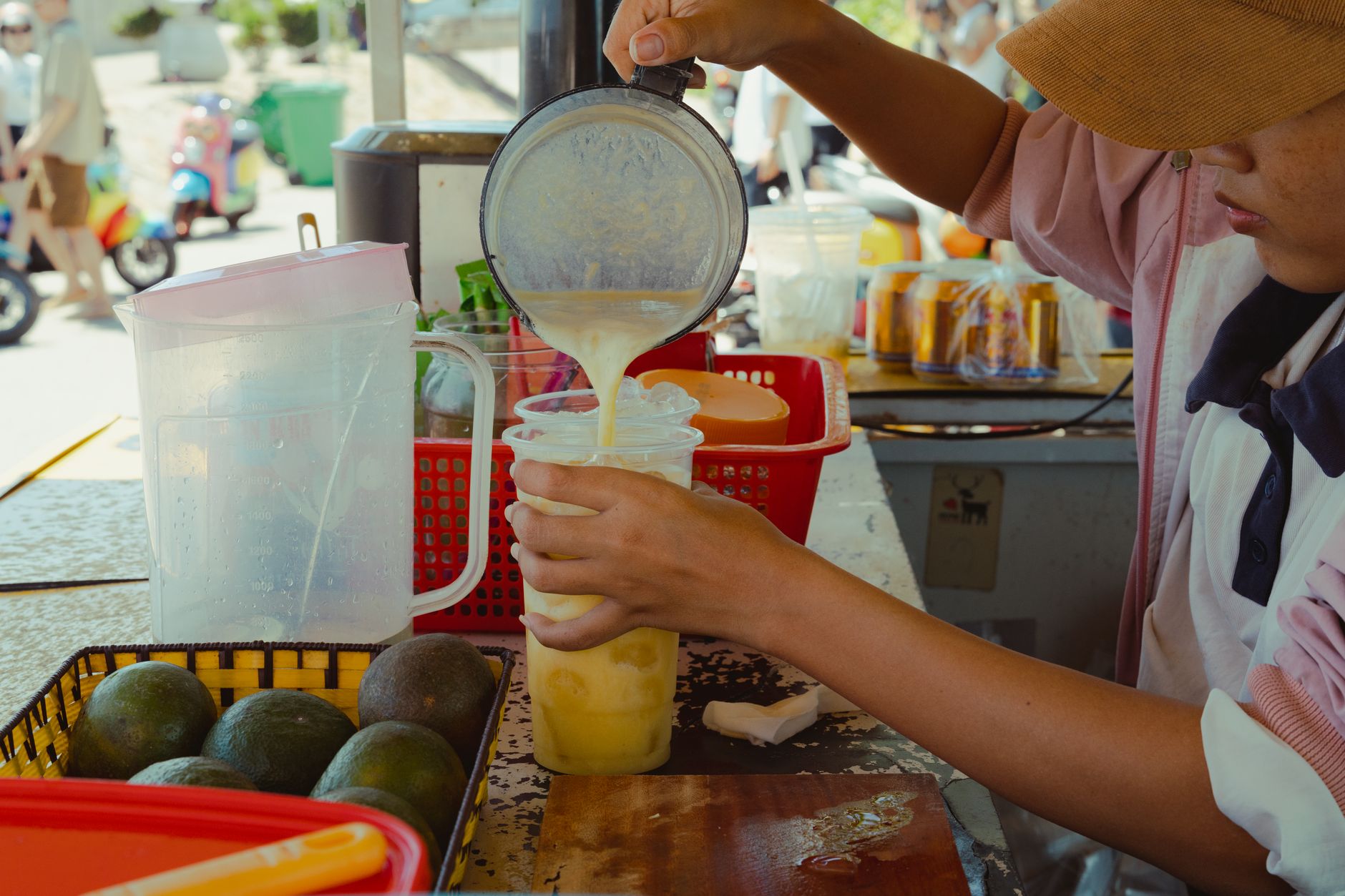
Fresh soy milk costs around 5,000–10,000 VND a glass and shows up on nearly every Vietnamese street corner by 7 a.m. It is easy to walk past without a second thought, but "sua dau nanh" deserves a closer look.
What It Is
"Sua dau nanh" literally breaks down as sua (milk) + dau nanh (soybean). The drink is made by soaking dried soybeans overnight, blending them with water, then straining and simmering the liquid until it thickens slightly and smells faintly nutty. The result is not the shelf-stable carton stuff sold in supermarkets abroad. It is thinner, fresher, and closer to the soy milk you'd find at a traditional Taiwanese or Chinese breakfast stall — which makes sense, given how much northern Vietnamese street food culture shares with southern Chinese food traditions.
Most vendors sweeten it with white sugar or a light syrup, though the amount varies wildly. If you want it less sweet, say it duong (less sugar). If you want it unsweetened entirely, say khong duong. Vendors will not be offended. They've heard it before.
Hot or Iced
This is the first decision you make at the cart. "Nong" means hot; "da" means iced.
Hot sua dau nanh is the more traditional order, especially in the north. In Hanoi on a cold December morning, a warm paper cup of soy milk alongside a "banh mi" or a bowl of "banh cuon" is a genuinely satisfying breakfast — not romantic travel-writing satisfying, just practically good. The warmth, the mild sweetness, the protein.
Iced sua dau nanh (sua dau nanh da) dominates in the south, where Saigon's heat makes a cold drink a sensible default from about March through November. The iced version is poured over crushed ice and is slightly more diluted as the ice melts, which many people prefer. It is refreshing in a way that the thick sweetness of, say, "ca phe sua da" is not.
Both versions are worth trying. They taste different enough that ordering the other one is not redundant.
The Variants: Peanut and Black Bean
Once you're paying attention, you'll notice the cart often has more than one pot.
Sua dau phong (peanut milk) is made the same way as soy milk but with soaked peanuts. It is richer, slightly oilier, and noticeably more filling. The color is a pale cream rather than the near-white of soy milk. It pairs well with a plain fried dough stick ("quay"), which you tear and dip into it — a breakfast combination that is especially common in Hanoi (하노이 / 河内 / ハノイ)'s Old Quarter and around Dong Xuan Market.
Sua dau den (black soybean milk) uses black soybeans instead of yellow, giving the drink a deep grayish-purple color and a more earthy, slightly less sweet flavor. It has a faint nuttiness that the standard version lacks. Black bean milk has a reputation in Vietnamese folk belief as being good for the kidneys and hair — whether that holds up to scrutiny is a separate conversation, but it means you'll find it at health-food stalls and traditional markets as much as at street carts.
Some vendors rotate all three, labeling them on a hand-painted board or just pointing to the relevant pot when you approach.
Photo by 🇻🇳🇻🇳Nguyễn Tiến Thịnh 🇻🇳🇻🇳 on Pexels
The Sidewalk-Cart Experience
The classic sua dau nanh setup is a converted bicycle or motorbike cart with two or three aluminum pots kept warm over a gas burner. You find these carts near wet markets, school gates, office buildings, and bus stops — anywhere people need a quick, cheap breakfast option before 9 a.m. Most carts are packed up by mid-morning.
In Saigon (사이공 / 西贡 / サイゴン), you'll also find permanent stalls in places like Ben Thanh Market's surrounding streets and in residential neighborhoods across Districts 3, 5, and 10. In Hanoi, the morning carts cluster around Hoan Kiem Lake's northern side and along the alley networks off Hang Gai and Bat Dan streets.
You will not need to say much. Hold up one finger or two, point to the pot you want, gesture at the ice bucket or wave it off. The vendor handles the rest. The drink comes in a small plastic bag with a straw, a paper cup, or occasionally a proper glass if the stall has seating.
What It Costs
Expect to pay 5,000–8,000 VND from a street cart. Sit-down cafes that serve sua dau nanh as part of a broader Vietnamese breakfast menu charge closer to 15,000–25,000 VND. Health food shops and organic cafes in Hanoi and Saigon sometimes push it to 35,000–45,000 VND, usually with a "no preservatives" pitch. The cart version is fresher.

Photo by Dương Nhân on Pexels
How It Fits Into Vietnamese Breakfast Culture
Sua dau nanh does not compete with vietnamese coffee for attention. It is not as culturally loaded, not as talked about in food writing, not going to show up in a food documentary. But it fills a different role: it is the drink for people who want something warm and slightly sweet without the caffeine, or who need something their stomach can handle early in the morning, or who are spending 7,000 VND and need it to count.
In that sense, it is a very honest drink. It does not try to be more than it is.
Bottom Line
Sua dau nanh is worth ordering at least once from an actual street cart, not a packaged version from a convenience store. The hot peanut milk variant with a fried dough stick is the most filling combination for the money. Iced black bean milk is the most interesting flavor if you want to go further than the standard.
Last updated · May 29, 2026 · independently researched, never sponsored.