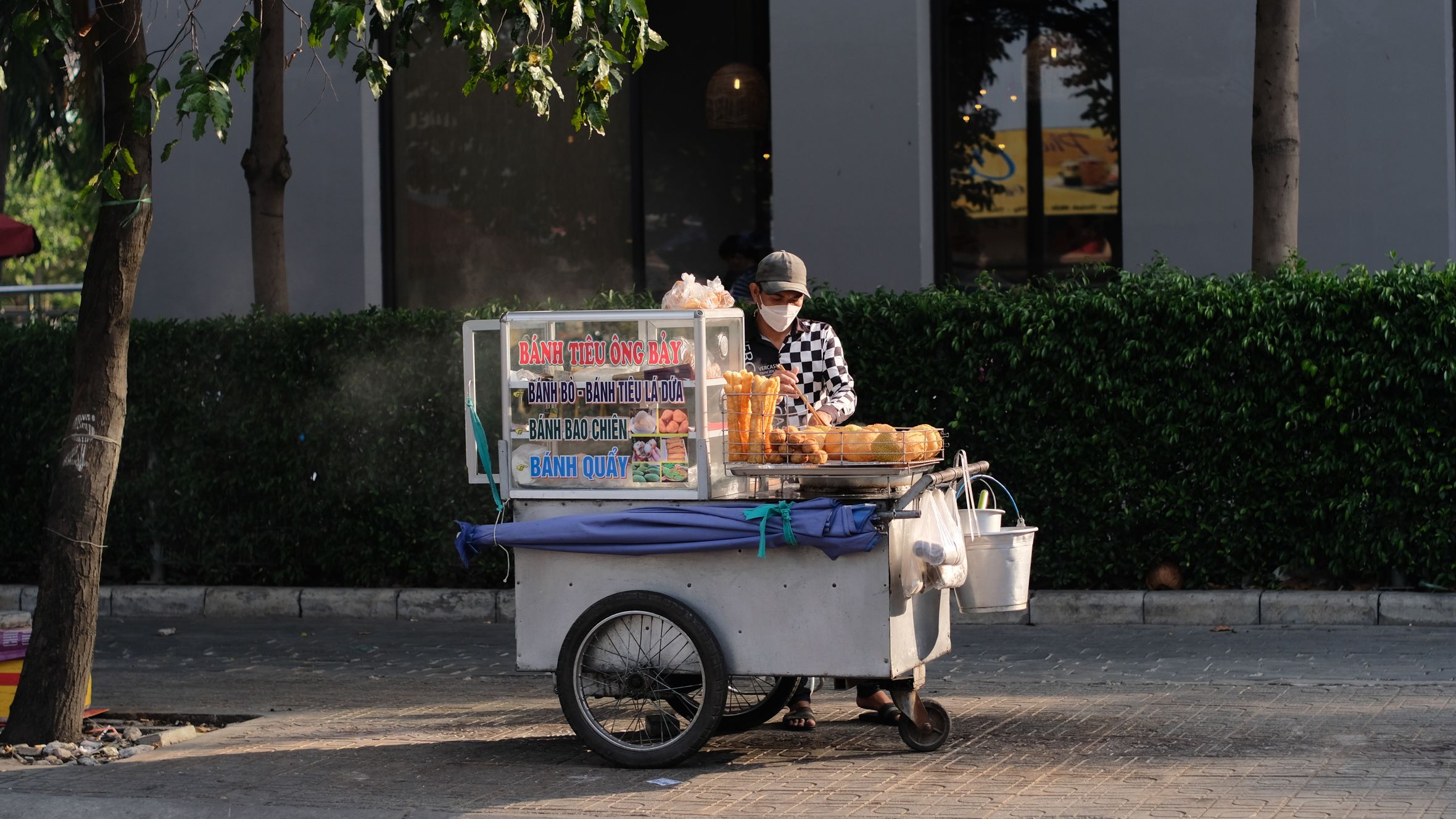
You'll smell the steam carts before you see them — that faint, wheaty warmth drifting off a metal cabinet on wheels, usually parked outside a school gate or bus station sometime between 6 and 9 a.m. "Banh bao" is Vietnam (베트남 / 越南 / ベトナム)'s take on the steamed bun, and while its bones are unmistakably Chinese, what's inside is something the Vietnamese have made entirely their own.
Where It Came From
Banh bao is a direct descendant of the Cantonese "baozi" and Shanghainese "mantou" tradition, brought south by Teochew and Cantonese migrants who settled in the Mekong Delta (메콩 델타 / 湄公河三角洲 / メコンデルタ) and Saigon from the 18th century onward. The name is literal: "banh" means cake or bread, "bao" means wrapped or enclosed. Early versions in Vietnam were plainer — simple pork or bean paste inside a leavened wheat dough — and served in the Chinese-Vietnamese (Hoa) community's teahouses.
Over the following century the filling evolved considerably. Vietnamese cooks added hard-boiled quail eggs, Vietnamese pork sausage ("gio lua"), and glass noodles, producing something richer and more structurally complex than a standard Cantonese bao. By the mid-20th century, banh bao was firmly street food, not teahouse food, and the southern version — denser, slightly sweeter dough, generous filling — had become the national standard.
The Anatomy of a Classic Banh Bao
A well-made banh bao should be roughly the size of a large orange. The dough is leavened with both yeast and baking powder, giving it a tight, pillowy crumb that's white rather than translucent. The exterior should have a small pinched crown at the top — a practical feature that lets you identify how full it is before you buy.
The canonical southern-style filling contains:
- Minced pork seasoned with fish sauce, sugar, and white pepper
- Half a hard-boiled quail egg (one per bun, centered)
- Gio lua (Vietnamese pork roll), sliced into small coins
- Dried wood-ear mushrooms and glass noodles for texture
- Occasionally a small amount of carrot or onion
The ratio of dough to filling is important. A good banh bao has enough filling that you hit pork and egg within the first two bites. A bad one is mostly dough with a smear of pork in the center.

Photo by Trần Phan Phạm Lê on Pexels
Regional Variants
Banh Bao Chieu (Northern Style)
In Hanoi and the surrounding north, banh bao tends to be smaller — closer to the size of a tennis ball — and the dough is less sweet. Fillings lean simpler: minced pork and mushroom, sometimes without the quail egg. You'll find them at "banh mi" carts alongside fried dough sticks in the early morning.
Banh Bao Nhan Dau Xanh (Sweet Mung Bean)
This dessert variant uses a sweetened mung bean paste filling — similar to the Cantonese lotus paste bao but grassier and less fatty. It's common in bakeries ("tiem banh") rather than street carts. If the bun is sold at a pastry counter rather than a steam cabinet, it's probably this version.
Banh Bao Xiu Mai
"Xiu mai" (from the Cantonese "siu mai") refers to open-topped pork meatballs served alongside or inside a smaller bao in the south. In Saigon's Cho Lon district — the historic Chinese quarter — you'll find dedicated xiu mai shops serving the meatballs in a light tomato broth with a small banh bao on the side for dipping. It's a breakfast combination worth going out of your way for.
Banh Bao Chay (Vegetarian)
Found mainly near pagodas and Buddhist markets on the 1st and 15th of the lunar month. The filling is typically tofu, taro, shiitake mushroom, and glass noodles. Dough composition is the same; quality varies widely depending on the vendor.
How to Order (and What to Watch For)
Street-cart banh bao is transactional. There's no menu. You point, you pay, you get a bun in a small plastic bag. Prices run 10,000–20,000 VND per bun depending on size and city; anything above 25,000 VND at a street cart suggests you're near a tourist area.
A few things to check before you buy:
- Steam cabinet should be actively steaming. Buns that have been sitting off-heat go gummy and the dough compresses.
- Look for the pinched top. A bun that's split or cracked during steaming was probably over-proofed or rushed.
- Weight in hand. A full bun feels heavy relative to its size. If it feels light, it's mostly dough.
Banh bao doesn't pair especially well with dipping sauce — the filling is already seasoned — but some southern vendors offer a small side of Maggi soy sauce or chili sauce. You don't need it.

Photo by Nguyen Truong Khang on Pexels
Where to Try the Canonical Version
Banh Bao Co Ba Cang — Saigon (District 5, Cho Lon) The most cited address among locals for old-school Cho Lon-style banh bao. The buns are large, the filling ratio is honest, and the xiu mai served alongside in tomato broth is the reason to come. Located on Trieu Quang Phuc street, open from around 6 a.m. until sell-out.
Banh Bao Dinh — Da Lat Da Lat's cooler climate makes steam food hit differently, and this small family operation near Xuan Huong Lake has been running the same recipe for decades. The dough is slightly thicker than the Saigon version — almost bread-like — and the filling is restrained. 12,000 VND per bun as of late 2024.
Banh Bao Hang Buom — Hanoi (Old Quarter) A northern banh bao done right: smaller, less sweet, served from a cart on Hang Buom street that sets up around 7 a.m. This is the version closest to the original Hoa teahouse bao, and the simplicity of the filling makes the pork quality obvious. Pair it with a cup of "ca phe sua da" from one of the sidewalk plastic-stool cafes nearby.
Practical Notes
Banh bao is a morning food. Most good street-cart vendors sell out by 9 or 10 a.m., and reheated buns from later in the day are noticeably worse. If you're in Saigon, District 5 is the best hunting ground for the southern-style version; if you're in Hanoi, the Old Quarter carts are the most accessible. Budget 15,000–20,000 VND per bun and eat it fresh, standing up.
Last updated · May 29, 2026 · independently researched, never sponsored.




