Vietnam (베트남 / 越南 / ベトナム)'s dessert landscape is dominated by one word: "che". It is not a single dish but a sprawling category — sweet soups, puddings, and porridges that span dozens of regional variants, ingredients ranging from mung beans to durian, and textures from silky-thin broths to dense, chewy jellies. If you have stood in front of a che cart and had no idea where to start, this guide is for you.
What Che Actually Is
At its core, che is any sweet preparation served warm or cold in a bowl or cup, built around a liquid base — usually coconut milk, sugar syrup, or both — and loaded with ingredients. Those ingredients might be legumes (mung bean, black-eyed pea, kidney bean), starchy roots (taro, cassava, sweet potato), glutinous rice, fruit, or jellies. Some versions are thin and drinkable. Others are thick enough to eat with a spoon and require assembly at the counter.
The word itself offers no further clue — "che" simply means this class of food, the way "soup" covers everything from a thin consommé to a thick chowder. Context and the modifier that follows tell you everything.
The Regional Divide
North, central, and south Vietnam each have a distinct relationship with che, and understanding that split helps you set expectations when you travel.
Hanoi and the North
Northern che tends to be simpler, less sweet, and often warm. The emphasis is on a single clean ingredient rather than layered complexity. "Che hat sen" — lotus seed sweet soup — is the defining northern version: whole lotus seeds simmered in a light rock-sugar syrup, sometimes with long nhan (longan) fruit added. It is subtle and not cloying, the kind of thing you eat slowly on a cold January evening in Hanoi's Old Quarter.
"Che kho" is another northern staple: a dense, slow-cooked mung bean paste that gets pressed into blocks and sliced — closer to a confection than a soup. You will find it sold by weight at Dong Xuan Market in Hanoi, particularly around Tet.
"Che troi nuoc" (glutinous rice balls filled with mung bean paste, served in ginger syrup) is popular across the north and eaten specifically at the Tet Doan Ngo festival in early summer, though street vendors sell it year-round.
Hue and the Central Region
Hue is arguably Vietnam's most obsessive che city. The former imperial capital developed an elaborate court cuisine, and che was part of it — local cooks count more than 20 distinct varieties. Most are served in small portions, meaning you are expected to order several and share.
Hue (후에 / 顺化 / フエ)-style che tends to be fragrant with pandan leaf and jasmine, less coconut-forward than the south, and often uses lotus seeds, longan, and agar jelly in delicate combinations. "Che bot loc" — a translucent tapioca-wrapped mung bean dumpling in a clear sweet broth — is a Hue signature that looks almost architectural when made well. A bowl of six or eight pieces runs about 20,000–30,000 VND at a Dong Ba Market stall.
Saigon and the South
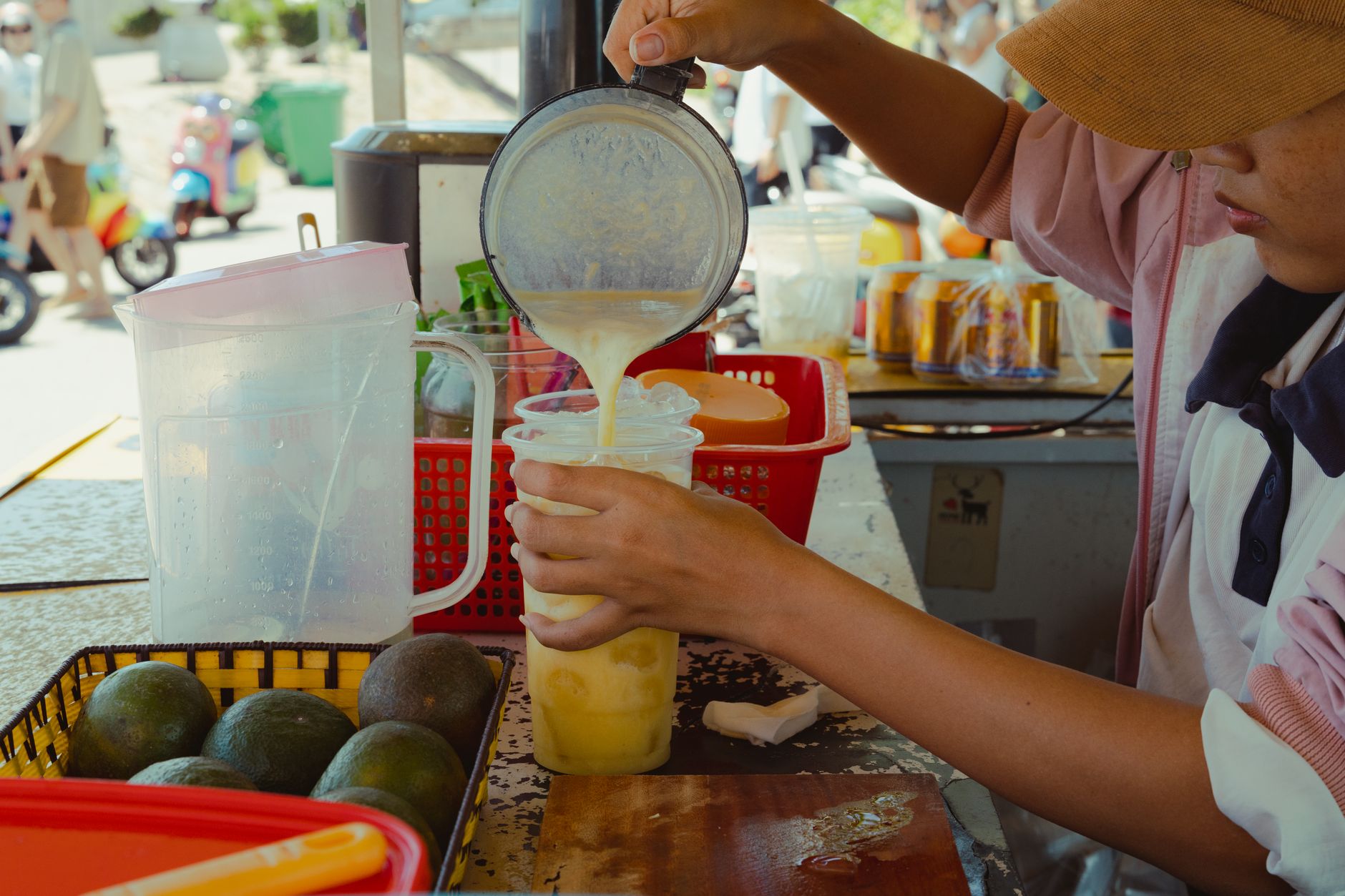
The south is where che gets theatrical. Southern versions are cold, abundant, topped with crushed ice, and built for layering and contrast. Vendors here operate with a repertoire of 10 to 20 components and assemble your cup to order.
"Che ba mau" — three-color dessert — is the south's icon. The three layers are typically: green pandan jelly or mung bean, yellow split mung bean paste, and red kidney beans or jelly, finished with coconut cream and shaved ice. In practice, many vendors use five or six colors. The name stuck from an earlier, stricter version.
"Che Thai" is the southern variant most influenced by neighboring Southeast Asian traditions: chunks of jackfruit, toddy palm seeds, water chestnuts, and grass jelly in coconut milk and syrup — a pick-and-mix approach where the vendor scoops from a row of containers into your cup. It is closer to what Thailand calls "tub tim krob" in spirit, though the Vietnamese version has its own distinct ingredient set.
"Che chuoi" — banana sweet soup — is one of the south's everyday staples: ripe plantain (not the eating banana variety — look for chuoi su or chuoi xiem) cooked in coconut milk thickened with tapioca, finished with a drizzle of coconut cream and toasted sesame. Simple, cheap (15,000–20,000 VND per bowl), and deeply satisfying.

Photo by Nguyễn Thị Thảo Hà (Ha Nguyen) on Pexels
How to Order at a Che Cart
At a multi-variety southern cart, point-and-mix ordering is standard. The vendor will show you the available components and scoop as you indicate. At a specialty single-dish stall (che hat sen, che ba mau), you just order by name and specify "nong" (hot) or "lanh/da" (cold/with ice).
Sizing is usually fixed — you get a cup or a bowl at a set price. Portion sizes are small by design; the expectation in Hue especially is that you eat two or three types in one sitting.
If you have a sensitivity to coconut milk or very sweet food, say "it duong" (less sugar) — vendors at tourist-adjacent stalls in Hoi An and Saigon will usually oblige.
Photo by Nguyễn Thị Thảo Hà (Ha Nguyen) on Pexels
Where to Try the Canonical Versions
Che Hue — Quan Che Hem, Hue. A narrow laneway off Hung Vuong street packed with low plastic stools and a rotating menu of 15-plus varieties. No English menu, but pointing works fine. Expect to pay 20,000–35,000 VND per bowl. Open from around 14:00 until sold out.
Che Ba Mau — Ben Thanh area, Saigon. The stretch of Thi Sach and the streets around Ben Thanh Market has several long-running che ba mau vendors. Look for the carts with rows of labeled containers around 15:00–20:00. One cup assembled to order: 25,000–35,000 VND.
Che Hat Sen — Hang Than street, Hanoi. This short street in Ba Dinh district is Hanoi's unofficial che strip. Multiple small shops serve warm lotus seed soup year-round, with the full northern roster available. A bowl costs 20,000–30,000 VND and pairs reasonably well with the egg coffee culture of the surrounding neighborhood.
Practical Notes
Che is almost always a street or market food — dedicated sit-down restaurants are rare. The best versions are usually neighborhood staples that open for a few hours in the afternoon and early evening. If a stall is empty at 18:00, it has either sold out or is not worth the wait — check for queue history rather than current crowd. Most che contains glutinous rice, tapioca, or both; those avoiding gluten should ask specifically, as substitution is not common.
Last updated · May 29, 2026 · independently researched, never sponsored.