Hue has no shortage of snacks worth hunting down, but "banh ep" — tapioca discs pressed hard on a sizzling iron plate with egg, dried shredded beef, and a fistful of fresh herbs — is one of the few that genuinely rewards the effort of finding it. It takes about ninety seconds to make and costs less than a cup of coffee. Eat it standing up, hot enough to burn your fingers slightly, wrapped loosely in the herbs the vendor hands you.
What Banh Ep Actually Is
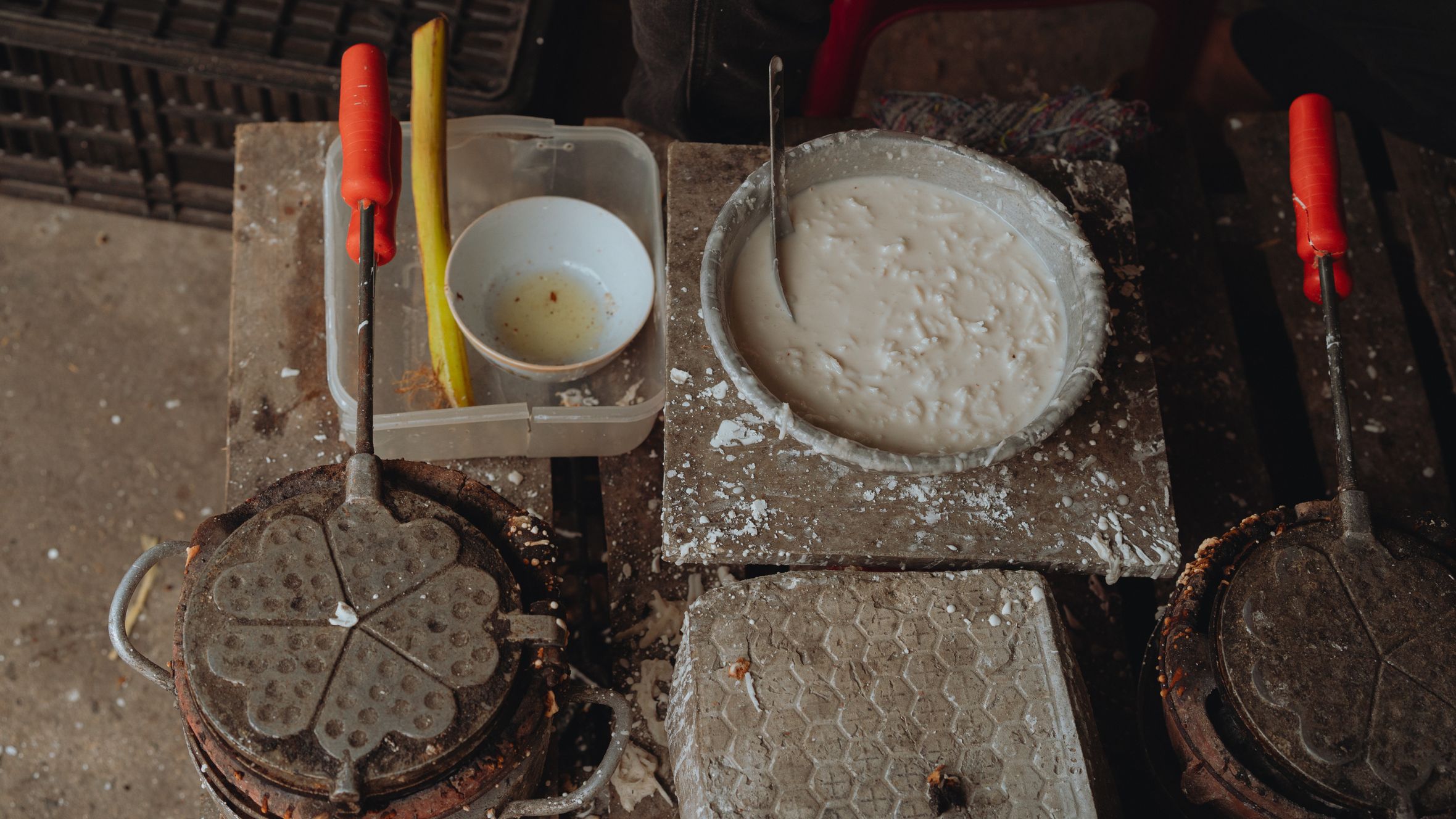
The disc starts as a thin round of dried tapioca — pale, stiff, almost tasteless on its own. The vendor lays it on a cast-iron press, cracks a quail or chicken egg over it, adds a pinch of dried "bo kho" (spiced shredded beef), and clamps the iron shut. Twenty seconds of pressure and heat fuses everything into a single crisp-edged, custardy-centered round. You get it with fresh mint, perilla, and sometimes a tiny dish of tương ot (chili sauce) thinned with a little vinegar. The flavor is restrained — eggy, faintly smoky, herby. It's a snack, not a meal, and its whole appeal is that it costs 5,000–10,000 VND per piece and tastes like it was made specifically for you.
Hue claims it as its own, and the city wears that ownership seriously. You won't find banh ep of this quality anywhere else in central Vietnam (베트남 / 越南 / ベトナム).
The Alley Shortlist
Hem 8, Nguyen Binh Khiem — The Benchmark
This is the one locals send you to first. A woman in her sixties runs a cart outside a narrow shophouse at the mouth of alley 8 off Nguyen Binh Khiem, operating roughly 3:00 PM to 7:30 PM daily, weather permitting. She uses quail eggs only, the iron is seasoned to a dark gloss, and she presses each disc twice — once to seal the egg, once to crisp the edges. You want the edges crispy. Price: 5,000 VND per piece. Order at least three.
Chi Thanh, Nguyen Cong Tru Street
This cart appears around 2:30 PM on the stretch of Nguyen Cong Tru closest to the intersection with Hung Vuong, on the shaded side of the street. It's run by two sisters who alternate days. The dried beef here is noticeably more generous — almost a small mound rather than a pinch — and they offer a choice of chili sauce levels. It closes when the tapioca discs run out, which on busy afternoons can be as early as 5:00 PM. Price: 6,000 VND per piece. Bring exact change; neither sister keeps a float.
Behind Dong Ba Market — The After-School Crowd
If you walk the narrow lanes directly behind Dong Ba Market toward the river embankment, you'll find two competing banh ep carts set up from around 3:30 PM. This is genuinely the after-school spot — students from the nearby secondary schools descend here and order in rounds of five and six. The carts are informal, sometimes sharing the same iron press in shifts. Quality varies slightly day to day, but prices stay at 5,000 VND and the energy is worth the trip alone. Go on a weekday for the full scene.
Nguyen Truong To Street, Near the Church End
At the quieter southern end of Nguyen Truong To, a vendor parks a motorbike-mounted setup near the low wall of a Catholic church most afternoons from 4:00 PM onward. This one is harder to time — she sometimes doesn't show on rainy days or public holidays — but the tapioca discs here are slightly thicker than average, giving the center more chew. She adds a thin smear of Maggi seasoning before pressing, which sounds wrong but isn't. Price: 7,000 VND per piece, and she wraps each one in a small square of newspaper in the old style.

Photo by Theodore Nguyen on Pexels
A Few Honest Notes on the Hunt
Banh ep vendors keep short windows for a reason: the tapioca discs soften and stick if the air is too humid, and a good press needs a hot iron, which means charcoal or a strong gas flame. Rain cancels most of them outright. The best strategy is to arrive in the 3:30–5:30 PM window, stay mobile, and accept that one or two spots on this list might simply not be there on the day you show up.
The snack pairs well with Hue (후에 / 顺化 / フエ)'s other afternoon rituals — a glass of "ca phe sua da" at a sidewalk table, or a short loop through the streets near the Imperial Citadel before the light drops. It's not a restaurant experience. That's the point.

Photo by Tuan Vy on Pexels
Practical Notes
All spots listed here are cash only, 5,000–10,000 VND per piece. Plan your visit for the 3:00–6:00 PM window on a dry weekday — weekends bring more foot traffic but thinner vendor consistency. If you're spending more time eating your way through Hue, the city's repertoire goes well beyond banh ep: "bun bo hue" in the morning and "banh canh" at lunch will fill out the rest of the day without any overlap.
Last updated · Aug 27, 2026 · independently researched, never sponsored.