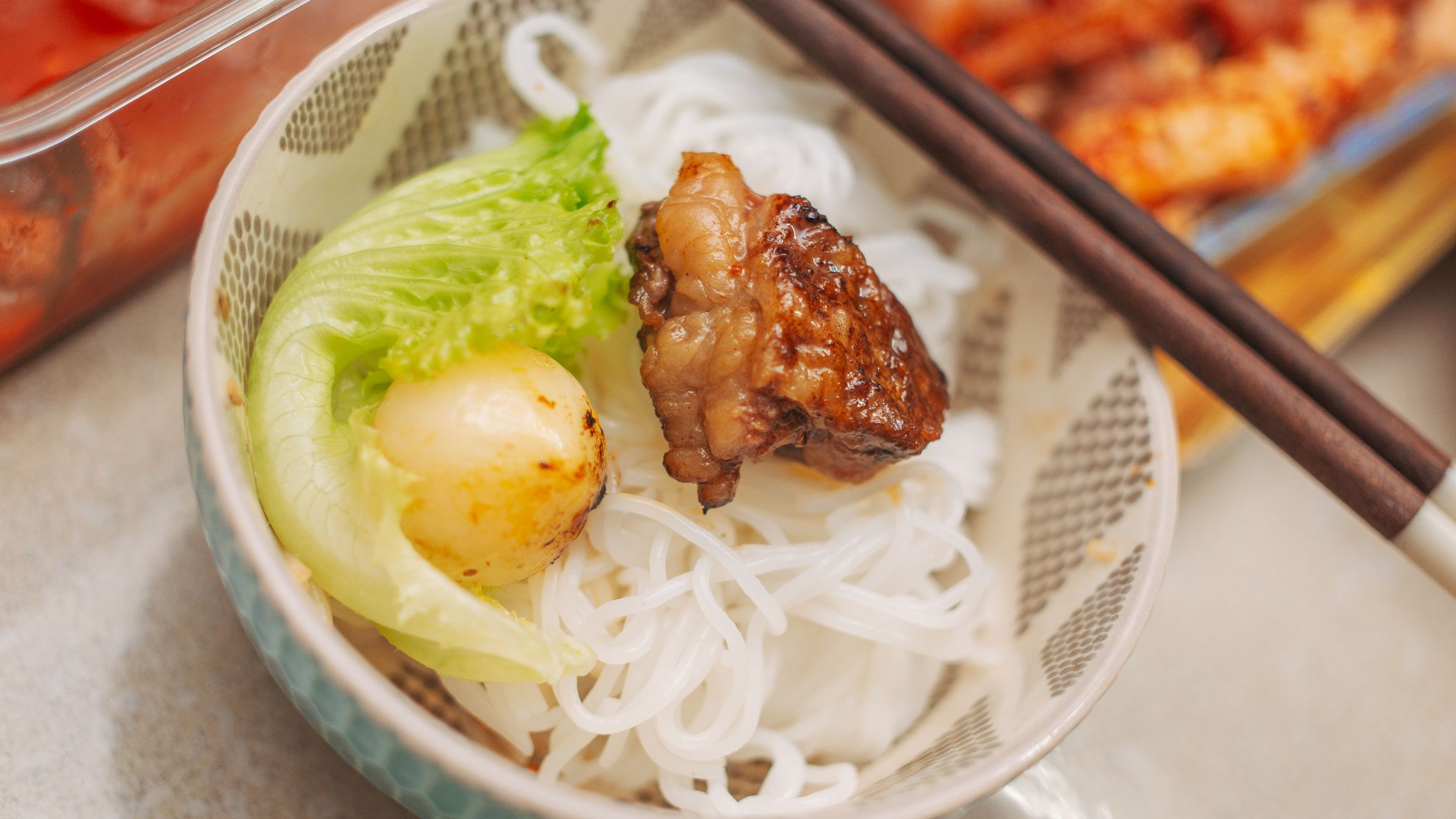
Few Vietnamese noodle dishes reward close attention the way "banh hoi" does. The noodles are pressed so thin that a single mat feels almost weightless, yet the texture, the slight chew, the way it absorbs scallion oil and fish sauce — that's where the craft lives.
What Banh Hoi Actually Is
Banh hoi is a dish of ultra-fine rice vermicelli, steamed and woven into flat rectangular or square mats, typically around 15–20 cm across. The weaving is done by hand or with a mold, creating a grid pattern that gives the surface its signature crosshatch. The mats hold together just enough to be folded or torn by chopsticks without falling apart.
The name breaks down simply: "banh" means cake or dough product, "hoi" is an older term referencing the fine, almost invisible strands. Locals in Binh Dinh sometimes call it banh hoi nuoc leo when it comes with a specific braised pork broth for dipping.
The dish is not the same as "bun" — bun noodles are round, extruded, and cooked in boiling water. Banh hoi is steamed in mats and stays flat. If you've confused them on a menu before, you're not alone.
History and Regional Roots
Banh hoi is most deeply rooted in the south-central provinces — Binh Dinh, Khanh Hoa, Ba Ria-Vung Tau — and the broader southern region. It likely developed as a festival food, something labor-intensive enough that it was reserved for Tet or village feast days when extended families gathered. Making the mats by hand requires patience: the batter has to be just thin enough to produce noodles the diameter of a hair, and the steaming time is short, maybe 3–4 minutes per tray.
Over time it became a morning staple in these provinces, sold from carts and small shops from around 6 a.m. until the mats ran out — often by 9 or 10. If you're arriving in Vung Tau (붕따우 / 头顿 / ブンタウ) or Qui Nhon and asking for banh hoi at lunchtime, you may already be too late.
In the south, particularly Saigon, banh hoi migrated into the city via southern migrants and now appears across Districts 1, 3, and Binh Thanh as both a breakfast item and a late-night grilled-meat accompaniment.

Photo by RDNE Stock project on Pexels
The Anatomy of a Banh Hoi Meal
A standard banh hoi order comes with several components. Understanding each one helps you order correctly and eat it the way locals do.
The Mats
You'll get a stack of 6–10 mats, usually pre-topped with dried shrimp and a drizzle of scallion oil — "mo hanh" — which is rendered pork fat or vegetable oil cooked down with sliced scallions until just wilted. This topping is non-negotiable. Without it, banh hoi is dry and bland. With it, the fat and allium carry the whole plate.
The Protein
This is where regional identity really shows. In Binh Dinh, the classic pairing is "heo quay" (crispy roast pork) or "nem nuong" — grilled pork paste on skewers, charred at the edges. In Ba Ria-Vung Tau, you'll often see it served with "bo nuong" (grilled beef) or a combination platter. In Saigon (사이공 / 西贡 / サイゴン)'s street stalls, "cha gio" — fried spring rolls — sometimes appear alongside, turning the meal into a more substantial spread.
The Dipping Sauce
The sauce varies by province. In Binh Dinh, it's often nuoc leo — a thick braised sauce made from peanuts, pork liver, and fermented soybean paste, closer to a hoisin-peanut hybrid than a standard fish sauce dip. Further south, a lighter nuoc cham (fish sauce, lime, chili, sugar) is more common. Some shops offer both. When in doubt, ask what the locals around you are using.
The Herbs
A plate of fresh herbs is standard: lettuce leaves, mint, perilla, bean sprouts, and sometimes sliced cucumber. The idea is to wrap a mat around some herb, add a piece of grilled meat, dip, eat in one or two bites. It's not a fork-and-knife dish.
How to Order Like a Local
Walk into a banh hoi shop and you'll typically see a handwritten board or just the components laid out in trays. Here's a rough script:
- "Cho toi mot phan banh hoi" — one portion of banh hoi (around 40,000–70,000 VND depending on province and protein)
- Specify your protein: "kem nem nuong" (with grilled pork paste), "kem heo quay" (with roast pork), "kem bo nuong" (with grilled beef)
- If you want extra scallion oil: "them mo hanh" — most shops will add it without charge
- If you want extra sauce on the side: "nuoc cham rieng"
Don't wait to be told how to assemble it. Watch the table next to you for 30 seconds. The approach is intuitive once you see it in action.
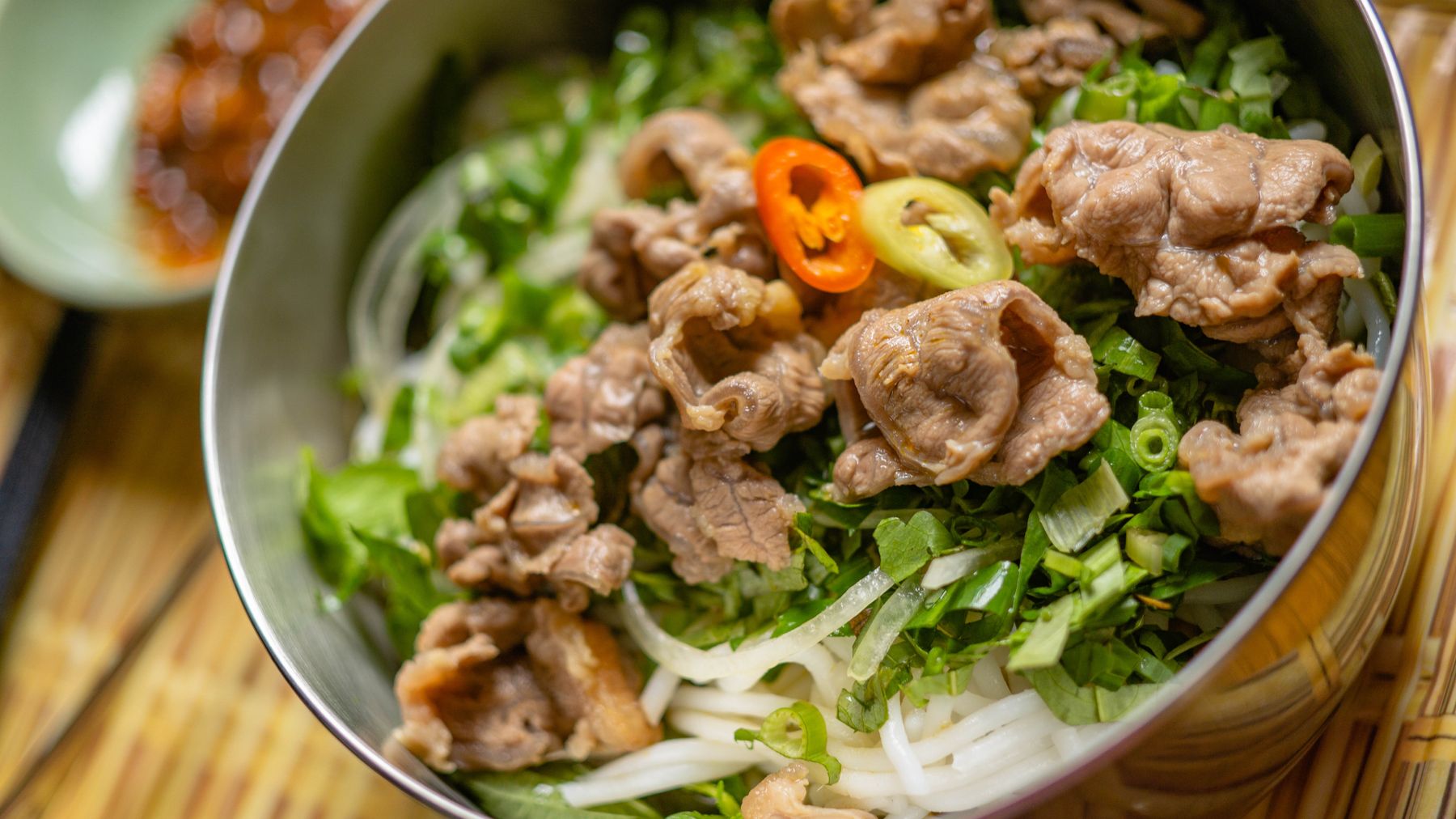
Photo by FOX ^.ᆽ.^= ∫ on Pexels
Where to Try the Canonical Version
Banh Hoi Ba Tuyen — Qui Nhon, Binh Dinh A long-standing spot on Tran Hung Dao street in Qui Nhon, open from 5:30 a.m. and usually sold out by 9. The nuoc leo here is deeper and richer than most — peanut-heavy with a slight fermented edge. Around 45,000 VND per portion with nem nuong.
Banh Hoi Long Hai — Ba Ria-Vung Tau Long Hai beach town, about 30 km from Vung Tau proper, has a cluster of banh hoi shops along the main beachfront road. The version here comes with grilled squid and pork as a combination — a Vung Tau habit — and the mat quality is notably fine. Prices run 55,000–80,000 VND depending on protein.
Quan Banh Hoi Nuong — Binh Thanh, Saigon For those visiting Saigon, the Binh Thanh district has a handful of reliable shops serving banh hoi as an evening grilled-meat meal rather than a morning dish. The adaptation to Saigon hours means you can actually find it at 7 p.m. Look for spots near Nguyen Xien street; expect 60,000–90,000 VND for a full spread.
Practical Notes
Banh hoi is predominantly a morning dish in its home provinces — arrive after 10 a.m. and many stalls will be gone. In Saigon, the evening versions around grilled-meat restaurants give you more flexibility. The dish is naturally gluten-free (rice-based), but always confirm the dipping sauce, as some nuoc leo versions contain wheat-based soy products.
Last updated · Aug 9, 2026 · independently researched, never sponsored.




