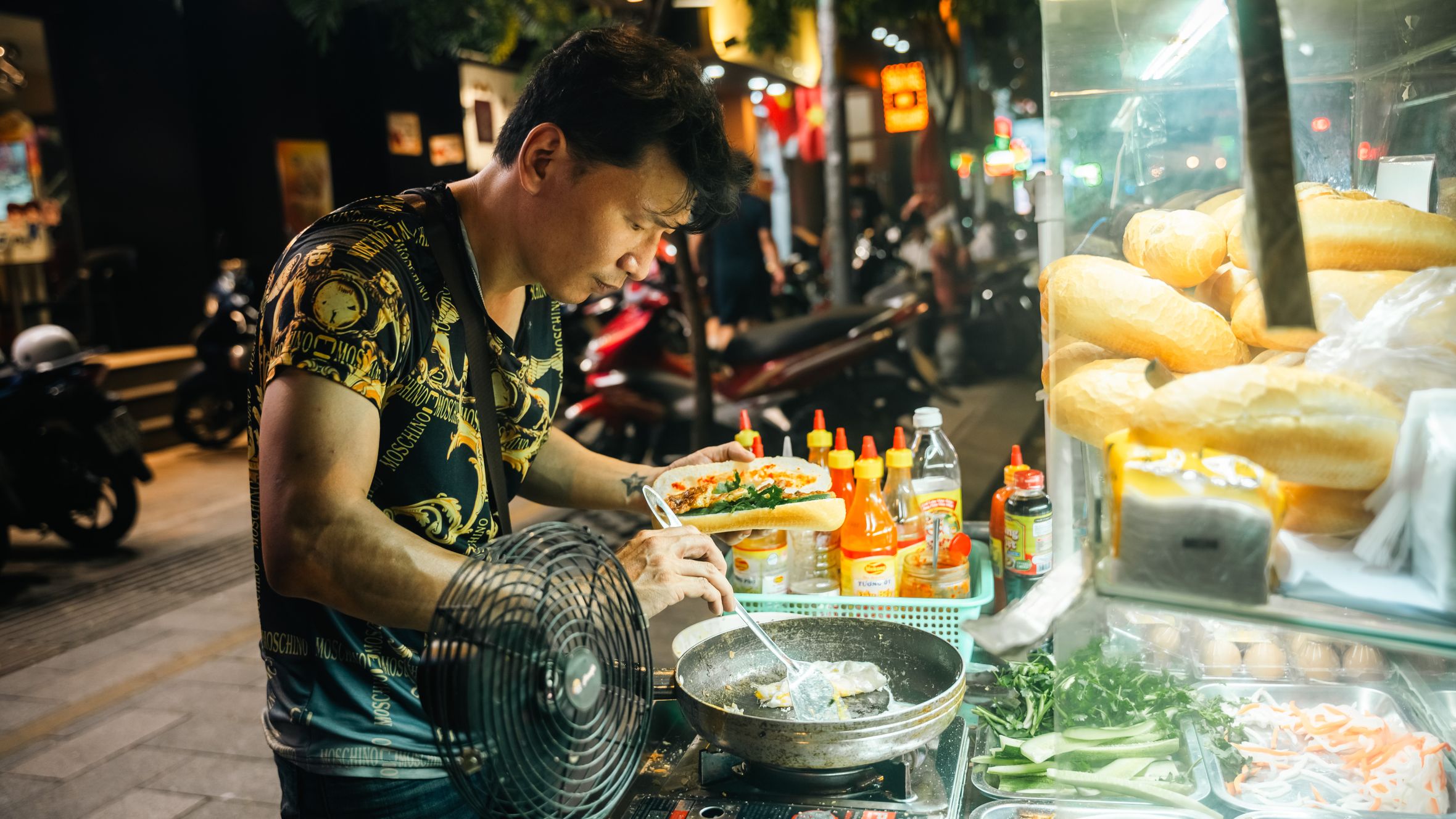
Few sandwiches have a biography as interesting as "banh mi". It started as a colonial import, got thoroughly Vietnamese-ified over about a century, and is now sold from carts and shopfronts across every province in the country — each region quietly insisting its version is the correct one.
Where the Baguette Came From
The French brought wheat bread to Vietnam in the nineteenth century, originally baked for the colonial administration. The Vietnamese adapted the baguette almost immediately, swapping some of the wheat flour for rice flour. The result is structurally similar — same oblong shape, same crisp crust — but lighter and airier inside, with a thinner shell that shatters properly when you bite it. A good banh mi (반미 / 越式法包 / バインミー) loaf should crackle. If it does not, someone cut corners on the rice flour ratio or the oven temperature.
By the mid-twentieth century, street vendors in Saigon were stuffing these loaves with pork, pickled vegetables, and chili. The sandwich format travelled north and adapted to local tastes along the way. Today there is no single canonical banh mi — there are at least four or five distinct regional schools, each with genuine differences in bread, filling, and sauce.
What Goes Inside: The Core Ingredients
Pate
"Cha lua" (Vietnamese pork roll) and "cha" (a catch-all for various pork preparations) are the proteins most people associate with banh mi, but pate is arguably the most important element for flavor. Vietnamese banh mi pate is smoother than French-style liver pate — blended finer, slightly saltier, and spread thick enough that you can taste it in every bite. It acts as a fat base that holds the sandwich together. Skip a vendor who skimps on it.
Dua Chua
"Dua chua" — pickled daikon and carrot — is the structural counterpoint to the richness of pork and pate. It is quick-pickled in rice vinegar and sugar, not fermented, so it stays crunchy. The acidity cuts through the fat. Without it, banh mi becomes heavy. Good dua chua is pale, slightly translucent, and has a clean sourness rather than a vinegary bite.
The Sauce Layer
Most Saigon (사이공 / 西贡 / サイゴン)-style banh mi gets a swipe of mayonnaise (introduced via French influence and now fully adopted), a drizzle of Maggi seasoning sauce, and fresh chili slices or chili paste. Hanoi versions often skip the mayo entirely and lean harder on the pate. Hoi An has its own thing going on — more on that below.

Photo by Pragyan Bezbaruah on Pexels
Regional Variants
Saigon-Style
The Saigon version is the template most people picture: a short, fat loaf, generous pate, cha lua, dua chua, cucumber strips, cilantro, and fresh chili. It is assembled fast, wrapped in paper, and handed to you within thirty seconds. Vendors in Saigon often offer five or six protein options — grilled pork, shredded chicken, sardines in tomato sauce, scrambled egg. Prices run from around 15,000 VND for a basic version to 35,000 VND for a loaded one.
Hoi An-Style
Hoi An's banh mi is different enough that locals insist on treating it as its own category. The bread loaf is slightly shorter and squatter. The filling typically includes a house-made meat sauce that is braised low and slow until it thickens into something close to a ragu, plus steamed pork, cha, pate, cucumber, and a fried egg on request. It is wetter and richer than the Saigon version — messier to eat, harder to forget. The most famous vendor, Banh Mi Phuong on Phan Chau Trinh street, has been there since 1974 and still draws a line by 8 a.m.
Da Nang-Style
Da Nang banh mi leans into grilled meats more than its neighbors. You will often find char-grilled pork patties or nem nuong (grilled pork sausage) as the main protein, with a slightly larger loaf and more chili heat. Some vendors add a thin layer of liver spread under the pate for extra depth. It is the most savory and smoky of the four main regional styles.
Hanoi-Style
Hanoi's relationship with banh mi is more restrained. The loaves are longer and crustier. The filling is simpler — pate, cha lua, a little butter, and sometimes a fried egg, but rarely the full vegetable-and-sauce assembly of the south. Hanoi vendors tend not to use mayonnaise. The result is cleaner and less rich. It is not inferior, just different in philosophy: fewer ingredients, more reliance on bread quality.
How to Order
At any street cart, the standard approach is to point at the protein you want and hold up fingers for quantity. Most vendors will ask "co trung khong" — do you want egg? — and "cay khong" — spicy or not? Saying "day du" (full/complete) usually gets you everything the vendor offers by default. If you want it mild, say "it cay". Budget travelers should know that even a fully loaded banh mi rarely costs more than 40,000 VND from a street cart; sit-down specialty shops can charge 60,000-80,000 VND.
One thing to watch: banh mi is best eaten within five minutes of assembly. The bread softens fast once the sauces hit it. Eat it standing up, ideally on the pavement where you bought it.

Photo by Hậu Mai on Pexels
Three Spots Worth Seeking Out
Banh Mi Huynh Hoa — Saigon (Le Thi Rieng street, District 1). The gold standard of the Saigon school. The loaves are stuffed so aggressively that they barely close. Queues after 6 p.m. are normal. Around 35,000-45,000 VND.
Banh Mi Phuong — Hoi An (Phan Chau Trinh street). The spot that made Hoi An-style internationally famous. Order the "dac biet" (special) for the full braised-meat version. Opens around 6:30 a.m. Around 30,000-40,000 VND.
Banh Mi 25 — Hanoi (Hang Ca street, Old Quarter). Clean, consistent, and a fair representation of what Hanoi does with the format. The egg banh mi here is particularly good. Around 25,000-35,000 VND.
Practical Notes
Banh mi is a morning and lunch food — most vendors sell out or close by early afternoon, and the bread is freshest before noon. If you are in Hoi An, Hue, or Da Nang, do not assume the Saigon version is the reference point; try what each city does on its own terms. The differences are real and worth paying attention to.
Last updated · May 29, 2026 · independently researched, never sponsored.




