Soc Trang's "banh pia" is one of the Mekong Delta (메콩 델타 / 湄公河三角洲 / メコンデルタ)'s most underrated gifts to Vietnamese food culture — a laminated pastry shell wrapped around mung bean paste, often spiked with durian and a salted egg yolk at the center. It looks humble, travels well, and carries a surprisingly layered history.
Where Banh Pia Comes From
The pastry traces its roots to the Teochew Chinese community ("nguoi Hoa Trieu Chau") who settled in southern Vietnam (베트남 / 越南 / ベトナム), particularly around Soc Trang province, starting in the 18th century. The name itself is a Romanization of the Teochew word for "cake" — pia simply means pie or pastry in that dialect. Teochew bakers brought with them the technique of hand-laminating lard into dough to create a shatteringly flaky crust, a method also visible in Southeast Asian cousins like the Malaysian mooncake and the Fujianese wife cake.
What makes banh pia distinctly Vietnamese is what happened next: the Khmer Krom population already living in Soc Trang introduced local durian and mung bean as primary fillings, and over generations the pastry absorbed the cooking sensibility of all three communities. The salted egg yolk — a Chinese preservation technique — became a signature inclusion, cutting through the sweetness of the paste the way it does in a good mooncake. By the 19th century, banh pia had settled into the form most people recognize today.
Soc Trang remains the undisputed production center. Drive down National Highway 1A through the province and you'll pass workshop after workshop with open fronts, racks of cooling pastries, and women in aprons pressing dough by hand. The town of Soc Trang city itself has a small but dedicated banh pia street near the Khmer Mahatup Pagoda area.
Anatomy of the Pastry
A standard banh pia is roughly 8–10 cm in diameter and weighs about 120–150 grams. The exterior is the defining feature: the dough is layered with lard through a process similar to rough puff pastry, then coiled and folded repeatedly so the finished shell has a visible spiral cross-section when sliced. Properly made, it cracks cleanly and sheds layers. Improperly made — too much water in the dough, not enough fat, or baked at the wrong temperature — it turns dense and biscuit-like.
The filling breaks down into three core elements:
- Mung bean paste — cooked, sweetened, and mashed "dau xanh" forms the base of nearly every variant. It should be smooth but not gummy, and not aggressively sweet.
- Durian paste — the canonical version folds in a ribbon of "sau rieng" paste, usually Ri6 or Monthong variety. Good durian banh pia is assertive; you can smell it through the wrapper. A pale, faint durian flavor means the producer is cutting costs.
- Salted egg yolk — one whole yolk sits at the center. It should be fully cooked through from the bake, firm but still slightly jammy. When you slice the pastry open and the yolk is bright orange and glistening, the baker got it right.
There are also hybrid fillings — taro, pandan lotus seed, and even an odd coconut-coffee variant that shows up in Saigon gift shops — but purists in Soc Trang still consider mung bean + durian + yolk the only configuration that counts.
Photo by Tuan Vy on Pexels
Reading the Label: How to Order
In Soc Trang markets and shops, banh pia is typically sold individually (around 15,000–22,000 VND per piece) or in gift boxes of 6, 10, or 12 pieces. Boxes run from 80,000 to 250,000 VND depending on producer and filling.
Here's the vocabulary you need:
- Banh pia dau xanh sa rieng trung muoi — the full classic: mung bean, durian, salted yolk. This is the one to start with.
- Banh pia khong trung — without the yolk, for those who want a lighter version.
- Banh pia chay — vegetarian version, made with vegetable shortening instead of lard. The texture is noticeably different — less shattery, slightly more bready.
- Banh pia mi la dua — pandan and lotus seed variant, more common in the Can Tho area.
When buying from a workshop, ask to see the cross-section before committing to a box. Visible spiral layers in the shell = well-laminated dough. No visible layers = skip it.
Variants Across the South
Banh pia has spread well beyond Soc Trang. In Saigon's District 5 and District 6 — historically Teochew-Cantonese neighborhoods — you'll find producers who make a slightly smaller version with a more intensely sweetened filling, catering to urban tastes. Ben Thanh Market sells a gifted-up version in tourist-facing packaging, but the pastry inside is usually mass-produced and pales against anything from Soc Trang itself.
Can Tho has its own small banh pia scene, where pandan and taro variants have become more prevalent than the durian-forward Soc Trang style.
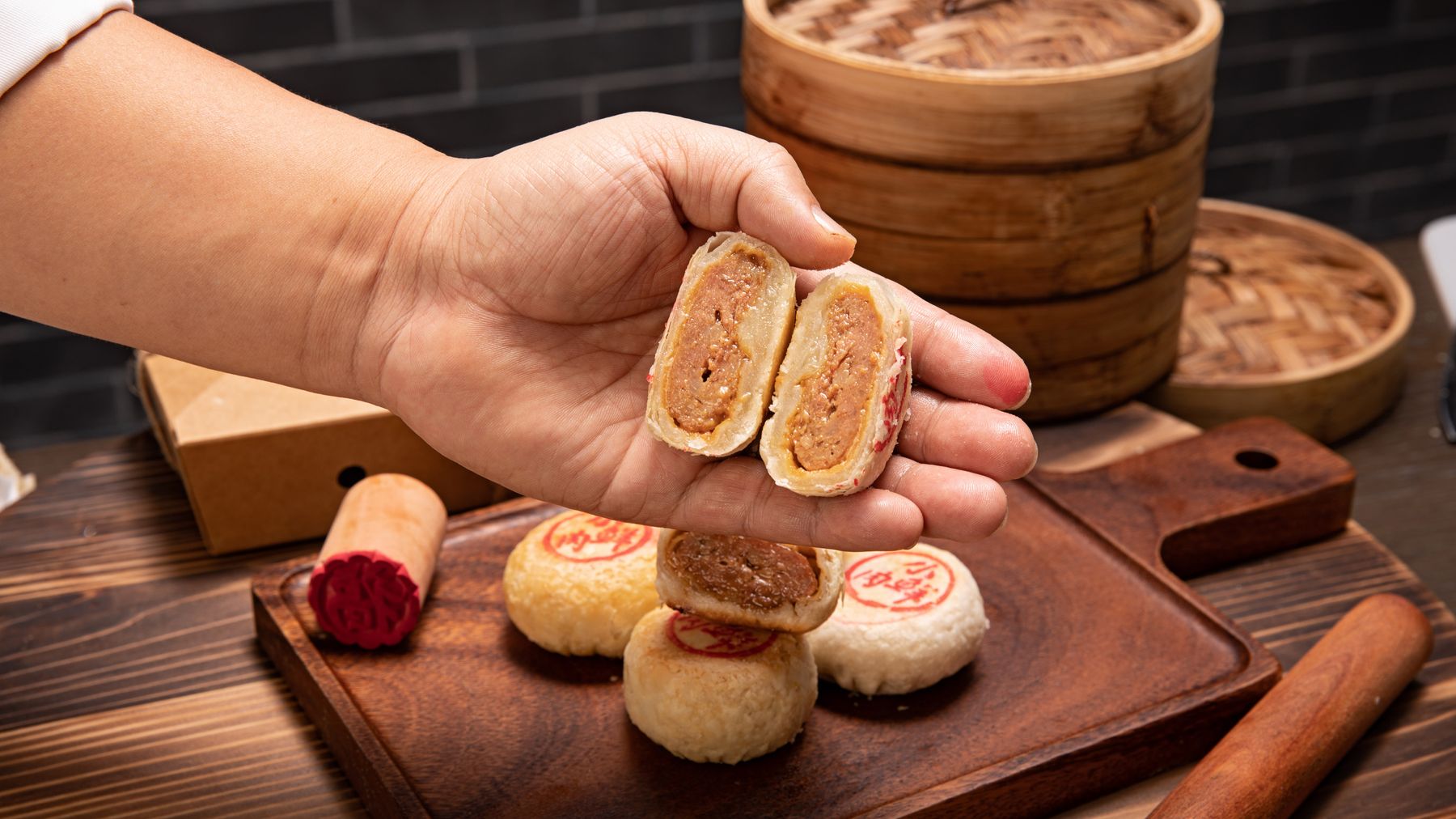
Photo by Change C.C on Pexels
Where to Try the Canonical Version
Tan Hue Vien — Soc Trang City
The most frequently cited producer in the province. Family-run, been operating since the 1970s. Their durian-yolk version has a good fat-to-sweetness balance and the dough lamination is consistently done. Located on Hung Vuong Street in Soc Trang city. Boxes from 120,000 VND.
Ba Thay Thu — Soc Trang City
A smaller workshop about 2 km from the town center. Worth seeking out if you want to watch the pastries being folded by hand rather than buying off a shelf. They sell individual pieces at 18,000 VND, hot from the rack in the mornings.
Kim Lan Bakery — District 5, Saigon
For travelers who can't make it down to the Mekong, Kim Lan on Nguyen Trai Street in Saigon is the best urban approximation. The Saigon version is slightly denser, but the ingredient quality is honest and the durian is not the artificial-flavored paste you'll find in airport gift shops.
Practical Notes
Banh pia keeps well at room temperature for 7–10 days, which makes it a practical souvenir from a Mekong Delta trip or a stop in Soc Trang en route between Saigon and Can Tho (about 130 km southwest of the city). Refrigerating the pastry will firm up the lard and dull the texture — eat at room temperature or warm briefly in an oven for 3–4 minutes. Pair with Vietnamese coffee or, if you want to do it properly in Soc Trang style, unsweetened lotus tea.
Last updated · May 29, 2026 · independently researched, never sponsored.