If you know "banh chung" — the square sticky rice cake wrapped in dong leaves that anchors Tet tables in the North — then banh tet is its southern counterpart: cylindrical, banana-leaf wrapped, and carrying its own distinct roster of fillings. The two cakes share a common ancestor but diverged over centuries as Vietnamese settlers moved south, adapting to what grew locally and what felt like home.
What Banh Tet Actually Is
"Banh tet" is a compressed log of glutinous rice wrapped tightly in banana leaves and boiled for six to eight hours until everything fuses into a dense, sliceable cylinder. A finished roll is typically 20–30 cm long and about 6 cm in diameter, though market vendors in the Mekong Delta (메콩 델타 / 湄公河三角洲 / メコンデルタ) often sell smaller, palm-sized versions meant to be eaten on the spot. The banana leaf gives the rice a faint grassy perfume that dong leaves — used in banh chung — don't replicate. That aroma alone tells you where you are in the country.
The cake is eaten year-round in the South and Center but peaks during Tet (뗏 (베트남 설날) / 越南春节 / テト), when families spend New Year's Eve crowded around a clay pot watching the rolls bob in boiling water. The cooking is as social as the eating.
A Brief History
The standard origin story links both banh chung and banh tet to the legend of Prince Lang Lieu of the Hung Kings dynasty, who offered rice cakes to represent heaven (round) and earth (square) to his father. The square shape migrated north and became banh chung; the cylindrical form — easier to roll with banana leaves, which grow abundantly in the South and Center — took hold as Vietnamese communities expanded below the 17th parallel. By the time settlements consolidated around the Mekong Delta in the 18th century, banh tet was already the default Tet rice cake from Hue southward.
Hue occupies an interesting middle position: the city makes both banh chung and banh tet, a culinary artifact of being the former imperial capital bridging North and South. In Hue's version the cake tends to be slimmer and more tightly wound, with a higher rice-to-filling ratio.
The Savory Version: What's Inside
The canonical savory banh tet — the one your average Ho Chi Minh City grandmother would defend without hesitation — is filled with a layer of cooked mung bean paste (xoi dau xanh) and a chunk of pork belly seasoned with fish sauce, black pepper, and sometimes a little shallot. The fat from the pork renders during the long boil and saturates the rice and mung bean from the inside out. You want to see some fat marbling in the pork; a lean cut produces a dry, disappointing result.
Slices are served at room temperature or lightly pan-fried in a little oil until the cut faces caramelize. The fried version — a common way to use leftover Tet banh tet — is arguably better than fresh. The edges crisp up while the center stays soft, and a smear of tuong (fermented hoisin-style sauce) or pickled vegetables alongside cuts through the richness.

Photo by Vietnam Tri Duong Photographer on Pexels
Sweet Variants: La Cam and Chuoi
Sweet banh tet is where regional creativity shows up most clearly.
Banh tet la cam uses the juice of la cam (magenta plant, Peristrophe roxburghiana) to dye the glutinous rice a deep purple-grey. The filling is typically sweetened mung bean paste only — no pork. The color alone makes it a visual centrepiece on a Tet tray, and the flavor is mild and faintly floral. La cam banh tet is common in Hue and increasingly available in Saigon specialty shops around Tet season.
Banh tet chuoi swaps in ripe banana mixed into the rice layer itself, with no separate filling. The banana sweetens and softens the rice as it cooks, and the result is denser and moister than the savory version. This variant is popular in the Mekong Delta — particularly around Can Tho and Vinh Long — where bananas are cheap and plentiful. A roll of banh tet chuoi bought from a riverside market stall costs around 15,000–25,000 VND and serves as breakfast or a midday snack without ceremony.
Some vendors also add coconut milk to the rice before wrapping, producing a richer, slightly sticky exterior. If you see the words "nuoc cot dua" on a market sign, that's the version with coconut milk — worth seeking out.
How to Order
At a market or street stall, banh tet is sold by the roll or by the slice (khuc). Asking for "mot khuc banh tet" gets you one slice; "mot don" gets you a whole roll, typically tied with a strip of banana leaf or thin rope. Specify man (savory) or ngot (sweet) if you're not sure what's on display, because vendors often sell both from the same basket.
Rolls are sometimes vacuum-packed for travel — decent ones last four to five days unrefrigerated, two weeks chilled. If you're buying to bring home, press the roll gently; it should feel firm all the way through, not soft in any section, which can indicate under-boiling or poor compression.
Price range for market-quality savory banh tet: 30,000–60,000 VND per roll in southern provinces; Saigon specialty shops charge 60,000–120,000 VND depending on pork quality and size.
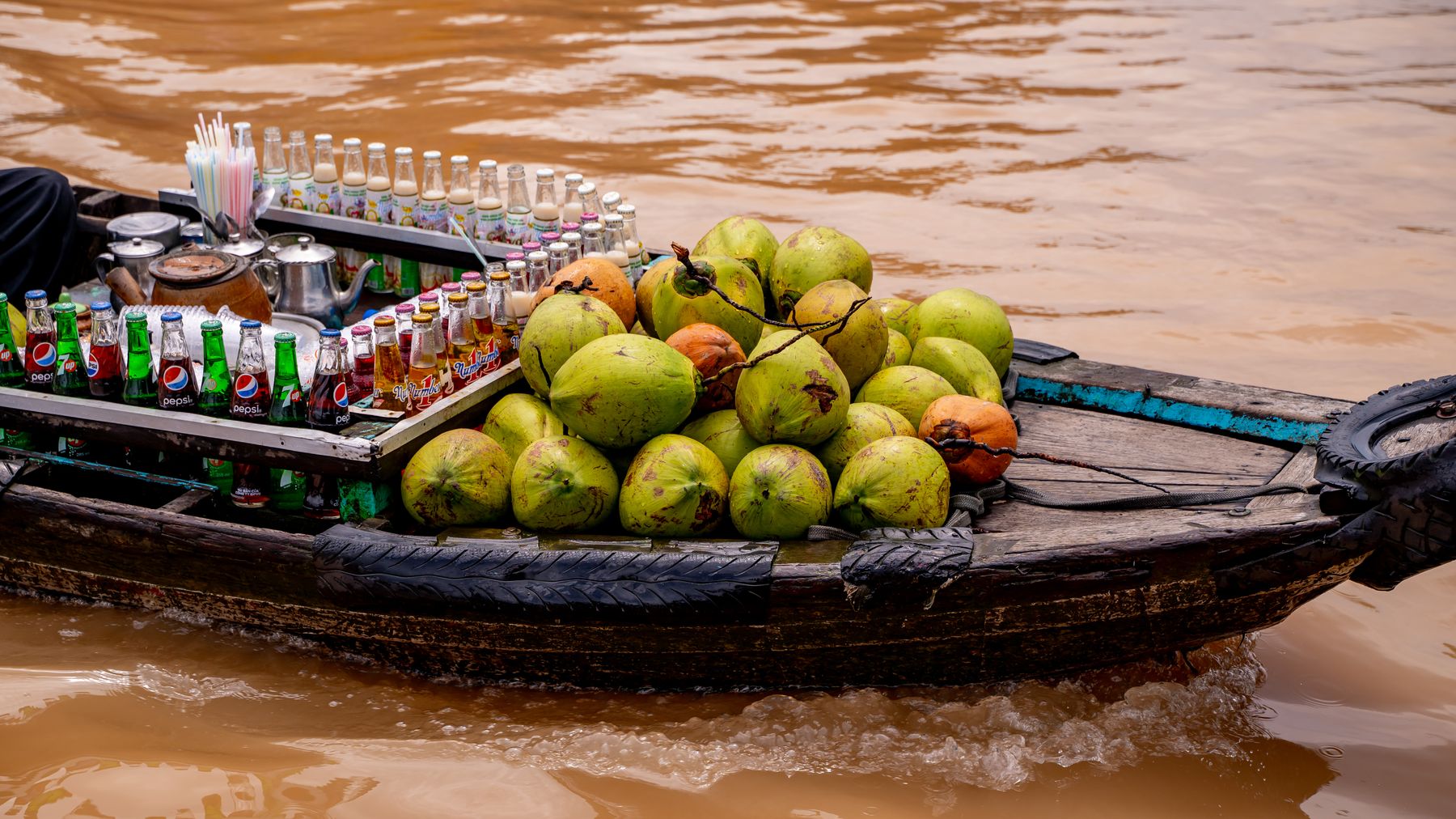
Photo by Vietnam Tri Duong Photographer on Pexels
Where to Try It
Cho Ben Thanh, Saigon — The covered market's dry goods section has several vendors selling banh tet year-round, not just during Tet. The savory rolls here are reliably well-made and priced fairly for tourists and locals alike. Look for the stalls in the northwest corner of the market hall.
Cho Dong Ba, Hue — Hue's main covered market is the place to try the slimmer Hue-style banh tet alongside its la cam variant. Morning is the best time; rolls sell out by early afternoon during Tet and before major public holidays. Hue's food culture is precise and detailed — the banh tet here reflects that.
Ben Ninh Kieu riverside market, Can Tho — For banh tet chuoi and coconut-milk variations, the floating market culture around Can Tho produces some of the most honest versions in the country. The riverside stalls near Ben Ninh Kieu sell them as casual snacks alongside "banh mi" and sugarcane juice. Early morning, when the river market activity peaks, is the time to go.
Practical Notes
Banh tet is available year-round in the South and Center, but quality and variety peak in the two weeks before and during Tet. Outside of festival season, your best bets are covered markets rather than supermarkets, whose packaged versions tend to be blander. If you're traveling through Hue, tasting both the Hue and southern styles side by side is a straightforward education in how one dish carries regional identity.
Last updated · May 29, 2026 · independently researched, never sponsored.