Hoi An has no shortage of dishes that claim to be untranslatable elsewhere, but "cao lau" is the one that actually earns the argument. The noodles are made with water drawn from a specific well, the toppings reference at least two foreign trading cultures, and the texture sits in a category entirely its own. If you are eating it outside Hoi An and someone tells you it is authentic, they are being generous.
What Cao Lau Actually Is
Cao lau (까오러우 / 高楼面 / カオラウ) is a dry noodle dish — closer to a composed salad than a soup — built on thick, chewy, slightly yellow noodles with a firm, almost gummy bite. A proper bowl comes with sliced char siu-style pork, a handful of crisp croutons made from the same noodle dough, fresh herbs (Vietnamese mint, bean sprouts, shaved banana flower), and a small ladle of concentrated braising liquid poured over the top rather than filling the bowl. You eat it with chopsticks, not a spoon.
The noodles get their color and chew from ash water — lye water made from the ash of trees specifically sourced from the Cham Islands (Cu Lao Cham), off the coast of Hoi An (호이안 / 会安 / ホイアン) — and from the mineral-heavy water of Ba Le Well, a Cham-era well still operating in the town center. Locals will tell you both elements are non-negotiable. Take either one out of the equation, and you have a different dish.
The Origin Debate
No one agrees on where cao lau came from, which is part of what makes it interesting.
The most cited theory points to Japanese influence. Hoi An was a significant port town during the 16th and 17th centuries, and a Japanese merchant quarter — Pho Hien — existed here long before the current Ancient Town took its present form. The thick, lye-water noodles bear a passing resemblance to certain Japanese udon preparations, and the restrained, dry presentation echoes something closer to Japanese noodle discipline than the broth-heavy Chinese noodle traditions more common in Vietnam's north.
The Chinese connection is harder to dismiss, though. The char siu pork — called "xa xiu" here — is unmistakably Cantonese in origin, and the crouton elements echo a technique used in some southern Chinese noodle dishes. Hoi An's Chinese trading community, particularly settlers from Fujian and Guangdong, were cooking here for centuries. The dish as it now exists almost certainly absorbed influences from both groups.
The Cham layer adds a third thread. The ash from Cu Lao Cham, and Ba Le Well itself — likely dating to the Cham kingdom of Champa before Vietnamese settlement expanded south — suggest the dish's foundations predate both the Japanese and Chinese trading periods. Whether that makes cao lau "Cham" in any meaningful culinary sense is a stretch, but the raw materials are older than the trading routes.
What seems most accurate is the least satisfying answer: cao lau is a Hoi An synthesis. It belongs to the specific centuries-long convergence of cultures that made this port town unusual, and it cannot be cleanly attributed to a single origin.
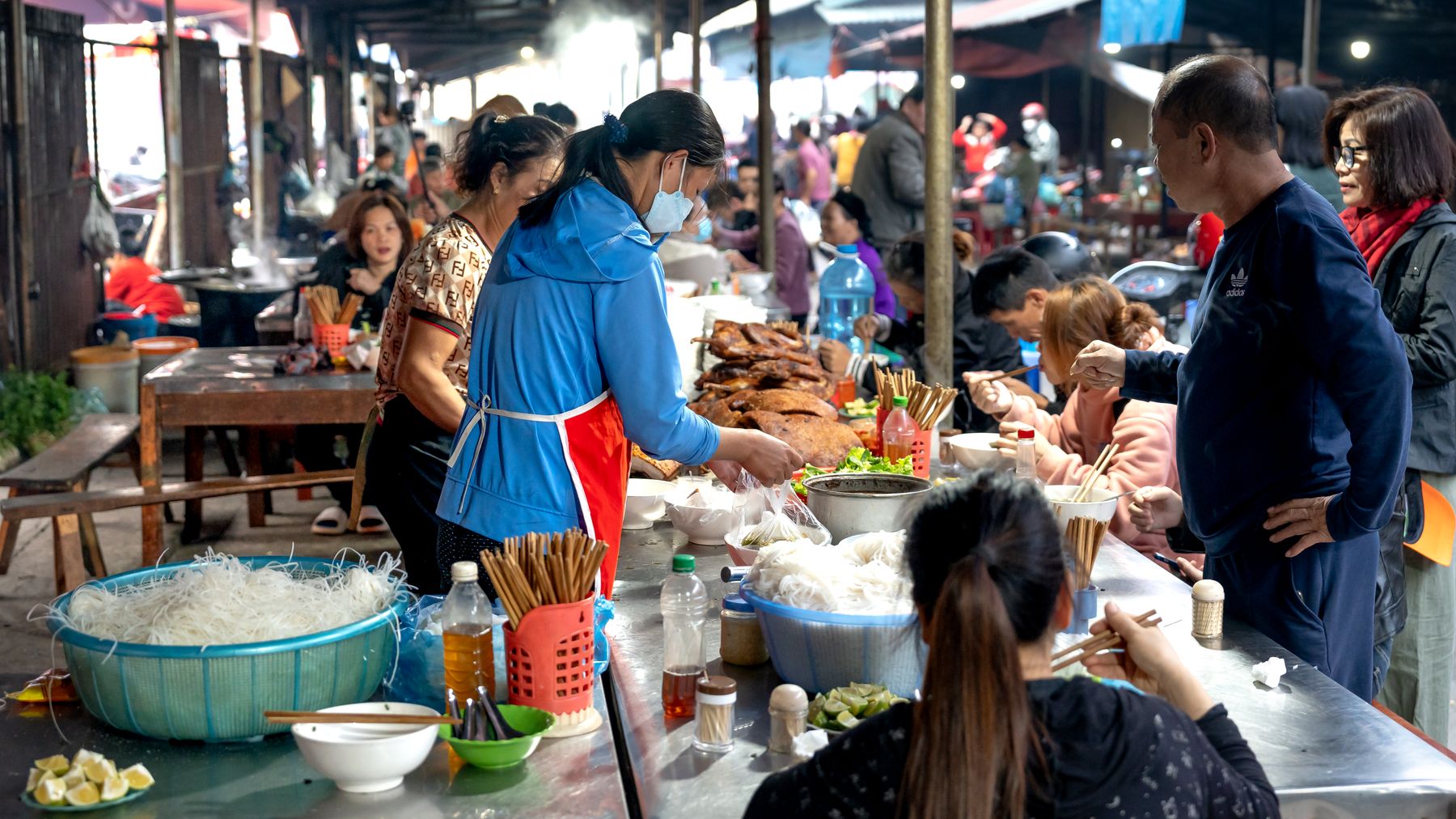
Photo by Quang Nguyen Vinh on Pexels
Traditional vs. Tourist Versions
This is where things get practical.
The canonical version — which you can still find at market stalls and family-run spots tucked off the main tourist drag — uses pork that has been slow-braised in a blend of soy, five-spice, and caramel until it is lacquered and slightly sticky. The croutons should be audibly crunchy and made from the same noodle dough, not generic fried crackers. The herb pile should include rau muong (morning glory shoots), Vietnamese mint, and bean sprouts. The dressing liquid is deeply savory, slightly sweet, and applied sparingly — maybe two tablespoons over the bowl.
The tourist-facing versions that proliferate along Tran Phu and Nguyen Thai Hoc streets are not bad, exactly, but they trend toward milder pork, more broth, softer croutons, and portion sizes calibrated for foreigners who want a full meal rather than a snack. Prices in those spots run 60,000–90,000 VND a bowl. At a market stall inside Hoi An Central Market, you are paying 35,000–50,000 VND for something that is usually better.
How to Order
Cao lau is not a dish you customize much, and the vendors who make it well tend to have one speed: their own. Do not ask for extra broth — that misses the point. Do not skip the croutons. If you are eating at a market stall, you will typically get one size; at a restaurant, you might have a choice between a small (nho) and regular (thuong) portion. The small is plenty if you are eating your way through several stops.
Eat it immediately. The noodles absorb the dressing fast, and the croutons go soft within minutes. This is not a dish you photograph extensively before touching.

Photo by Võ Văn Tiến on Pexels
Where to Try the Canonical Version
Hoi An Central Market Stalls
The cluster of stalls on the ground floor of the covered market on Tran Phu, near the Thu Bon River, is the starting point. Cao Lau Ba Be is the most consistently cited name here — open from around 06:00 to 11:00, closed when she runs out. Around 40,000 VND. Arrive before 09:00 if you want to be sure.
Phuong Cao Lau (Hoi An)
45 Tran Phu, closer to the Japanese Covered Bridge end of the street. A step up in setup from the market stalls — actual tables, slightly higher price (55,000 VND) — but the noodle quality is consistently good and the pork is properly lacquered. Handles the lunch crowd better than most.
Cao Lau Thanh (Hoi An)
A family operation that has been running for decades, currently located near the intersection of Le Loi and Nguyen Thai Hoc. No English menu, minimal signage. Order by pointing at the noodles. This is the version that most closely matches what locals describe as the reference bowl.
For travelers passing through Hanoi or Saigon who want a comparison point: a handful of Central Vietnamese restaurants in both cities serve cao lau, but the noodles are made with tap water and local ash, so the texture is softer and the flavor lighter. It is worth trying once to understand what the Hoi An water actually does — the difference is not subtle.
Practical Notes
Cao lau is a morning and early-afternoon dish in Hoi An; most stalls close by noon or 13:00 at the latest. Budget 35,000–90,000 VND depending on venue. If you are planning a full food morning in Hoi An, pair it with "banh mi" from Phuong's cart and finish with a "ca phe sua da" at one of the riverside cafes — three dishes, three distinct cultural genealogies, all within 500 meters of each other.
Last updated · May 29, 2026 · independently researched, never sponsored.