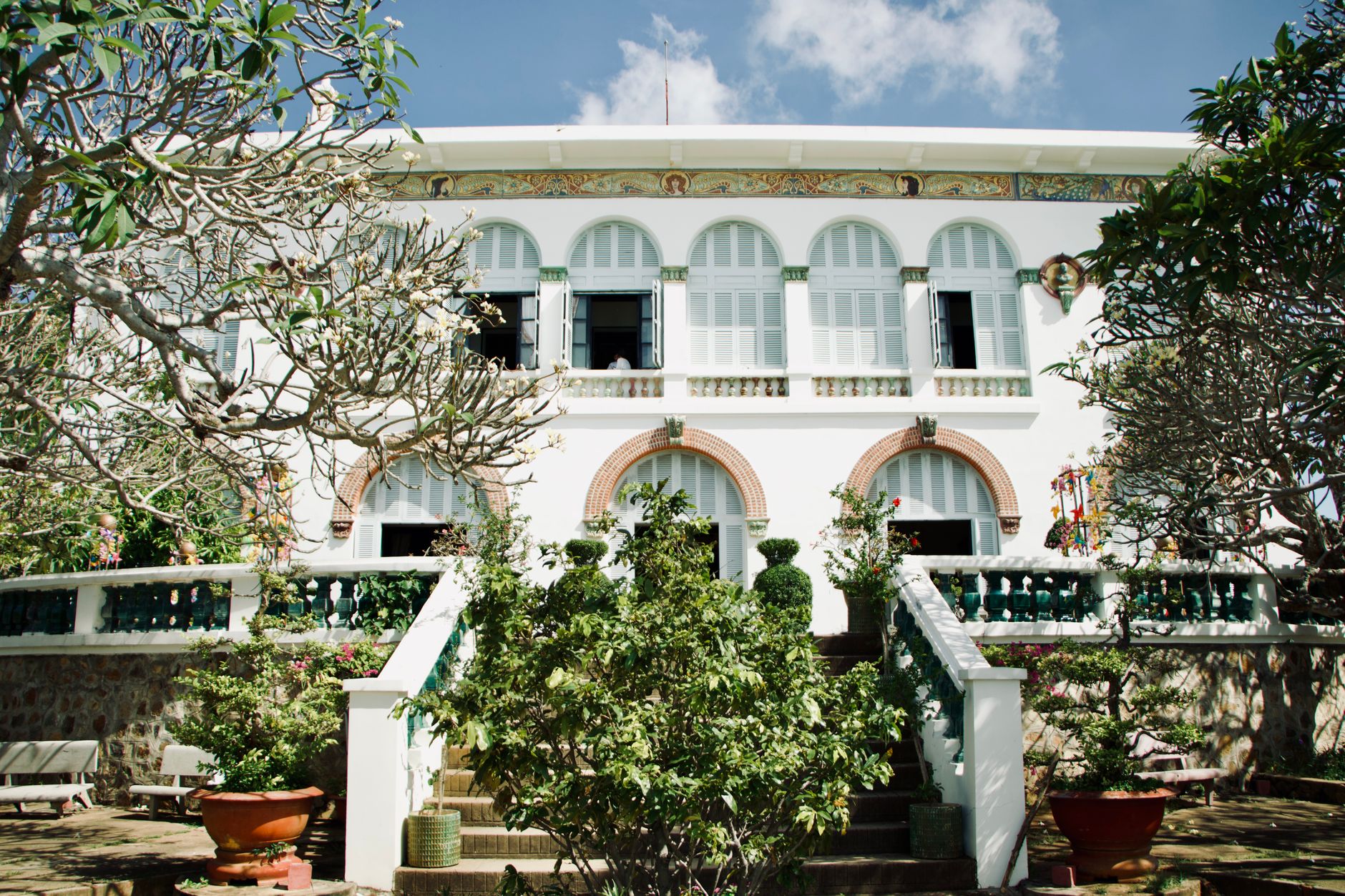
Cho Dong Ba sits on the north bank of the Huong River, about 500 meters east of the Imperial Citadel. It's not a tourist market dressed up with lanterns and English menus. It's the real commercial heart of Hue, where locals buy everything from lotus tea to school uniforms, and where you can eat some of the best Central Vietnamese food in the city for under 30,000 VND.
What it is and how it got here
Cho Dong Ba has operated in some form since the early 1800s, originally established during the Nguyen Dynasty as a trading post near the citadel walls. The current main building — a large, weathered concrete hall with a distinctive clock tower — dates from a 1960s reconstruction. The market sprawls well beyond that building, with hundreds of stalls spilling out along Tran Hung Dao and Trung Dinh streets. There are roughly 2,000 vendors here on any given day.
It's divided loosely into zones: dry goods and fabric on the upper floors, fresh produce and meat on the ground level, and prepared food concentrated along the outer edges and the riverfront side. The layout is chaotic by design — or rather, by decades of organic growth.
Why travelers bother
Three reasons. First, it's the most efficient place in Hue (후에 / 顺化 / フエ) to eat your way through Central Vietnamese specialties in a single morning. Second, the fabric and "ao dai" tailoring stalls on the second floor are genuinely good and significantly cheaper than Hoi An. Third, it gives you something most polished tourist sites don't — an unfiltered look at daily life in a mid-sized Vietnamese city. Nobody here is performing for visitors.
Best time to visit
The market opens around 5:00 AM and winds down by 6:00 PM. For food, arrive between 6:30 and 9:00 AM — that's when the breakfast vendors are in full swing and the ingredients are freshest. For shopping, late morning (9:00–11:00 AM) is less frantic.
Seasonally, February through April is the sweet spot. Hue's notorious rainy season runs from September through January, and a downpour turns the outdoor stall areas into a muddy obstacle course. Summer (May–August) is hot enough that spending an hour inside a concrete market hall with no air conditioning becomes a test of endurance. Spring mornings are warm but manageable.
How to get there
If you're based in Hue's tourist district south of the river (around Pham Ngu Lao or Le Loi streets), Cho Dong Ba is a 10-minute walk across Truong Tien Bridge. That's the simplest option.
From Hue's train station, it's about 2 km — a 5-minute taxi ride costing around 30,000–40,000 VND on a metered cab or Grab. From Phu Bai Airport, the market is 15 km southeast; a Grab car runs 150,000–200,000 VND and takes 25–30 minutes depending on traffic.
If you're arriving from Da Nang (다낭 / 岘港 / ダナン), the train takes about 2.5 hours and costs 60,000–100,000 VND for a seat. Buses from Da Nang run frequently for around 80,000 VND.
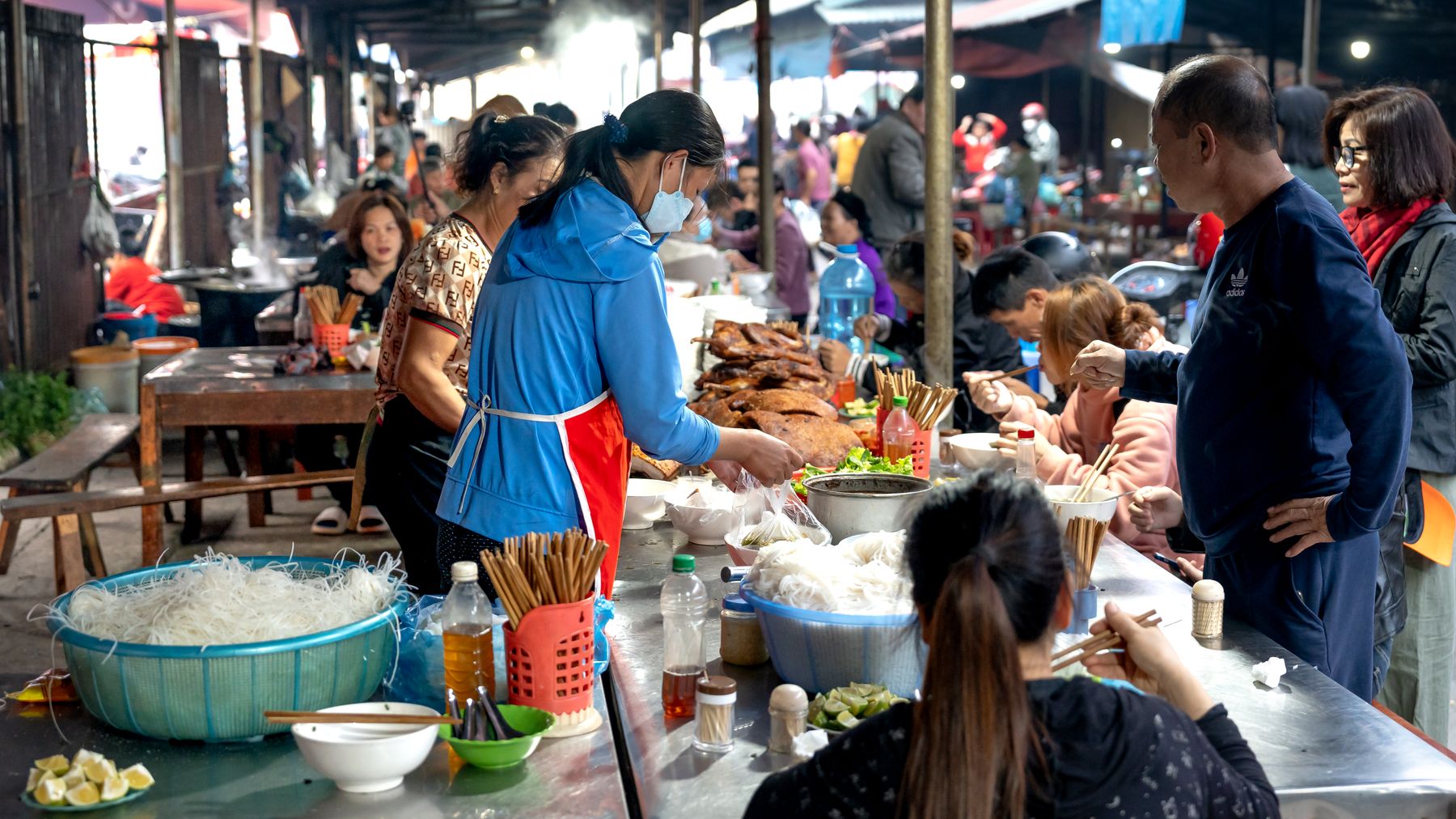
Photo by Quang Nguyen Vinh on Pexels
What to do
Eat the breakfast circuit
Start at the food stalls along the market's eastern perimeter. The "bun bo Hue" here is the no-nonsense local version — heavy on lemongrass and shrimp paste, served in small bowls for 20,000–25,000 VND. You'll also find "banh canh" (thick tapioca noodle soup with crab), "banh beo" (steamed rice cakes with shrimp floss), and "che" dessert soups. Eat where the Vietnamese customers are sitting. If a stall has only tourists, keep walking.
Browse the fabric and tailoring floor
The upper level houses dozens of fabric merchants and tailors. You can buy silk, cotton, or linen by the meter, or commission a custom "ao dai" for 400,000–800,000 VND depending on the fabric — roughly half of what you'd pay in Hoi An's tailor shops. Turnaround is typically 24–48 hours. Bring a photo reference of what you want.
Buy "non la" conical hats
Hue is the traditional center of conical hat production, and Cho Dong Ba has stalls selling everything from basic sun hats (15,000 VND) to the decorative "non bai tho" — poem hats with verses visible when held against sunlight. These run 30,000–60,000 VND and are one of the few souvenirs that are both genuinely local and easy to pack.
Pick up local ingredients
If you're staying somewhere with a kitchen, the ground-floor produce section is worth a walk. Hue-specific items to look for: "me xung" (sesame and peanut candy), "tom chua" (fermented sour shrimp paste), dried lotus seeds, and local chili pastes. These also make lightweight, packable gifts.
Walk the riverfront stalls
The row of vendors along the Huong River side of the market sell flowers, incense, and Buddhist devotional items. It's not a shopping destination for most travelers, but it's visually interesting and quieter than the interior.
Where to eat nearby
Beyond the market stalls themselves, two options stand out. "Banh khoai" — Hue's version of "banh xeo" (crispy rice crepes stuffed with shrimp and pork) — is excellent at Hanh Restaurant on Pho Duc Chinh street, a 5-minute walk south of the market. Portions run 30,000–40,000 VND. For a sit-down bowl of "bun bo Hue" with air conditioning, Ba Roi on Nguyen Du street is reliable and popular with locals. A bowl costs about 35,000 VND.
Where to stay
Most travelers stay south of the Huong River, within walking distance of both Cho Dong Ba and the Imperial Citadel. Budget guesthouses along Pham Ngu Lao and Le Loi streets run 200,000–400,000 VND per night. Mid-range hotels with river views cluster around Hung Vuong street, averaging 600,000–1,200,000 VND. If you want to be closer to the market, there are a few local hotels on the north bank along Tran Hung Dao, though the area is louder and less polished.

Photo by Theodore Nguyen on Pexels
Practical tips locals would tell you
- Bring cash in small bills. Almost nobody accepts cards, and breaking a 500,000 VND note at a stall selling 20,000 VND noodles will not make you popular.
- Wear shoes you don't love. The ground floor gets wet, especially near the meat and fish sections. Sandals with grip work best.
- Bargain gently on goods, not on food. For fabric and souvenirs, offering 70–80% of the first quoted price is normal. For prepared food, prices are generally fixed and already low — haggling over a bowl of noodles is considered rude.
- Keep bags in front of you. Pickpocketing is not rampant, but the market is dense and crowded. Don't leave a phone in a back pocket.
- Learn the phrase "bao nhieu" (how much?). It gets you further than pointing and holding up fingers.
Common mistakes to avoid
Don't come at noon expecting a lively atmosphere — many stalls close for lunch and the heat is brutal. Don't buy packaged spices or coffee without checking expiration dates; stock turnover varies. Don't assume the market is only for shopping — most of the best food in Hue is eaten standing up at stalls like the ones here, not in restaurants. And don't skip the upper floors — first-time visitors often stay on the ground level and miss the tailoring section entirely.
Practical notes
Cho Dong Ba is open daily. No entrance fee. Budget 1.5 to 2 hours if you want to eat, browse, and explore without rushing. It pairs well with a morning visit to the Imperial Citadel, which is a short walk west along the river.
Last updated · May 29, 2026 · independently researched, never sponsored.