What Chua Hoi Khanh actually is
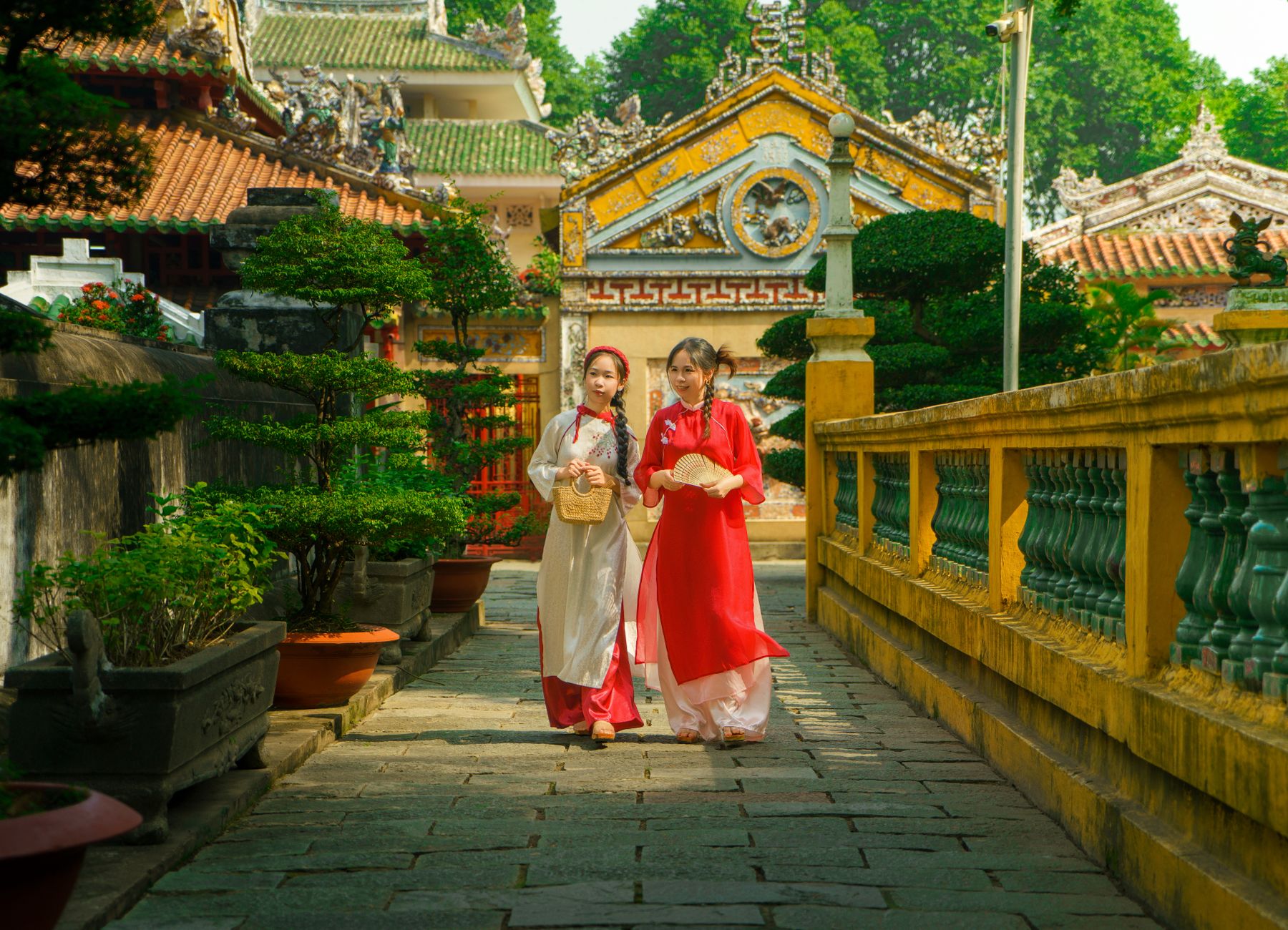
Chua Hoi Khanh is a Buddhist pagoda in Thu Dau Mot, about 30 km north of central Saigon. Built in 1741, it's one of the oldest surviving pagodas in southern Vietnam (베트남 / 越南 / ベトナム) — nearly three centuries of continuous use, through colonial occupation, war, and urban sprawl. The compound sprawls across roughly two hectares and includes the main worship hall, a large reclining Buddha statue, ancestral halls, and a quiet garden that feels completely disconnected from the motorcycle-choked streets outside.
The pagoda holds national heritage status, and it played a role as a meeting point during resistance movements in the early twentieth century — though today it functions purely as a working Buddhist temple and a place locals come to pray, burn incense, and escape the heat.
What makes it worth the trip from downtown Saigon (사이공 / 西贡 / サイゴン) isn't one single wow factor. It's the accumulation of details: carved wooden panels darkened by centuries of incense smoke, ceramic mosaics on the roof ridges, and a 52-meter reclining Buddha completed in 2009 that ranks among the largest in Vietnam. The whole place has a worn-in, lived-in quality that newer pagodas simply can't replicate.
Why travelers go
Most visitors to Saigon never leave the District 1–District 3 orbit. Chua Hoi Khanh gives you a reason to push north into what was formerly Binh Duong province, now part of expanded Ho Chi Minh City. The pagoda draws far fewer international tourists than spots like the Jade Emperor Pagoda downtown, which means you'll mostly share the grounds with local worshippers and monks.
Photographers come for the woodwork inside the main hall — intricate carvings of dragons, phoenixes, and lotus motifs that date back to various restoration periods across the 1800s. The reclining Buddha out back is an obvious draw: it's massive, photogenic, and free to visit. And if you have any interest in southern Vietnamese Buddhism as a living tradition rather than a museum exhibit, this is a good place to observe it.
Best time to visit
The dry season — November through April — is the comfortable window. Mornings before 10 AM are ideal: cooler air, softer light for photos, and fewer people. During Tet / 越南春节 / テト) and the Lunar New Year period (usually late January or February), the pagoda fills with locals making offerings and praying for the year ahead. It's lively and colorful, but expect crowds and incense smoke thick enough to taste.
The wet season (May through October) brings afternoon downpours that can strand you under a pagoda eave for an hour. Not the worst place to wait out rain, but plan accordingly. Weekdays year-round are quieter than weekends.
How to get there from central Saigon
From District 1, you have a few options:
- Motorbike or Grab bike: The fastest door-to-door option. About 30 km, taking 45–70 minutes depending on traffic. A Grab bike runs roughly 80,000–120,000 VND one way.
- Grab car: Same route, 150,000–220,000 VND. More comfortable in the heat.
- Bus: Bus route 604 runs from the Saigon bus station (Ben Xe Mien Dong) toward Thu Dau Mot. The fare is around 20,000 VND, but the ride takes 1.5–2 hours with stops. From Thu Dau Mot bus station, the pagoda is about 2 km — walkable or a quick xe om ride for 15,000–20,000 VND.
The pagoda sits on Yersin Street (Duong Yersin) in Thu Dau Mot. If you're navigating by GPS, search "Chua Hoi Khanh Thu Dau Mot" — the pin is reliable.

Photo by HONG SON on Pexels
What to do once you're there
Walk the main worship hall
The oldest structure in the complex. Look up at the ceiling beams and the carved wooden altar screens. These aren't reproductions — some panels have been here since the 1800s. The patina of age is visible in the darkened wood and the slightly uneven floors. Remove your shoes, keep your voice low, and avoid pointing cameras directly at people praying.
See the reclining Buddha
The 52-meter-long statue sits behind the main hall. It depicts the Buddha entering nirvana and was completed in 2009. Inside the base, there's a small exhibition space with Buddhist art and calligraphy. The scale is genuinely impressive when you stand next to it — this isn't a miniature tucked in a garden.
Explore the ancestral halls
Several side halls honor monks and local historical figures. These are quieter than the main hall and give a sense of how the pagoda functions as a community anchor, not just a tourist site.
Sit in the garden
The grounds include old trees, bonsai collections, and benches. After the sensory intensity of Saigon traffic, ten minutes sitting here with nothing to do is genuinely restorative.
Visit the ceramic workshop area
Thu Dau Mot has a long tradition of lacquerware and ceramics. Some workshops near the pagoda area sell locally made pieces. These aren't tourist-trap souvenirs — Thu Dau Mot lacquerware has a real regional reputation.
Where to eat nearby
Thu Dau Mot isn't a food destination on the level of Saigon's street food districts, but it holds its own. Look for "banh beo" — small steamed rice cakes topped with dried shrimp and scallion oil, served on tiny saucers. Thu Dau Mot's version is a local point of pride. You'll find vendors along the streets near the central market, plates running 30,000–50,000 VND.
For something more substantial, "com tam" shops are everywhere — broken rice with grilled pork, a fried egg, and pickled vegetables. A full plate costs 35,000–50,000 VND. If you're heading back toward Saigon, the stretch of road near Binh Duong's industrial zones has surprisingly good roadside "bun bo Hue" — spicy beef noodle soup that's become a staple across the south.
Where to stay
Most travelers visit Chua Hoi Khanh as a half-day trip from Saigon and don't need accommodation in Thu Dau Mot. But if you want to stay:
- Budget: Local guesthouses (nha nghi) around Thu Dau Mot center run 200,000–350,000 VND per night. Basic but clean.
- Mid-range: A few business hotels in the 500,000–800,000 VND range offer air conditioning, Wi-Fi, and breakfast.
- Comfortable: Becamex Hotel Thu Dau Mot is the most reliable option at around 900,000–1,200,000 VND per night.

Photo by Theodore Nguyen on Pexels
Practical tips locals would tell you
- Dress modestly: shoulders and knees covered. The monks won't turn you away in shorts, but you'll get looks, and it's respectful.
- Bring cash. There's no ticket office or entrance fee, but donation boxes are placed throughout. A small contribution — 20,000–50,000 VND — is customary.
- The incense smoke inside the main hall can be intense. If you're sensitive, visit early morning before the midday prayer rush.
- Combine this with a visit to the Thu Dau Mot church (a French colonial-era Catholic church about 1 km away) for an interesting contrast in southern Vietnamese religious architecture.
Common mistakes to avoid
- Arriving midday: Between 11 AM and 2 PM, the heat is brutal and most of the complex bakes in direct sun. The reclining Buddha area has minimal shade.
- Skipping the side halls: Most visitors snap photos of the reclining Buddha and leave. The main worship hall and ancestral rooms are where the real character lives.
- Not budgeting enough time: People assume thirty minutes is enough. Give yourself at least 90 minutes to walk the full grounds without rushing.
- Expecting English signage: There's very little. Download Vietnamese phrases or use a translation app. The monks are friendly but most speak limited English.
Practical notes
Chua Hoi Khanh works best as a morning trip from Saigon — leave by 7:30 AM, explore until late morning, eat lunch in Thu Dau Mot, and head back. It pairs well with a broader day exploring the northern reaches of greater Ho Chi Minh City, a part of the city most visitors never see.
Last updated · May 29, 2026 · independently researched, never sponsored.