Con Market is the oldest and most lived-in market in Da Nang — not a tourist attraction dressed up as one, but a functioning neighbourhood hub where vendors have been feeding the same customers for decades. If you want to understand how Da Nang eats, start here.
Getting to Con Market
The market sits on Ong Ich Khiem Street in Hai Chau District, about 2 km from the Han River waterfront. A grab bike from the beach hotels along My Khe costs around 25,000–35,000 VND. There's no convenient parking for cars, so don't bother. The market opens early — most food stalls are running by 6:30 am — and the best eating window is 6:30 am to 10:30 am, after which the lunch crowd thins out the good stuff fast.
The Mi Quang Stalls Inside
"Mi Quang" is the dish Da Nang (다낭 / 岘港 / ダナン) is most serious about, and Con Market has some of the most consistent versions in the city. Unlike the pho-heavy north or the bun bo hue tradition up the road in Hue, mi quang is a turmeric-yellow noodle dish served with just a shallow pool of rich broth — more of a sauce, really — piled with pork, shrimp, quail eggs, crushed peanuts, and a heap of fresh herbs and rice crackers on the side.
Head to the covered wet-market section on the ground floor. Three stalls in the northeast corner — identifiable by the yellow plastic stools stacked outside before service — are the ones worth sitting down at. A bowl runs 30,000–40,000 VND. Don't skip the banh trang (rice crackers) that come alongside; crumble them in. The broth-to-noodle ratio is intentionally low, which confuses first-timers who expect soup. This is correct. Eat it as it comes.
For comparison, the stall nearest the west entrance serves a slightly richer, more shrimp-forward version — worth trying if you're doing a full morning loop.
Banh Cuon and Banh Xeo on the Ground Floor
Two stalls near the main south entrance do "banh cuon" — steamed rice rolls filled with minced pork and wood-ear mushroom, served with a light dipping broth and fried shallots on top. These are quieter by 9 am, so aim to hit them first. Expect to pay 25,000–30,000 VND for a plate.
"Banh xeo" — the crispy, turmeric-laced rice crepe filled with shrimp, pork belly, and bean sprouts — appears at a handful of stalls toward the back of the hall. The Da Nang version is smaller than the southern style: more taco-sized than the plate-sized crêpe you'd find in Saigon. You wrap pieces in mustard leaf and dip in fish sauce. Three pieces for around 20,000 VND is standard.
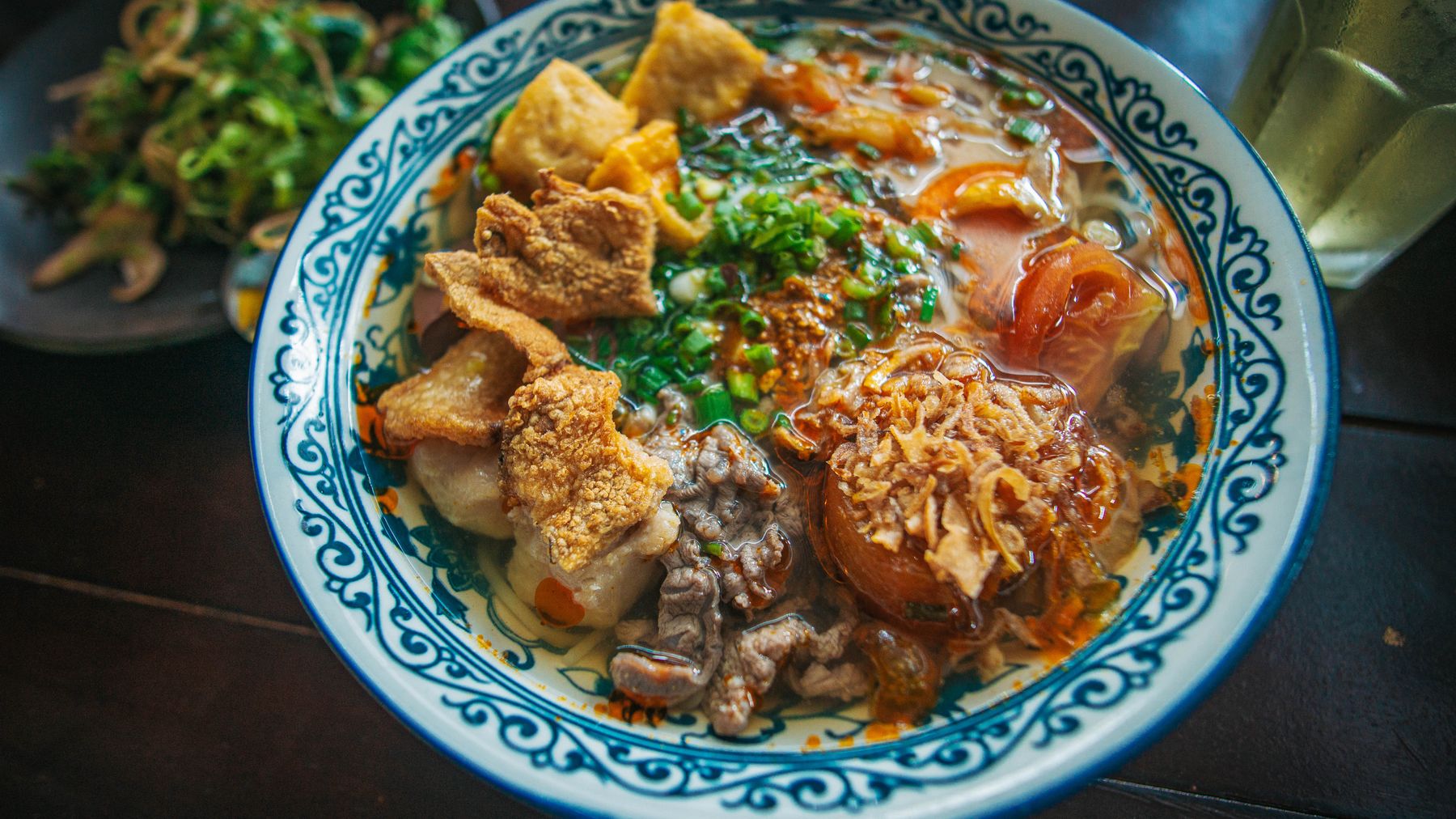
Photo by FOX ^.ᆽ.^= ∫ on Pexels
The Sidewalk Ring Around Con Market
Some of the best eating isn't inside at all. The streets immediately surrounding the market — particularly Hung Vuong and Ong Ich Khiem — fill with mobile carts and semi-permanent stalls from around 6 am.
Banh Mi Carts on Hung Vuong
The "banh mi (반미 / 越式法包 / バインミー)" carts on Hung Vuong are worth a stop even if you've already eaten. Da Nang's banh mi leans heavily on house-made pate and a specific sweet-pickled daikon ratio that's different from the Hoi An version. A loaded baguette is 15,000–20,000 VND. The cart with the red-and-white umbrella near the intersection with Tran Phu is a regular morning fixture.
Bun Bo Hue Stalls on Ong Ich Khiem
Three or four stalls along Ong Ich Khiem offer "bun bo hue" — the spicy lemongrass beef noodle soup from Hue, which has long since crossed the Hai Van Pass and settled comfortably into Da Nang breakfast culture. Bowls here cost 35,000–45,000 VND and come with the proper accompaniments: raw banana blossom, perilla, bean sprouts, and a shrimp paste condiment on the side. The one at No. 47 has the longest queue most mornings, which tells you what you need to know.
Com Tam Near the Back Gate
If you arrive closer to 10 am, the "com tam" stalls near the market's back gate are switching from breakfast to the late-morning crowd. Broken rice with grilled pork chop, a steamed egg cake (cha trung), and pickled vegetables for 40,000–55,000 VND. Simple, filling, and the kind of meal that doesn't photograph interestingly but stays with you all day.
What to Drink
Da Nang has a solid Vietnamese coffee culture. A "ca phe sua da" — iced milk coffee — from any of the small plastic-chair cafes on the surrounding streets costs 15,000–20,000 VND and is substantially better than anything from a chain. There's a reliable older woman who parks a thermos cart just inside the south entrance selling plain black drip coffee at 10,000 VND a cup. She's been there longer than most of the food stalls.

Photo by Kirandeep Singh Walia on Pexels
How to Navigate the Market
Con Market has three main floors. The food stalls are almost entirely on the ground floor and the immediate sidewalk ring. Floors two and three are fabric, clothing, and household goods — fine for browsing, not relevant to a food crawl. The ground floor is loosely organized: wet goods (meat, fish, produce) in the back half, prepared food toward the street-facing entrances. Follow the smell and the plastic stools.
Bring small bills — 10,000 and 20,000 VND notes. Most stalls don't have change for 200,000 VND and will look at you like you've made a personal affront.
Practical Notes
Con Market is at its best on weekday mornings between 7 and 9:30 am; weekends bring more foot traffic but the same stalls. Avoid coming straight from Hoi An for a single meal — the 30 km drive is fine, but build a full morning around it rather than treating it as a quick detour. Cash only throughout.
Last updated · May 29, 2026 · independently researched, never sponsored.