What is Con Ngang?
Con Ngang is a narrow sandbar island — "con" means islet in southern Vietnamese — sitting in the Tien River branch of the Mekong, within Dong Thap province. It stretches roughly 3 km long but barely 500 m wide at its thickest point, a sliver of alluvial soil that's been slowly built up by seasonal flooding over decades. Historically it fell under Tien Giang's administrative lines, but following provincial boundary adjustments it now belongs to Dong Thap.
There's no town here. A handful of farming families tend fruit orchards and fish ponds. Migratory birds — herons, cormorants, egrets — nest in the dense vegetation along the banks. The island floods partially during the wet season (August–November), which is part of what keeps it agricultural rather than developed. If you're looking for a Mekong Delta (메콩 델타 / 湄公河三角洲 / メコンデルタ) experience that hasn't been packaged into a tour-bus itinerary, Con Ngang is that kind of place.
Why travelers go
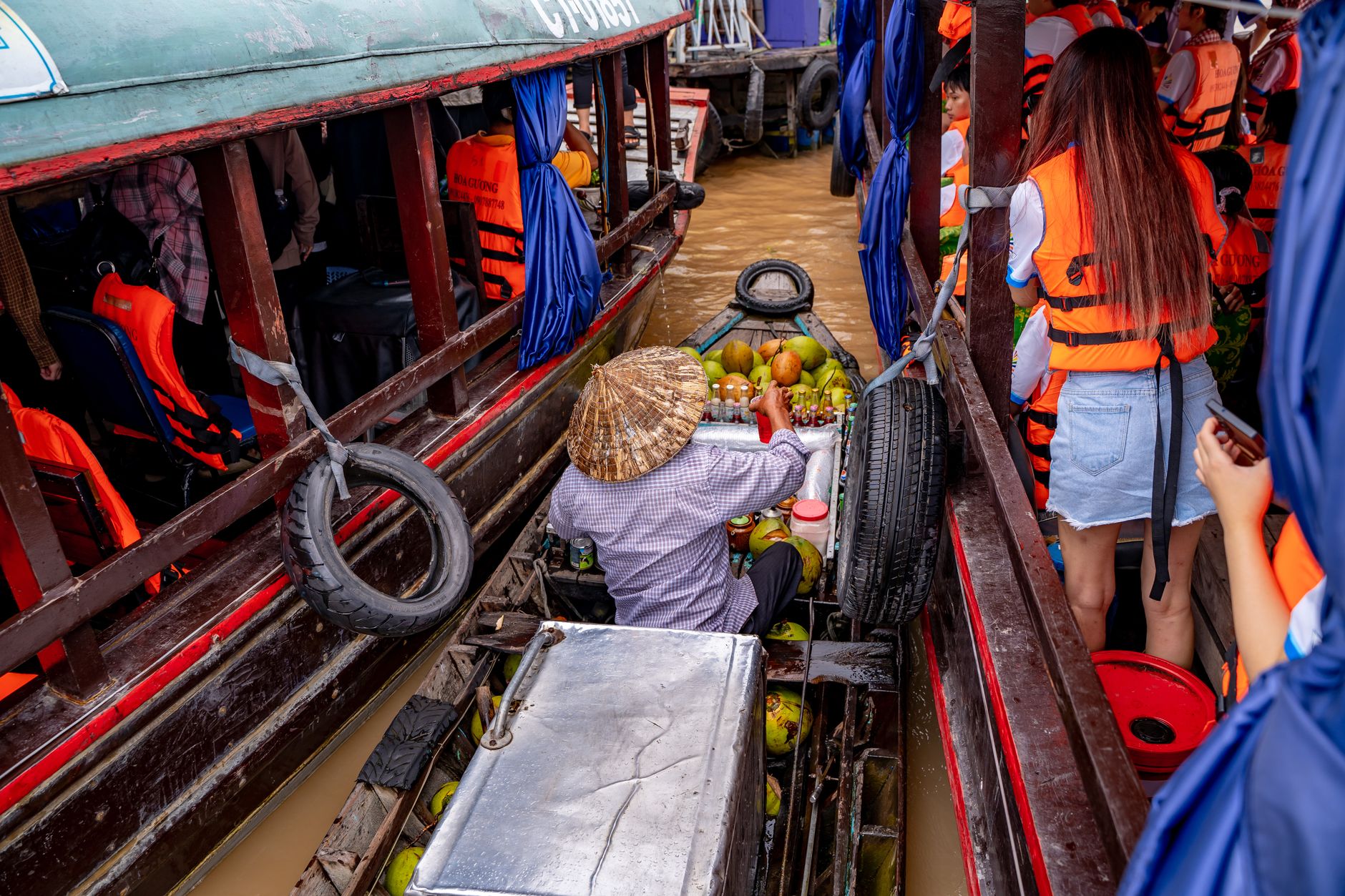
The honest answer: most don't. Con Ngang doesn't appear on standard Mekong tour routes, which is exactly the appeal for a certain type of traveler. You go because you want an unscripted morning on the river — watching fruit barges pass, walking through longan and mango orchards, eating whatever the family you're visiting happens to cook that day.
It's also a good excuse to spend time in Dong Thap more broadly, a province that gets overlooked in favor of Can Tho or Ben Tre. Dong Thap has Tram Chim National Park, the lotus fields around Thap Muoi, and Sa Dec's flower villages. Con Ngang fits naturally into a wider loop through the province.
Best time to visit
The sweet spot is December through April — dry season, when the floodwaters have receded and the island's orchards are accessible on foot. January and February tend to be especially pleasant: cooler mornings (by delta standards, around 24–26°C), low humidity, clear skies.
Avoid September and October if you want to actually walk the island. The Tien River swells and parts of Con Ngang go underwater. That said, if you're specifically interested in the Mekong's flood season ecology — floating markets in full swing, fish traps everywhere, the river at its widest — visiting by boat during high water has its own logic. Just don't expect to do much on land.
The fruit harvest season (May–July) is also worth timing for: longan, mango, and rambutan are at their peak, and orchard families are happy to let visitors pick and eat.
How to get there
The nearest major hub is Sa Dec, about 20 km away by road and river. From Saigon, you can reach Sa Dec in roughly 3.5–4 hours by bus from Mien Tay Bus Station (tickets run 120,000–150,000 VND). If you're coming from Can Tho (껀터 / 芹苴 / カントー), it's about 60 km northeast — around 1.5 hours by car or motorbike.
From Sa Dec, you'll need to get to the riverbank opposite Con Ngang. Local boat owners operate informal crossings — there's no scheduled ferry. Expect to pay 50,000–100,000 VND per person for a return trip, negotiated on the spot. If you're traveling with a local contact or homestay host, they'll usually arrange the boat. Hiring a motorbike in Sa Dec (150,000–200,000 VND/day) gives you flexibility to reach the launch point and explore the surrounding area afterward.
There is no bridge to Con Ngang. Boat is the only way.

Photo by Dang vu hai on Pexels
What to do
Walk the orchard paths
The island is small enough to cover on foot in a couple of hours. Dirt paths wind between longan, mango, sapodilla, and coconut groves. Farming families generally don't mind visitors walking through — a wave and a "xin chao" goes a long way. During harvest months, you can buy fruit directly: a kilo of longan might cost 15,000–25,000 VND.
Watch the bird colonies
The dense tree cover along Con Ngang's edges shelters nesting colonies of egrets and herons. Early morning (before 7 AM) and late afternoon (after 4 PM) are when the birds are most active — arriving to roost or heading out to feed. Bring binoculars if you have them. This isn't a managed bird sanctuary like Tram Chim, but the concentration of wading birds can be impressive during nesting season (March–June).
Fish with locals
If you're friendly and patient, fishermen on the island will sometimes let you join a net-casting session along the bank. The Tien River around Con Ngang yields catfish, snakehead, and various small species that end up in the day's "lau" (hot pot). This isn't a bookable experience — it's just what happens when you show up without a schedule.
Boat around the island
Ask your boatman to circle Con Ngang rather than just crossing directly. The full perimeter takes 30–40 minutes by small motorboat and gives you a sense of the island's shape, the erosion patterns on the banks, and the floating fish farms moored nearby.
Where to eat nearby
Con Ngang itself has no restaurants. Your eating options are back in Sa Dec or along the river road.
Look for "hu tieu" Sa Dec style — the town is famous for its version of this southern noodle soup, with a clear pork broth, rice noodles, and toppings that vary by stall. A bowl runs 30,000–45,000 VND. Sa Dec market (Cho Sa Dec) has several reliable stalls in the morning.
Also worth trying: "banh xeo" from any of the small family-run places along the river road between Sa Dec and Cao Lanh. Mekong Delta "banh xeo" tends to be larger and crispier than the central Vietnamese version, stuffed with shrimp, pork, bean sprouts, and herbs. Expect 25,000–40,000 VND per crepe.
Where to stay
Con Ngang has no formal accommodation. Your options:
- Sa Dec: A few guesthouses and mini-hotels in the 200,000–400,000 VND/night range. Nothing fancy, but clean rooms with air conditioning and hot water. Sa Dec's riverfront area near Huynh Thuy Le Old House is the most pleasant neighborhood to base from.
- Cao Lanh (Dong Thap's provincial capital, 25 km north): More hotel options including mid-range places in the 500,000–800,000 VND range. Useful if you're combining Con Ngang with Tram Chim or Xeo Quyt.
- Homestays: Occasionally, farming families on or near Con Ngang host visitors informally. This requires a Vietnamese-speaking contact to arrange. Don't show up expecting a bed — confirm beforehand.

Photo by Vietnam Tri Duong Photographer on Pexels
Practical tips locals would tell you
- Bring cash. There are no ATMs on the island and card payment doesn't exist here. Bring enough VND for your boat, fruit purchases, and any meals.
- Wear shoes you don't mind getting muddy. Orchard paths are dirt, and even in dry season they can be soft near the riverbank.
- Sunscreen and a hat are non-negotiable. There's limited shade between orchards, and the river reflection amplifies the heat.
- Speak a few Vietnamese phrases or bring a translation app. English is essentially nonexistent on Con Ngang and limited in Sa Dec outside of hotels.
- Mosquito repellent, especially if visiting during late afternoon when the birds come in — where birds roost, mosquitoes thrive.
Common mistakes to avoid
- Arriving without a boat plan. Don't assume there'll be a boat waiting. Arrange your crossing in Sa Dec before heading to the riverbank, or have a local phone number for a boatman.
- Trying to visit during peak flood season and expecting dry land. Check water levels if visiting August–November.
- Treating it like a tourist attraction. There's no ticket office, no guide, no itinerary. This is someone's farmland. Be respectful, ask before photographing people, and don't leave trash.
- Rushing it. Con Ngang rewards a slow morning, not a 30-minute checkbox visit. Give yourself at least half a day including the boat ride and a wander through Sa Dec afterward.
Practical notes
Con Ngang works best as part of a broader Dong Thap trip — combine it with Sa Dec's flower villages, a morning at Tram Chim, and a bowl of "hu tieu" at the market. It's not a destination that justifies a standalone journey from Saigon, but folded into 2–3 days in the province, it's the kind of quiet, unpackaged river experience the Mekong Delta does better than anywhere else in Vietnam.
Last updated · May 29, 2026 · independently researched, never sponsored.