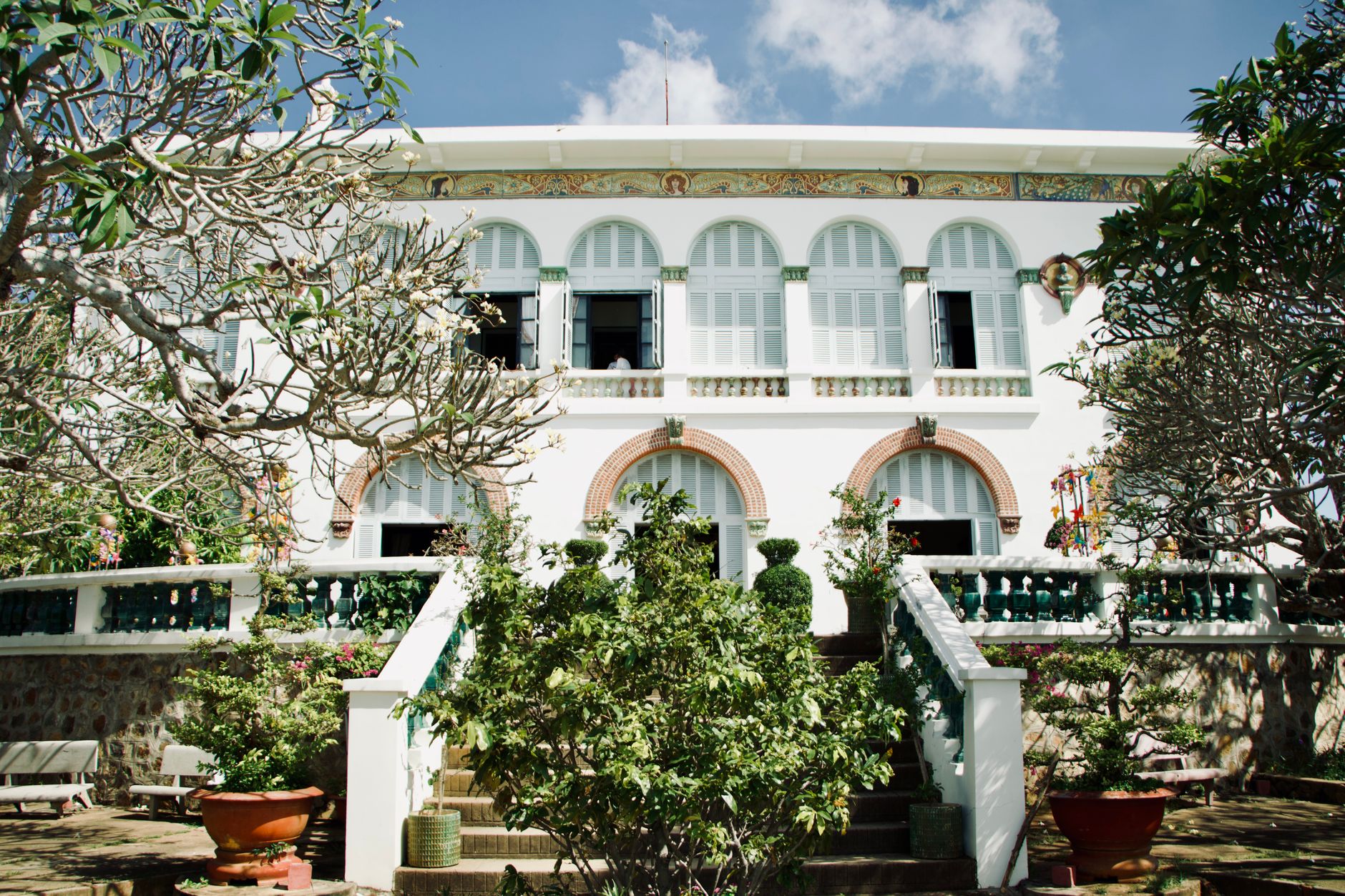
Da Nang Museum ("Bao tang Da Nang") sits near the west bank of the Han River and does something most city museums in Vietnam don't — it actually holds your attention. Three floors, well-labeled exhibits in English and Vietnamese, and enough Cham stonework and ethnographic detail to justify an hour or two of your afternoon.
What it is
Housed in a French-colonial-era building at 24 Tran Phu Street, Da Nang (다낭 / 岘港 / ダナン) Museum opened in 2011 after a significant renovation of the former Cham Museum annex. It's separate from the better-known Museum of Cham Sculpture a few blocks south. Where the Cham museum focuses tightly on Hindu-Buddhist sculpture, Bao Tang Da Nang covers the full sweep — prehistoric tools, Sa Huynh culture jewelry, Cham ceramics, Nguyen dynasty documents, French colonial artifacts, wartime photographs, and postwar daily life.
The building itself is worth noting: thick walls, tall shuttered windows, tiled floors. It feels like what it is — a repurposed administrative building from the early 20th century that keeps cool without much air conditioning.
Why travelers go
Most visitors come for one of three reasons. First, context. If you're heading to Hoi An or My Son, the Sa Huynh and Cham galleries here give you background that makes those sites land harder. Second, the wartime floor. It's small but direct — photographs, equipment, personal effects. No heavy-handed narration, just objects and dates. Third, it's a quiet break from the beach-and-bridge circuit that dominates most Da Nang itineraries.
It's not a full-day destination. Think of it as a sharp 60-to-90-minute stop that connects the dots between the places you'll see elsewhere in central Vietnam.
Best time to visit
Da Nang's dry season runs from roughly March to August, with peak heat in June and July. The museum is indoors, so weather matters less than you'd think — but if you're combining it with a walk along the riverfront or lunch in the neighborhood, March through May is the sweet spot. Warm but not brutal, and before the summer tourist surge.
Avoid October and November if you can. That's typhoon season, and while the museum won't flood, getting across town in sideways rain isn't fun.
The museum is open Tuesday through Sunday, 8:00–11:30 and 13:30–17:00. Closed Mondays. Arrive right at 8:00 or after 14:00 and you'll likely have galleries to yourself.
How to get there
From the Da Nang beachfront hotel strip (My Khe area), it's about 3 km west — a 10-minute taxi or Grab ride costing 25,000–40,000 VND. From the train station, it's barely 1 km, walkable in 15 minutes heading east toward the river.
If you're based in Hoi An (호이안 / 会安 / ホイアン), take the yellow bus (route 1) from Hoi An bus station to Da Nang's central bus stop on Dien Bien Phu Street, about 60–75 minutes, 30,000 VND. From there, it's a 10-minute walk north to the museum.
Renting a motorbike? Parking is available on-site for 5,000 VND.

Photo by ㅤ quang vinh ㅤ on Pexels
What to do inside
Walk the Cham and Sa Huynh galleries (Ground Floor)
The ground floor covers pre-Vietnamese civilizations in the region. Sa Huynh burial jars, bronze tools, and gold jewelry from around 500 BCE sit alongside Cham sandstone carvings and ceramic fragments. The labeling is decent — you'll actually learn the difference between Sa Huynh and Cham material culture, which matters if My Son is on your list.
Study the wartime photography (Second Floor)
The second floor moves through French colonialism and the American War. The strongest section is a set of black-and-white photographs from the 1960s and 1970s showing daily life in Da Nang during wartime — not propaganda posters, but documentary images. There's also a collection of military equipment and field medical kits.
Check the ethnography room (Third Floor)
The top floor covers ethnic minority groups in the former Quang Nam-Da Nang region — Co Tu, Xo Dang, and Gie Trieng communities. Textiles, musical instruments, and ritual objects. It's a small collection but gives you a sense of the highland cultures that most beach-focused visitors never encounter.
Spend time in the courtyard
Between the building and the street, there's a courtyard with a few stone pieces and old cannons. It's shaded, usually empty, and a good place to sit and read the bilingual information boards without rushing.
Combine with the Museum of Cham Sculpture
The Cham sculpture museum is about 800 meters south on the same street. If you're interested in the Cham galleries at Bao Tang Da Nang, walking to the sculpture museum afterward is the obvious next move. Budget another 60–90 minutes there. Entry is 60,000 VND.
Where to eat nearby
Walk five minutes east toward the Han River and you'll hit a cluster of local restaurants on Bach Dang Street. "Mi quang" — turmeric noodles with pork, shrimp, herbs, and a small amount of broth — is the dish Da Nang is proudest of, and you'll find good bowls at Mi Quang Ba Vi on Le Dinh Duong for around 35,000–45,000 VND.
For something heavier, "banh xeo" (crispy stuffed crepes) is everywhere in this neighborhood. Banh Xeo Ba Duong on Hoang Dieu Street is a 10-minute walk from the museum and has been operating since the 1980s. Expect to pay 50,000–60,000 VND per serving.
Where to stay
The museum is in central Da Nang, so you have options in every range:
- Budget: Guesthouses around the train station area run 200,000–400,000 VND/night. Basic but walkable to the museum.
- Mid-range: Hotels on Bach Dang Street along the river, 600,000–1,200,000 VND/night. River views, breakfast included at most.
- Higher-end: The beachfront strip on Vo Nguyen Giap has international-brand hotels from 1,500,000 VND and up. You'll need a Grab to reach the museum, but it's a short ride.

Photo by Tuan Minh on Pexels
Practical tips locals would tell you
- Admission is 20,000 VND (under $1 USD). No need to pre-book. Pay at the door.
- Bring your phone for photos — no restrictions on non-flash photography.
- The English translations are serviceable but occasionally awkward. If you read French, some of the colonial-era labels are more detailed in French than English.
- There's no cafe inside. Grab a "ca phe sua da" from one of the street-side shops on Tran Phu before entering.
- The museum has basic air conditioning on the upper floors but can feel warm on summer afternoons. Morning visits are more comfortable.
Common mistakes to avoid
- Confusing it with the Museum of Cham Sculpture. They're different institutions, different collections, different buildings. Both are worth visiting, but know which one you're walking into.
- Skipping the third floor. Most visitors tire out after the wartime exhibits and leave. The ethnography room is small but has some of the most interesting textiles in the building.
- Coming on a Monday. It's closed. This catches people every week.
- Rushing through in 20 minutes. The museum rewards slow looking. The Sa Huynh jewelry alone is worth a careful pass.
Practical notes
Bao Tang Da Nang isn't the reason you come to Da Nang — the beaches, "bun cha" stalls, and the route to Hoi An handle that. But it's the kind of stop that makes a trip feel less like a checklist and more like you actually understand where you are. Budget 90 minutes, combine it with the Cham museum down the street, and eat mi quang afterward. That's a solid half-day in central Da Nang.
Last updated · May 29, 2026 · independently researched, never sponsored.