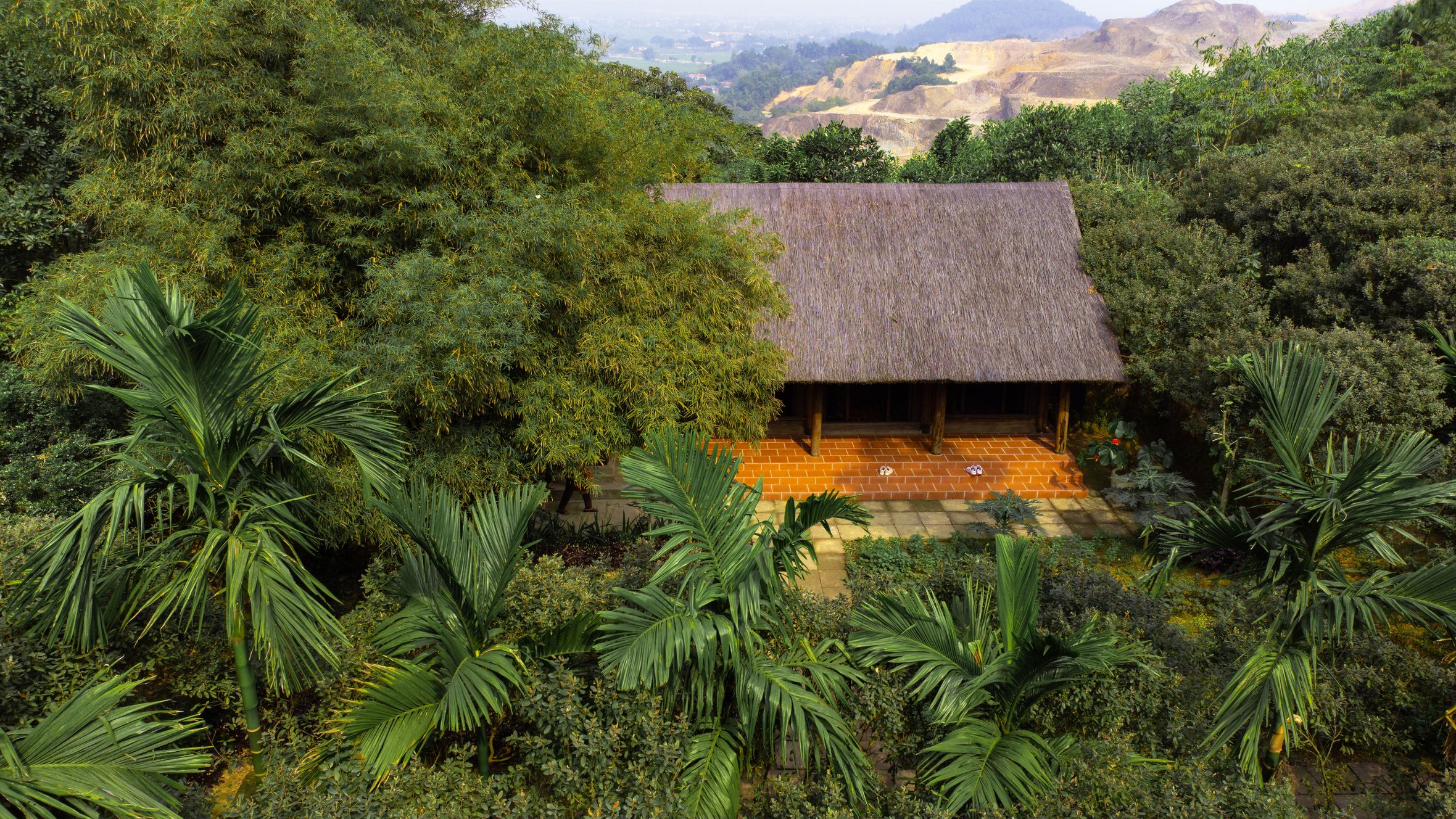
Lan Na Nua sits in the forested hills of Son Duong district, about 50 km from Tuyen Quang city center. It's one of those quiet historical sites that most foreign travelers skip entirely — but if you're interested in 20th-century Vietnamese history beyond the usual Cu Chi Tunnels circuit, it's a worthwhile detour through genuinely beautiful northern countryside.
What it is
Lan Na Nua (literally "the second hill shelter") is a reconstructed thatched hut and surrounding forest area in Tan Trao commune. This is where Ho Chi Minh (호치민 / 胡志明 / ホーチミン) lived and worked in the months before the August Revolution of 1945. The site includes the original lean-to shelter (rebuilt to its 1945 dimensions), a small museum, the nearby Tan Trao banyan tree where the national congress was held, and Hong Thai village with its Dinh (communal house).
The whole area is sometimes called the Tan Trao Historical Complex, with Lan Na Nua as its centerpiece. It was designated a national special relic in 2012.
Why travelers go
Most visitors are Vietnamese — school groups, party delegations, domestic tourists doing heritage circuits through the north. Foreign travelers who make it here tend to be history-focused or are passing through on motorbike routes between Hanoi (하노이 / 河内 / ハノイ) and Ha Giang. The appeal is threefold: the site itself is modest but well-preserved, the surrounding forest and rice terraces are genuinely scenic, and you'll likely have the place mostly to yourself on weekday mornings.
It pairs well with a broader northern loop. Tuyen Quang province connects naturally to routes heading toward Ha Giang or Ba Be Lake, making Lan Na Nua a logical half-day stop rather than a destination you'd fly across the country for.
Best time to visit
October through March offers the driest, coolest conditions. Mornings in December and January can drop to 10-12°C in the hills — bring a layer. The rice harvest in September-October turns the surrounding valleys golden. Avoid July-August if you dislike mud; the forest trails get slippery and leeches come out.
The anniversary of the Tan Trao Congress (August 16-17) draws large crowds and ceremonies. Interesting if you want to see the cultural performance side; skip those dates if you prefer quiet.
How to get there
From Hanoi (165 km, ~3.5 hours by car): Take the Hanoi-Thai Nguyen expressway, then cut west on QL37 through Dai Tu and into Son Duong district. The road is decent two-lane asphalt the whole way. You can also bus to Tuyen Quang city (3 hours from My Dinh station, around 120,000 VND) and hire a local xe om or taxi for the remaining 50 km to Tan Trao.
By motorbike: This is the best option if you're already touring the north. From Hanoi, it's a comfortable day ride via Thai Nguyen. If you're coming south from Ha Giang, drop through Bac Quang and Chiem Hoa — stunning mountain roads with almost no tourist traffic.
Local transport from Tuyen Quang city: Grab doesn't reliably operate here. Negotiate a return taxi (expect 500,000-700,000 VND for a half-day including waiting time) or rent a motorbike from your hotel (150,000-200,000 VND/day).

Photo by Quang Nguyen Vinh on Pexels
What to do
Lan Na Nua shelter and museum
The shelter itself takes about 10 minutes to see — it's a simple bamboo-and-thatch lean-to on a hillside, surrounded by forest. The adjacent museum has photographs, maps, and artifacts from 1945. Signage is in Vietnamese with some English captions. Budget 45 minutes for both.
Tan Trao banyan tree and Dinh
A 2 km walk (or short ride) from Lan Na Nua brings you to the massive banyan tree where the national congress convened. Next to it stands the Hong Thai communal house — a traditional Tay ethnic "dinh" with dark timber and a raised floor. This is arguably more photogenic than the main shelter.
Village walking
Tan Trao commune is home to Tay and Dao ethnic communities. The villages along the stream have stilt houses, small fish ponds, and rice paddies hemmed by bamboo groves. No entry fee, no guides needed — just walk the concrete paths between hamlets.
Forest hiking
Trails behind Lan Na Nua lead into secondary forest. Nothing is well-marked, so stick to obvious paths unless you have a local guide. A 3-4 km loop through the trees is manageable in an hour.
Where to eat
Options near the site are limited to a few local com binh dan stalls in Tan Trao village — rice with stir-fried greens, pork, and tofu for 35,000-50,000 VND. For something more substantial, drive back toward Tuyen Quang city where you'll find "pho" shops, "bun cha" stalls, and a few proper restaurants along the riverfront. Try the local specialty "com lam" (bamboo-tube rice) if you spot it at roadside stalls near ethnic minority villages — it's the Tay staple here and goes well with grilled stream fish.
Where to stay
There's no tourist accommodation in Tan Trao itself. Your options:
- Tuyen Quang city (50 km): Several decent hotels in the 300,000-600,000 VND range. Muong Thanh has a branch here if you want reliable mid-range. The riverfront area is pleasant for evening walks.
- Homestays in Son Duong district: A handful of Tay stilt-house homestays have popped up along the road between Tuyen Quang and Tan Trao. Basic but authentic — expect a mattress on the floor, mosquito net, shared bathroom, and home-cooked dinner for around 250,000-350,000 VND per person including meals.

Photo by Quang Nguyen Vinh on Pexels
Practical tips
- Entry to Lan Na Nua and the Tan Trao complex is free.
- Bring cash — there are no ATMs near the site. The closest is in Son Duong town, 15 km away.
- Wear proper shoes if you plan to hike the forest trails. Flip-flops work fine for the main sites.
- A local guide isn't necessary but can add context. Ask at your hotel in Tuyen Quang city — expect 300,000-500,000 VND for a half-day.
- Phone signal (Viettel) is fine at the main sites but patchy on forest trails.
Common mistakes
Rushing through: People drive out, snap a photo of the hut, and leave within 20 minutes. The site rewards slower exploration — walk to the banyan tree, loop through the village, sit by the stream.
Skipping it on a Ha Giang trip: If you're already riding north from Hanoi toward Ha Giang, Tan Trao adds maybe 2 hours to your day and breaks up the long highway slog through Thai Nguyen.
Expecting English signage everywhere: It's limited. Download Vietnamese-English on Google Translate offline before you go.
Practical notes
Lan Na Nua works best as a half-day stop on a longer northern Vietnam route rather than a standalone day trip from Hanoi. Combine it with Tuyen Quang city's riverside, or use it as a waypoint toward Ha Giang or Ba Be. The site is modest — that's part of its appeal.
Last updated · May 29, 2026 · independently researched, never sponsored.





