What it is and why it matters
Lang Minh Mang sits about 12 km south of Hue's city center, on the west bank of the Huong River. It's the burial complex of Emperor Minh Mang, the second ruler of the Nguyen Dynasty, who reigned from 1820 to 1841. Construction started in 1840 and was completed by his successor three years later.
Of all the royal tombs around Hue (후에 / 顺化 / フエ), this one is the most deliberately designed. Minh Mang was a Confucian traditionalist who planned the layout himself — a symmetrical axis running from the main gate through courtyards, pavilions, and lakes to the burial mound at the rear. The whole thing spans about 28 hectares, and unlike the Tomb of Tu Duc (which feels like a poet's retreat) or the Tomb of Khai Dinh (which leans European), Lang Minh Mang is classical Chinese-Vietnamese architecture at its most disciplined.
Why travelers go
The compound rewards people who like architecture and landscape working together. The central axis pulls you through a sequence of gates, stone courtyards, honor guards of mandarins and elephants, a stele pavilion, and then Hien Duc Mon — the gate that opens onto Trung Minh Ho, a crescent-shaped lake crossed by three stone bridges. Beyond the lake, the path climbs through more gates and pine groves to the actual tomb mound, sealed and never opened.
It's less visited than Tu Duc's tomb and quieter than the Imperial Citadel Thang Long up north, which means you can actually stand in a courtyard for a few minutes without someone's selfie stick in your frame.
Best time to visit
Hue's weather is its own thing. The wet season runs roughly September through January, with the heaviest rain in October and November — flooding isn't uncommon. February through April is the sweet spot: cooler temperatures (22-28°C), less rain, and the gardens around the tomb are green without being waterlogged.
May through August is hot — regularly above 35°C — and the stone courtyards have zero shade. If you visit in summer, go early. The site opens at 7:00 AM, and the first hour is the most comfortable.
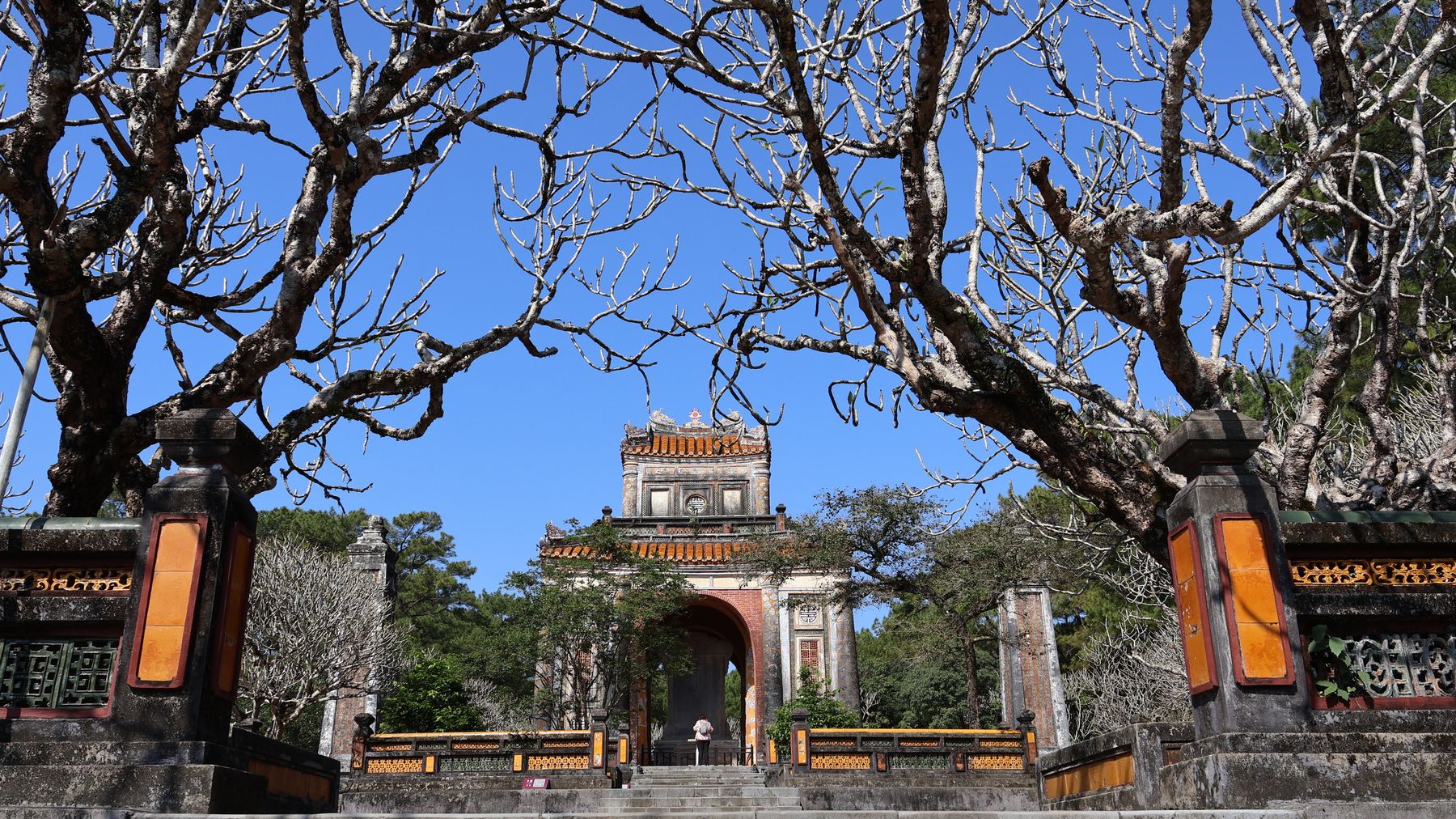
Photo by Minh Lê on Pexels
How to get there from Hue
From the center of Hue, Lang Minh Mang is about 12 km by road — roughly 25 minutes on a motorbike or taxi.
- Grab car: 80,000-120,000 VND one way, depending on traffic and pickup location. The most straightforward option.
- Motorbike rental: Most guesthouses rent semi-automatics for 120,000-150,000 VND per day. The road south along the river is flat and easy to navigate. Parking at the tomb costs 5,000-10,000 VND.
- Boat: Tourist boats leave from the pier near Toa Khiem on the Huong River. A shared boat tour that includes Lang Minh Mang plus one or two other tombs runs about 200,000-350,000 VND per person. The boat ride takes around 45 minutes to an hour and drops you at a landing near the tomb entrance. You walk the last 500 meters.
- Bicycle: Possible if you're fit and don't mind the heat. The ride takes about 50 minutes from the Old Quarter.
Entrance fee: 150,000 VND for a single-site ticket. If you're visiting multiple Hue heritage sites, the combo ticket (530,000 VND) covers the Imperial Citadel, several tombs including this one, and a few other spots over three days.
What to do — 5 specifics
Walk the central axis end to end
Don't wander randomly. Start at Dai Hong Mon (the main gate) and follow the central path all the way to the burial mound. The axis is about 700 meters long, and the sequencing — open courtyard to enclosed pavilion to lake to forest — is the entire point. Rushing through or skipping sections breaks the rhythm Minh Mang intended.
Spend time at Trung Minh Ho
The crescent lake with its three stone bridges is the emotional center of the complex. The middle bridge (Trung Dao Kieu) was reserved for the emperor. Stand on it and look back toward Hien Duc Mon — the reflection in the water on a still morning is the best photo opportunity here.
Read the stele
The Stele Pavilion (Bi Dinh) houses a marble tablet where Minh Mang's successor recorded the emperor's achievements. It's in classical Chinese characters, but the English signage nearby gives a decent summary. Most people walk past it in ten seconds. Give it two minutes — it tells you a lot about how the Nguyen court saw itself.
Explore the side paths
Once you've walked the main axis, take the smaller paths around the lake. The east and west sides have smaller pavilions (Ta Phuoc Duc and Huu Phuoc Duc) that are usually empty. The pine and frangipani trees along the perimeter are older than anything you'll find in Hue's city parks.
Compare it to the other tombs
If you visit the Tomb of Tu Duc (romantic, asymmetrical, built for leisure) and the Tomb of Khai Dinh (compact, ornate, French-influenced) on the same day or week, the contrasts are striking. Each tomb reflects the personality of its emperor more than any museum exhibit could.
Where to eat nearby
There's not much right at the tomb itself — a few drink vendors and snack stalls near the parking area. Head back toward Hue for a proper meal.
"Bun bo Hue" is the obvious local dish — a spicy beef and pork noodle soup that originated here and tastes different in Hue than anywhere else in the country. Quan Bun Bo Hue O Phuong on Nguyen Du Street is a reliable local spot, with bowls running 35,000-45,000 VND.
For something lighter, look for "banh canh (반깐 / 粗米粉汤 / バインカイン)" — thick tapioca noodle soup, often with crab. Small shops along Kim Long Street (on the way back from the tomb) serve decent versions for 30,000-40,000 VND.
Photo by Vietnam Tri Duong Photographer on Pexels
Where to stay in Hue
- Budget: Guesthouses and hostels in the backpacker area east of the Huong River, 150,000-350,000 VND per night.
- Mid-range: Hotels along Le Loi Street or near the south bank, 500,000-1,200,000 VND per night. Clean rooms, air conditioning, breakfast included.
- Upper range: Riverside hotels and boutique properties along the north bank near the Citadel, 1,500,000-3,500,000 VND per night.
Practical tips locals would tell you
- Bring water. There's one small kiosk inside the complex and it charges tourist prices.
- Wear shoes you can walk in on uneven stone. Flip-flops on wet laterite paths are a recipe for a fall.
- The combo heritage ticket is only worth it if you plan to visit at least three sites. For just Lang Minh Mang alone, buy the single ticket.
- If you hire a Grab or taxi, ask the driver to wait. Getting a ride back from the tomb area can take 15-20 minutes during quiet hours.
Common mistakes to avoid
- Rushing through in 20 minutes. The complex needs at least 45 minutes to an hour to appreciate properly. The spatial progression is the architecture — skipping ahead defeats the purpose.
- Visiting at midday in summer. The stone courtyards radiate heat. By noon in July, it's genuinely unpleasant. Morning or late afternoon only.
- Skipping the boat option. The river approach is how visitors originally arrived. It's slower, but it gives you context for the tomb's relationship to the Huong River and the surrounding landscape that you completely miss arriving by road.
- Not combining with other tombs. Lang Minh Mang, the Tomb of Tu Duc, and the Tomb of Khai Dinh are all within a few kilometers of each other. Doing all three in a half-day by motorbike is realistic and gives you a much richer picture of Hue's royal history than any single site alone.
Last updated · May 26, 2026 · independently researched, never sponsored.