Ngo Mon is the south-facing main gate of Hue's Imperial City, and it's where most visitors get their first real sense of what the Nguyen Dynasty was about. It's not just a gate you walk past — you can climb up to the Ngu Phung (Five Phoenix) pavilion on top, stand where emperors once addressed crowds, and look out across the flag tower and the Huong River beyond.
What it is and why it matters
Built in 1833 under Emperor Minh Mang, Ngo Mon replaced an earlier gate from Gia Long's reign. The name translates roughly to "Meridian Gate" — it faces due south, aligned with imperial geomancy principles. The structure is massive: a stone-and-brick base roughly 57 meters wide with five entrances, topped by the Ngu Phung pavilion with its double-eaved roof of yellow and green glazed tiles.
The central entrance was reserved exclusively for the emperor. Court officials used the two flanking passages, and soldiers and horses went through the outermost ones. That hierarchy is still visible in the different sizes of the archways.
This is also where Emperor Bao Dai formally abdicated in August 1945, handing the imperial sword and seal to representatives of the new government. A small plaque marks the spot. Whether you care about that history or not, the pavilion on top gives you one of the best vantage points in the entire citadel complex.
Why travelers go
Ngo Mon is the entry point to the Imperial Citadel, so nearly everyone passes through it. But most people just snap a photo at ground level and walk in. That's a mistake. The pavilion upstairs is open to visitors, and it's worth the five minutes it takes to climb. From there you get a clear sightline across the courtyard to Thai Hoa Palace, and turning around, you look out over the flag tower and the Perfume River. Early morning, before the tour buses arrive, it's one of the quieter spots in the complex.
The architecture itself rewards a closer look. The wooden pavilion uses a mix of Chinese-influenced construction and distinctly Vietnamese decorative elements — dragon motifs, phoenix carvings, and the characteristic enamel-inlaid columns that show up throughout the Hue (후에 / 顺化 / フエ) monuments.
Best time to visit
Hue's weather is its own thing. The sweet spot is February through April — dry, warm but not brutal, with temperatures around 25-30°C. September through November brings heavy rain and occasional flooding, so the citadel grounds can be soggy and grey.
For Ngo Mon specifically, arrive before 8:30 AM or after 3:30 PM. The midday sun is harsh on the exposed pavilion, and tour groups from Da Nang tend to arrive between 10 AM and 2 PM. If you visit during Tet or a festival season, Ngo Mon sometimes gets decorated with lanterns and banners, which makes for better photos but bigger crowds.
How to get there
If you're coming from Da Nang (다낭 / 岘港 / ダナン) (the nearest major transport hub), you have a few options:
- Train: Da Nang to Hue takes about 2.5 hours. Tickets run 70,000-120,000 VND depending on seat class. The route follows the coast over Hai Van Pass — it's a genuinely good train ride.
- Bus: Regular buses and limousine vans take 2-3 hours, 100,000-150,000 VND. Most drop you at the south bus station; from there it's a 15-minute taxi to the citadel.
- Motorbike: Riding over Hai Van Pass yourself takes about 2 hours. Rental bikes in Da Nang run 120,000-180,000 VND per day.
From Hue's tourist area (south bank of the river around Le Loi and Pham Ngu Lao streets), Ngo Mon is about 2 km north. A Grab bike costs 15,000-20,000 VND, or you can walk across Truong Tien Bridge in about 20 minutes.
Ngo Mon is inside the Imperial City, so you need a citadel ticket: 200,000 VND for adults (as of 2024). That single ticket covers the entire Imperial Enclosure.

Photo by Thái Nguyễn on Pexels
What to do
Climb the Ngu Phung Pavilion
Stairs on either side of the gate lead up to the pavilion. The wooden interior has been restored, and there's usually a small exhibit of historical photos showing Ngo Mon through different periods. The view north into the citadel and south toward the river is the real draw.
Walk the full citadel circuit from here
Ngo Mon is the logical starting point for exploring the Imperial City. From the gate, walk straight north through the courtyard to Thai Hoa Palace, then deeper into the Forbidden Purple City. Budget 2-3 hours for the full complex.
Look at the stonework up close
The base of Ngo Mon has detailed bas-relief carvings — clouds, dragons, lotus flowers — that most visitors walk right past. The craftsmanship is some of the best-preserved in the citadel.
Catch the flag tower at sunset
The Ky Dai (flag tower) sits directly in front of Ngo Mon. In the late afternoon, the light hits the tower and the gate together in a way that actually justifies pulling out your camera.
Visit during a cultural event
Hue occasionally hosts "ao dai" shows and traditional music performances near or inside Ngo Mon during festival periods. The Hue Festival (held every two years) sometimes stages events at the gate itself.
Where to eat nearby
The citadel area isn't the city's best food zone, but two things are worth seeking out within walking distance:
- "Bun bo Hue" at Quan Bun Bo Hue O Phuong, about 800 meters southeast of Ngo Mon on Chi Lang street. A bowl runs 35,000-45,000 VND. This is the city's signature noodle soup — spicy, beefy, with lemongrass broth and thick round noodles.
- "Banh canh" — the thick tapioca-rice noodle soup — is everywhere around the citadel. Look for small stalls on Dang Dung or Mai Thuc Loan streets. 30,000-40,000 VND per bowl.
For Vietnamese coffee, the cafes along the south bank of the river (Vo Thi Sau street area) are a 10-minute walk from the gate and offer river views.
Where to stay
- Budget: Hostels and guesthouses along Pham Ngu Lao and Chu Van An streets, 150,000-350,000 VND per night. Basic but clean, and within walking distance of the citadel.
- Mid-range: Hotels in the Le Loi / Hung Vuong area, 500,000-1,200,000 VND. Many have river views.
- Higher-end: A few boutique hotels sit inside or near the citadel walls. Expect 1,500,000-3,500,000 VND per night.
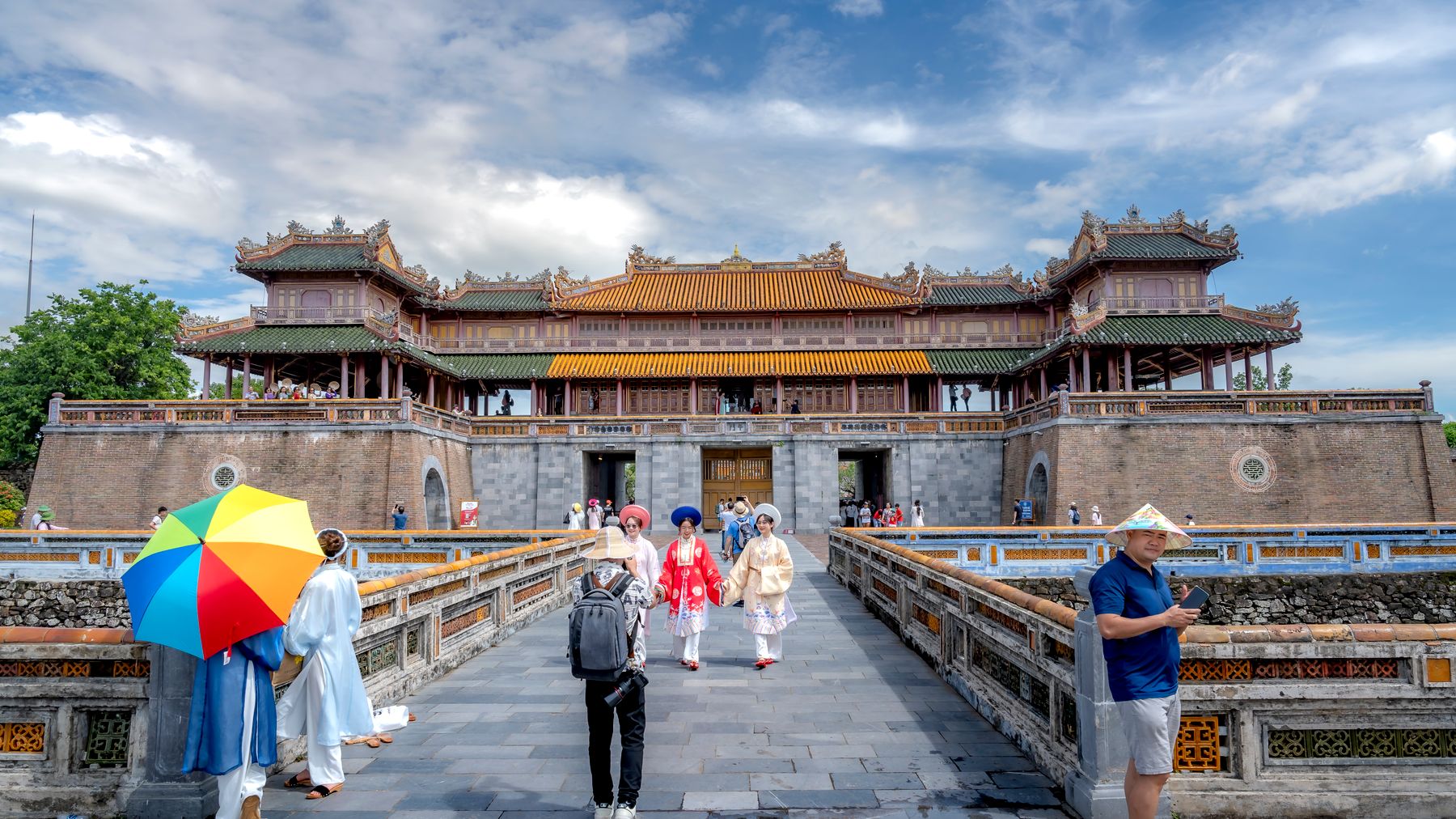
Photo by Quang Nguyen Vinh on Pexels
Practical tips locals would tell you
- Wear a hat. The walk from the river to Ngo Mon and through the citadel is mostly unshaded. Hue's sun is no joke, even in spring.
- Bring water. There's a drink stand inside the citadel, but it's past Thai Hoa Palace — nothing at Ngo Mon itself.
- The citadel ticket is checked at Ngo Mon's entrance. Keep it — you'll need it again if you visit the Tomb of Tu Duc or Tomb of Khai Dinh on the same combination ticket.
- If you're interested in Hue's royal history beyond the citadel, the tombs south of town are worth a half day. The Tomb of Khai Dinh in particular has an interior unlike anything else in Vietnam.
Common mistakes to avoid
- Not going upstairs. Most people treat Ngo Mon as a doorway. The pavilion on top is open and free with your citadel ticket. Don't skip it.
- Arriving midday. The heat, the crowds, and the flat light all work against you. Morning or late afternoon is better in every way.
- Rushing the citadel. Some travelers try to see the Imperial City in 45 minutes. The complex is large and spread out. Give it at least two hours, starting from Ngo Mon.
- Confusing the citadel layers. Hue has three nested enclosures: the outer Kinh Thanh (citadel), the Hoang Thanh (Imperial City, where Ngo Mon sits), and the Tu Cam Thanh (Forbidden Purple City) inside that. Knowing the layout before you arrive saves confusion.
Practical notes
Ngo Mon and the Imperial City are open daily from 7:00 AM to 5:30 PM (last entry around 5:00 PM). The 200,000 VND ticket is good for a single entry. Audio guides are available at the entrance for 100,000 VND. If you're combining Hue's citadel with the royal tombs, a multi-site ticket offers better value — ask at the booth.
Last updated · May 29, 2026 · independently researched, never sponsored.