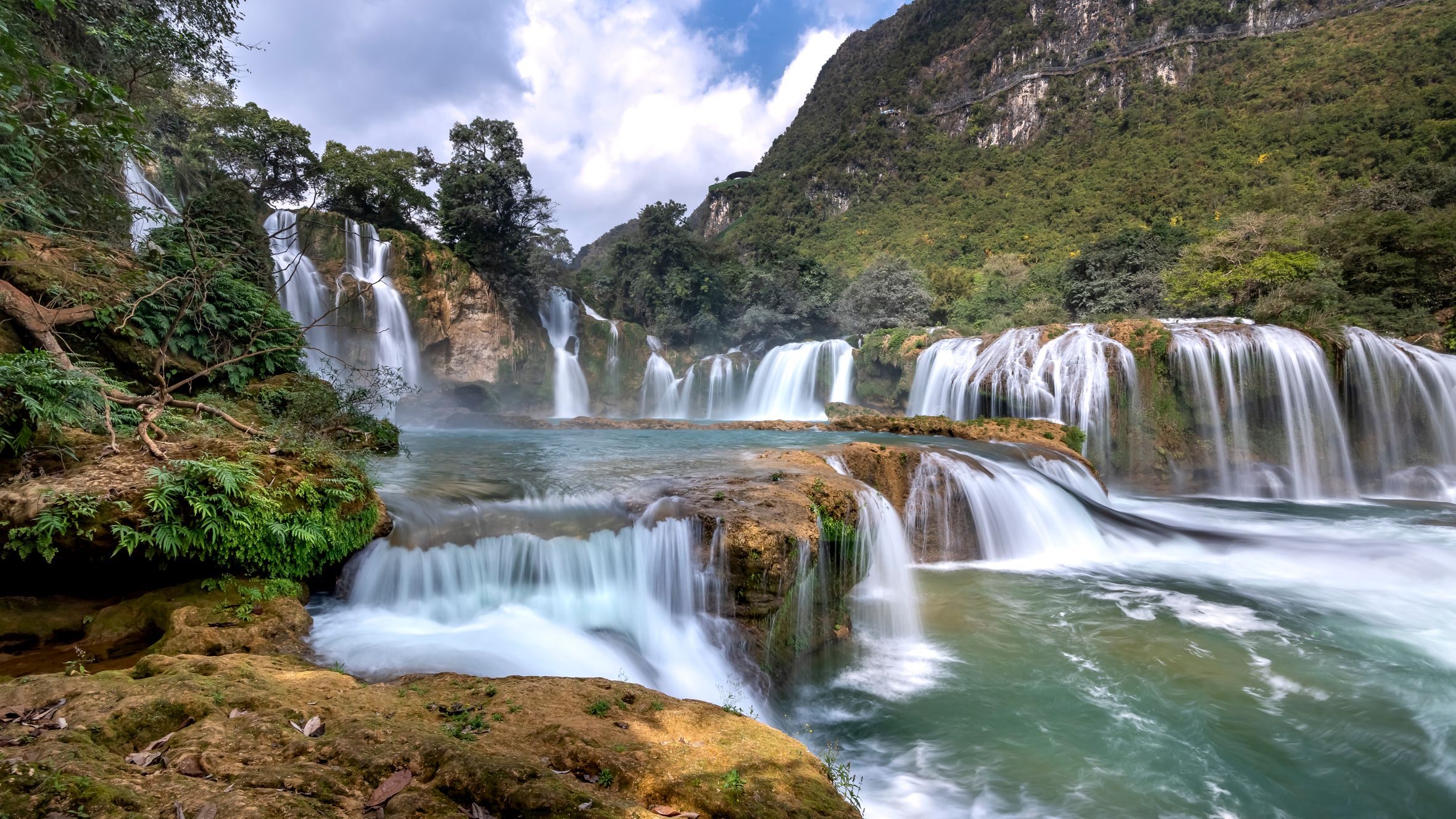
Thac Lieng Nung isn't on most tourists' radar, and that's precisely what makes it worth the trip. This wide, thundering waterfall drops roughly 30 meters over a cliff of dark basalt columns in what is now Lam Dong province — surrounded by coffee plantations, dense forest, and very few selfie sticks.
What it is
Thac Lieng Nung (sometimes written Lieng Nung Falls) sits about 15 km south of the town of Duc Trong in Lam Dong's highland interior. The waterfall is fed by a tributary of the Da Nhim River and cascades over columnar basalt — the same kind of hexagonal rock formations you see at places like the Giant's Causeway, except here they're wrapped in tropical greenery and red laterite soil.
The name comes from the K'Ho minority language. The K'Ho and Ma peoples have lived in these highlands for centuries, and the waterfall has long held spiritual significance for local communities. You'll notice small shrines and offerings near the base if you look carefully.
Unlike the more developed waterfalls closer to Da Lat — Datanla, Elephant Falls, Pongour — Lieng Nung has stayed relatively low-key. There's a ticket booth, a cleared path, and not much else. That's the appeal.
Why travelers go
Three reasons, mostly. First, the basalt columns. They form a dramatic dark wall behind and beside the falls, and during the wet season the water fans out across the full width — maybe 40 meters across — in a white curtain that's genuinely impressive. Second, the quiet. You might share the site with a handful of Vietnamese families on a weekend, or have it entirely to yourself on a weekday. Third, it pairs well with a broader trip through the Central Highlands (중부 고원 / 中部高原 / 中部高原) if you're heading between Da Lat and destinations further south or west.
Photographers come for the golden-hour light that cuts through the canopy around 4:30-5:00 PM from March to September. The mist from the falls catches it nicely.
Best time to visit
The wet season — roughly May through October — is when the falls are at full power. September and October tend to be peak flow. The trade-off: trails get muddy and slippery, and afternoon downpours are almost daily.
The dry season (November to April) means thinner water flow but easier access and clearer skies. January through March is the sweet spot for comfortable weather — daytime highs around 24-26°C, cool mornings.
Avoid major holiday weekends around Tet if you want solitude. The falls themselves won't be crowded by Ninh Binh (닌빈 / 宁平 / ニンビン) or Ha Long standards, but the roads fill up and accommodation prices spike.
How to get there
From Da Lat, Thac Lieng Nung is about 50 km south — roughly 1.5 hours by motorbike via QL20 and local roads. The ride passes through coffee and macadamia plantations, and it's a pleasant one if you're comfortable on two wheels.
If you're coming from Saigon, the most practical route is to take the overnight sleeper bus to Da Lat (around 300,000 VND, 7-8 hours), then rent a motorbike in town for 120,000-180,000 VND/day. Several shops along Phan Dinh Phung street rent manuals and semi-automatics.
By car, you can book a private driver from Da Lat for roughly 800,000-1,200,000 VND round-trip including waiting time. Grab doesn't reliably operate out here.
The last few kilometers to the falls are on a concrete lane that narrows as it approaches the entrance. There's a small parking area. Entrance fee at last check was 20,000 VND per person — basically nothing.

Photo by Serg Alesenko on Pexels
What to do
The main trail from the ticket booth to the waterfall base takes about 15-20 minutes on foot, descending through forest with some uneven stone steps. Wear shoes with grip — flip-flops are a bad idea, especially in the wet months.
At the base, you can wade into the shallow pool if the current isn't too strong (stick to the edges during high water). The basalt columns are best viewed from the left side of the pool looking back at the falls. There's a rough scramble path up the left bank that gives you a higher vantage point — worth it for photos, but watch your footing.
Beyond the waterfall itself, the surrounding area is good for a half-day of low-key exploration. The road in passes through K'Ho villages where you'll see coffee beans drying on tarps and the occasional roadside stall selling avocados, passion fruit, and "ruou can" (rice wine in communal jars with bamboo straws). If someone offers you a sip, it's rude to refuse.
Where to eat
There's no restaurant at the falls. Bring water and snacks. For a proper meal, head back toward Duc Trong town, where a handful of "com binh dan" (everyday rice) shops line the main road. Expect to pay 35,000-50,000 VND for a plate of rice with grilled pork, greens, and soup.
If you're returning to Da Lat, treat yourself to a bowl of "bun bo Hue" at Bun Bo Hue Ba Tuyet on Hai Ba Trung street — thick, spicy, and around 45,000 VND. Da Lat also has surprisingly good "banh mi" from the carts near the central market, and the city's egg coffee scene has grown in the last few years with several decent cafes along Tran Phu.
Where to stay
Most travelers base themselves in Da Lat and day-trip to Lieng Nung. Da Lat has accommodation at every price point — hostels from 150,000 VND/night, decent mid-range hotels around 500,000-800,000 VND, and some genuinely nice boutique places in the 1,200,000-2,000,000 VND range up in the hills above town.
If you want to stay closer to the falls, there are a few basic guesthouses ("nha nghi") in Duc Trong for 200,000-350,000 VND. Don't expect much beyond a clean bed, hot water, and Wi-Fi that sort of works. That said, staying local means you can hit the falls at dawn before anyone else shows up.

Photo by Quang Nguyen Vinh on Pexels
Practical tips
- Footwear matters. The trail is steep in places and wet rocks are slick. Trail shoes or even old sneakers beat sandals.
- Bring a dry bag if you're carrying electronics. Mist from the falls soaks everything within 20 meters of the base.
- Cash only. No ATMs near the falls; the nearest reliable ATMs are in Duc Trong or Da Lat. Bring small bills for the entrance fee and roadside snacks.
- Combine it. If you're already exploring Da Lat's waterfalls, Lieng Nung makes a solid add-on — especially if Datanla felt too theme-park for your taste.
- Bug spray. Mosquitoes near the pool are persistent year-round.
Common mistakes
Showing up in flip-flops is the big one — every visit someone's gingerly hobbling back up the trail with bruised toes. Arriving midday in the dry season and being disappointed by low water flow is another; if volume matters to you, come in September. And don't try to drive here after dark — the last stretch has no lighting and the lane is narrow enough that oncoming motorbikes appear with zero warning.
Final note
Thac Lieng Nung won't compete with Phong Nha's caves or Ha Long Bay for scale, but it delivers something harder to find in Vietnam these days: a genuinely beautiful spot where tourism hasn't paved over the experience. Give it half a day, bring decent shoes, and you'll come back with better photos and fewer crowds than anywhere around Da Lat proper.
Last updated · May 29, 2026 · independently researched, never sponsored.





