What it is
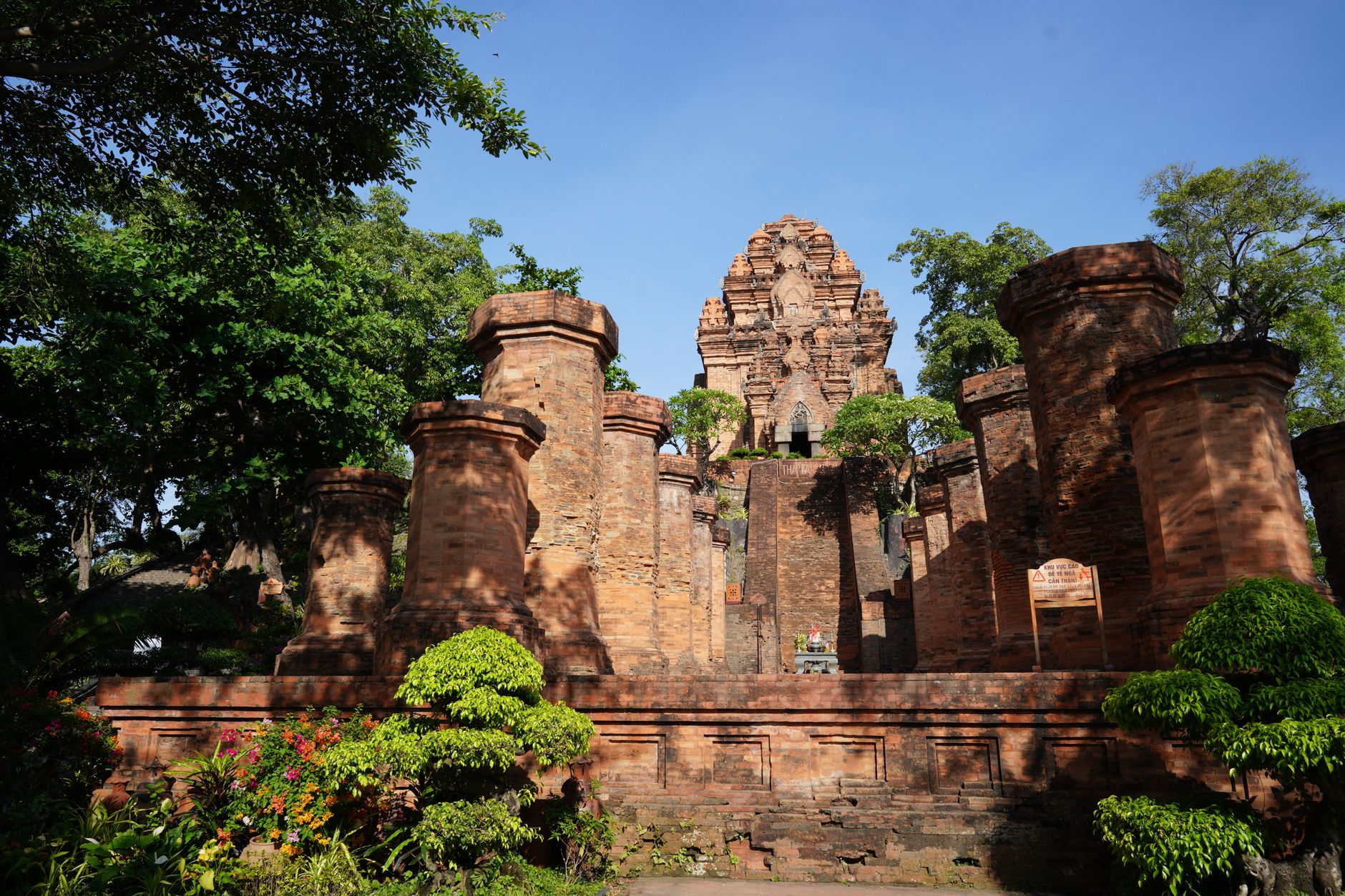
Po Nagar sits on Cu Lao hill at the mouth of the Cai River in Nha Trang (냐짱 / 芽庄 / ニャチャン), Khanh Hoa province. It's a Cham Hindu temple complex — not ruins, not a museum, but an active religious site where people still come to pray, burn incense, and make offerings. The towers were built between the 7th and 12th centuries, dedicated primarily to the goddess Po Ina Nagar (also called Thien Y A Na in Vietnamese tradition), a mother deity associated with rice, crops, and the land.
Of the original eight or more towers, four remain standing. The main tower — the North Tower, or "Thap Chinh" — is the tallest at roughly 23 meters and the most architecturally intact. Its tiered roof, carved stone pillars, and interior linga-yoni altar give you a direct look at Cham religious architecture that influenced temple design across Southeast Asia. If you've visited My Son near Hoi An, Po Nagar offers a different perspective: smaller scale, urban setting, still in daily use.
Khanh Hoa province recently merged with Ninh Thuan, but Po Nagar's location hasn't changed — it's right in Nha Trang city, about 2 km north of the main tourist beach strip.
Why travelers go
Three reasons, mostly. First, Po Nagar is one of the best-preserved Cham temple sites in Vietnam (베트남 / 越南 / ベトナム), and unlike My Son, it hasn't been heavily damaged by war. Second, it's inside the city — no half-day excursion required. Third, the hilltop gives you a wide view over the Cai River, fishing boats, and the Nha Trang coastline. It's a 45-minute visit that tells you more about central Vietnam's pre-Vietnamese history than most places you'll find without leaving town.
Best time to visit
Nha Trang's dry season runs from January to August, with March through June being the most comfortable — warm but not yet peak-heat, and very little rain. The site is outdoors and exposed, so visiting during a downpour (September–December rainy season) means slippery stone steps and limited visibility.
Time of day matters more than season. Go before 9:00 AM or after 3:30 PM. Tour buses hit between 10:00 and 14:00, and the complex is compact enough that 60 tourists feels crowded. Early morning light is better for photos of the towers facing east, and you'll share the space with locals making offerings rather than tour groups.

Photo by Nguyên Đoàn on Pexels
How to get there
From Nha Trang's central beach area (around Tran Phu Street), Po Nagar is about 2 km north. A Grab bike costs 15,000–20,000 VND, a Grab car around 25,000–35,000 VND. You can also walk it in 25 minutes along the river — follow Yersin Street north to the Xom Bong bridge, and the towers are visible on the hill to your left.
If you're coming from elsewhere in Vietnam, Cam Ranh International Airport is 35 km south of Nha Trang. Airport shuttle buses run to the city center for about 60,000 VND, or a taxi costs 350,000–450,000 VND. The Nha Trang train station sits right in town, and trains from Hue (roughly 10 hours, from 350,000 VND for a hard seat) or Saigon (7–9 hours, from 300,000 VND) arrive daily.
What to do
Walk the tower complex
Start at the Mandapa — the open pillared hall at the entrance level, partially restored. It originally served as a meditation and rest hall for pilgrims. From there, climb the brick and stone staircase to the tower platform. The North Tower (main tower) is the priority: step inside to see the black stone statue of the goddess, draped in robes and surrounded by incense. The central and south towers are smaller but worth circling to compare construction styles across centuries.
Read the inscriptions
Several carved stone stelae with Sanskrit and old Cham script sit around the complex. Informational signs in Vietnamese and English provide context, but the carvings themselves — dancers, musicians, mythological animals — are the real draw. Look for the carved tympanum above the North Tower entrance depicting a dancing Shiva.
Visit the small exhibition hall
A building near the entrance displays Cham artifacts — ceramics, linga, small sculptures — recovered from the site and surrounding area. It takes about 10 minutes and helps contextualize what you're seeing in the towers.
Watch a traditional dance performance
Free Cham dance performances happen periodically inside the complex grounds — typically a few times daily, though schedules aren't always posted consistently. If you hear music while walking around, follow it. The performances last about 10 minutes and feature traditional Cham costumes and instruments.
Photograph the river view
From the hilltop, you look south over the Cai River estuary, colorful fishing boats, and the Xom Bong bridge. It's a good, honest view of working Nha Trang rather than the resort strip.
Admission is 30,000 VND per person. You'll be offered a loaner robe if your clothing doesn't cover shoulders and knees — it's a religious site, and the rule is enforced.
Where to eat nearby
Walk south from Po Nagar across the Xom Bong bridge and you're in an area known for "nem nuong" — Nha Trang-style grilled pork sausage rolls. Nem Nuong Dang Van Quyen on Ly Tu Trong Street, about 1 km from the towers, has been around for decades and serves a full spread: grilled pork patties, rice paper, fresh herbs, dipping sauce. A set for one person runs 60,000–80,000 VND.
For something lighter, "banh can" — small savory rice cakes cooked in clay molds, topped with egg and served with fish sauce broth — is a Nha Trang breakfast staple. You'll find stalls along Nguyen Thi Minh Khai Street in the mornings.

Photo by ㅤ quang vinh ㅤ on Pexels
Where to stay
Nha Trang has every price range. Budget guesthouses near the backpacker zone along Biet Thu and Hung Vuong streets run 200,000–400,000 VND per night. Mid-range hotels along Tran Phu (the beachfront road) go for 600,000–1,200,000 VND. High-end resorts cluster south of the center toward Bai Dai beach. For visiting Po Nagar, staying near the northern end of Tran Phu puts you within easy walking distance.
Practical tips
- Shoes off inside the towers. Wear sandals you can slip on and off.
- Bring your own water — there's a drink vendor near the entrance, but prices are marked up.
- The site is small. Budget 30–45 minutes for a thorough visit, an hour if you catch a dance performance.
- Combine with the nearby Long Son Pagoda (2 km south) to fill a half-morning of Nha Trang's non-beach attractions.
Common mistakes
- Going midday. The hilltop has almost no shade. At noon in April, it's genuinely uncomfortable.
- Skipping the lower level. Most visitors walk straight up the stairs. The Mandapa pillars at the bottom are worth a few minutes.
- Expecting My Son scale. Po Nagar is four towers on a small hill, not a sprawling archaeological park. Adjust expectations and you'll appreciate it more for what it is — a compact, still-living piece of Cham heritage inside a modern Vietnamese city.
Last updated · May 26, 2026 · independently researched, never sponsored.