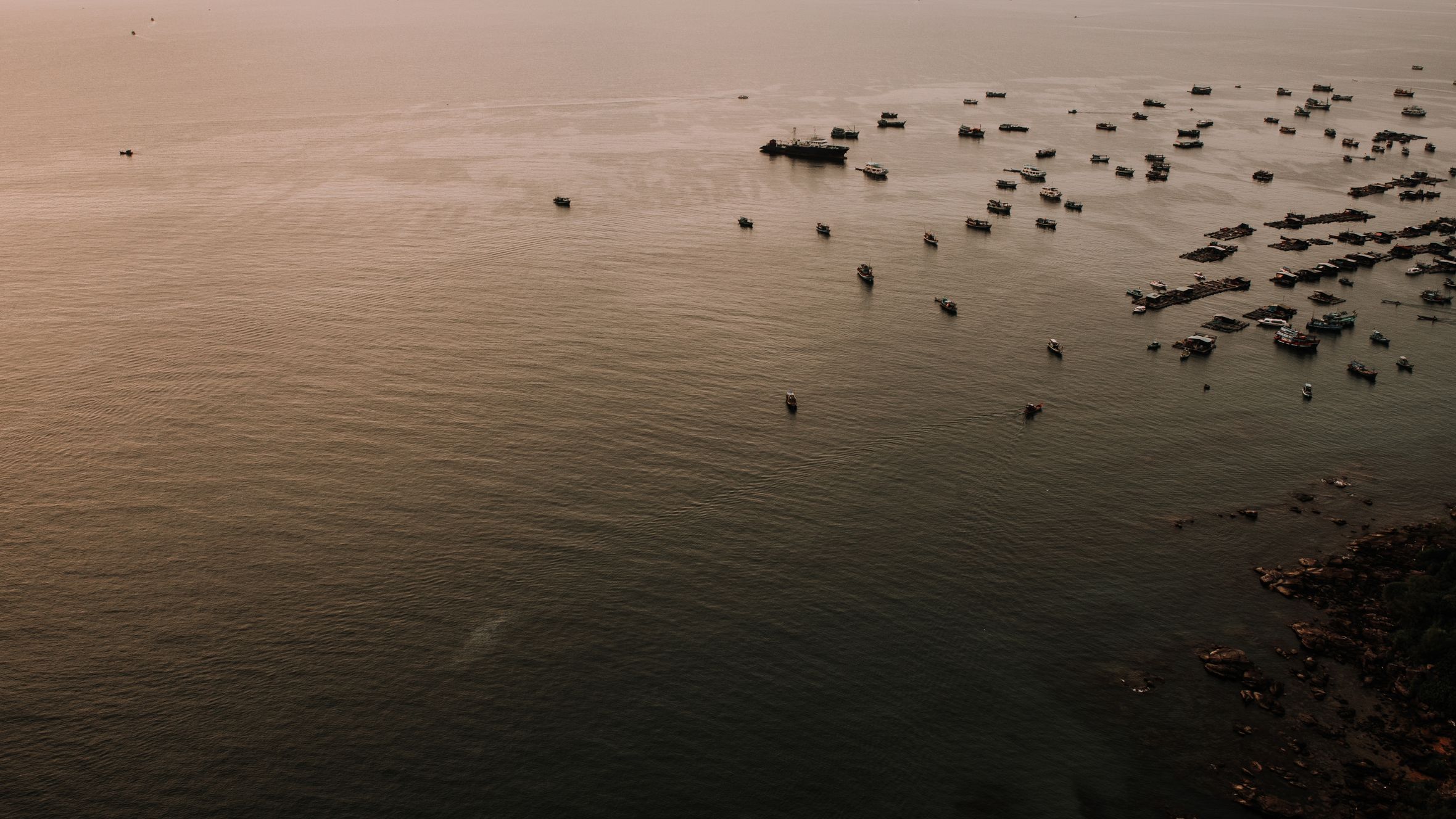
Xuan Dai Bay sits about 25 km north of Tuy Hoa city along the coast of what most travelers still know as Phu Yen province. It's a deep, calm inlet framed by low green hills and fishing villages — the kind of place where lobster traps outnumber tourists and the loudest sound at noon is a rooster losing an argument.
What it is
Xuan Dai Bay (Vinh Xuan Dai) is a natural bay stretching roughly 50 square kilometers between Song Cau town and the Xuan Dai peninsula. Unlike Ha Long Bay's limestone drama or Nha Trang (냐짱 / 芽庄 / ニャチャン)'s resort sprawl, this is a working waterscape. Floating fish farms dot the inner bay, fishing boats cluster at the mouth, and a string of small beaches hide along the eastern shore. The area gained some domestic fame after appearing in Vietnamese films and tourism campaigns around 2018-2020, but international visitors remain rare.
Historically, the bay served as a natural harbor for Cham trading vessels, and later as a French colonial anchorage. Today it's mostly aquaculture — lobster, grouper, oysters — which is exactly why the seafood here is absurdly fresh and cheap.
Why travelers go
- Seafood at source prices. Lobster for 350,000-500,000 VND per kilo. Grilled oysters for 5,000 VND each. You eat on plastic chairs beside the water where your meal was swimming an hour ago.
- Empty beaches. Bai Nom, Bai Bang, and Bai Tu Nham are crescent-shaped sand strips with no sunbed rental operations and no hawkers.
- The light. Phu Yen's coast faces east, and the dawn over Xuan Dai Bay is the reason Vietnamese photographers keep coming back. Golden hour here is genuinely golden — no haze, no high-rises blocking the horizon.
- Slow pace. There's no party scene, no backpacker strip, no banana boats. If you want stimulation, go to Da Nang. If you want to read a book in saltwater silence, come here.
Best time to visit
January through August. The dry season runs roughly February to September, with the calmest seas from March to June. Avoid October through December — this coast catches the tail of the northeast monsoon, and heavy rain can make coastal roads slippery and boat trips inadvisable. Water temperature hovers around 26-28°C from April to August.
How to get there
The nearest airport is Tuy Hoa (Dong Tac Airport, code TBB), with daily flights from Hanoi and Saigon on Vietnam Airlines and VietJet. Flight time is about 1.5 hours from either city. From Tuy Hoa airport, Xuan Dai Bay is 30 km north — a 40-minute drive via QL1A and DT641.
If you're traveling overland from Quy Nhon (110 km south of the bay), grab a bus to Song Cau town (about 2.5 hours, 80,000-100,000 VND). From Nha Trang, it's roughly 200 km north, around 4 hours by car or bus.
Once in Song Cau, you'll want a motorbike. Rent locally for 120,000-150,000 VND/day. The coastal roads around the bay are narrow but paved and mostly flat — manageable even if you're not an experienced rider.

Photo by Serg Alesenko on Pexels
What to do
Visit the floating fish farms
Hire a boat from Xuan Dai wharf (around 200,000-300,000 VND for a 1-2 hour loop). Fishermen will pull up lobster cages and let you pick your lunch. Some farms serve food directly on their platforms — grilled fish, steamed clams, cold beer.
Beach-hop the eastern shore
Bai Nom is the most accessible (paved road from Song Cau, 8 km). Bai Tu Nham requires a short boat ride or a bumpy dirt track — fewer people, rougher sand, better snorkeling near the rocks. Bai Bang sits at the northern tip and is best reached by boat.
Ganh Da Dia day trip
The hexagonal basalt columns at Ganh Da Dia are 20 km south of Song Cau. Think a smaller, less crowded Giant's Causeway. Combine it with a stop at O Loan Lagoon for "banh xeo" stuffed with shrimp from the lagoon — a Phu Yen specialty that's noticeably different from the southern-style crepes.
Sunrise from Mui Dien
Vietnam's easternmost mainland point is about 45 km southeast. The lighthouse sits on a cliff, and on clear mornings you see the sun break the ocean horizon unobstructed. Leave by 4:30 AM from Song Cau to make it.
Where to eat
Skip anything with an English menu — there aren't many anyway. The best meals happen at the floating farms (ask your boatman) or at the row of seafood shacks along the Song Cau waterfront near the old market. Key dishes:
- Lobster steamed with beer — the local default preparation. Simple, sweet, no sauce needed.
- Grilled "banh xeo (반세오 / 越南煎饼 / バインセオ)" with shrimp and squid — crispy, turmeric-yellow, dipped in a fish-sauce-and-green-mango mix.
- "Hu tieu" with fish cake — a morning staple in Song Cau. Light broth, rice noodles, house-made fish cakes.
- Raw blood cockles with lime — not for everyone, but a local delicacy at around 40,000 VND per plate.
Budget 150,000-300,000 VND per person for a full seafood meal with beer. Lobster pushes it higher.
Where to stay
Accommodation is limited and mostly domestic-tourist oriented. Options:
- Song Cau town — a handful of mini-hotels (nha nghi) along the main road. Basic but clean, 200,000-400,000 VND/night. Try Nha Nghi Hoang Gia near the market.
- Xuan Dai Bay Resort — the one semi-upscale option, on the southern shore. Bungalow-style rooms from around 800,000-1,200,000 VND. Pool, bay views, decent breakfast.
- Homestays in Xuan Tho village — a few families rent rooms. Ask at the Song Cau tourist office or search on local booking apps (Traveloka works better than Booking.com here).
Don't expect Hoi An-level hospitality infrastructure. This is still a fishing town that happens to have a beautiful bay.

Photo by Vietnam Hidden Light on Pexels
Practical tips
- ATMs exist in Song Cau but not near the beaches. Withdraw cash in town before heading out.
- Language — very little English spoken. Download Vietnamese phrases or use Google Translate's camera mode for menus.
- Sunscreen and a hat — shade is scarce on the beaches. There are no umbrella rentals.
- Boat safety — life jackets are sometimes absent on fishing boats. Ask for them ("ao phao") or bring an inflatable one.
Common mistakes
- Rushing through. People treat Xuan Dai as a half-day stop between Quy Nhon and Nha Trang. Give it two nights minimum to actually decompress and explore the outer beaches.
- Coming on weekends in summer. Domestic tourists from the highlands descend in July-August weekends. Midweek is quieter.
- Expecting nightlife. Song Cau shuts down by 9 PM. Bring a book, a speaker, or a taste for early bedtimes.
- Skipping the boat. The bay looks nice from shore, but it reveals itself properly from the water. Budget for at least one boat trip.
Final note
Xuan Dai Bay isn't trying to compete with Phu Quoc or Da Nang. It doesn't have the infrastructure, the marketing, or the Instagram fame. What it has is cheap lobster, empty sand, and the kind of quiet that's getting harder to find along Vietnam's coast. Go before the resorts figure that out.
Last updated · May 29, 2026 · independently researched, never sponsored.







