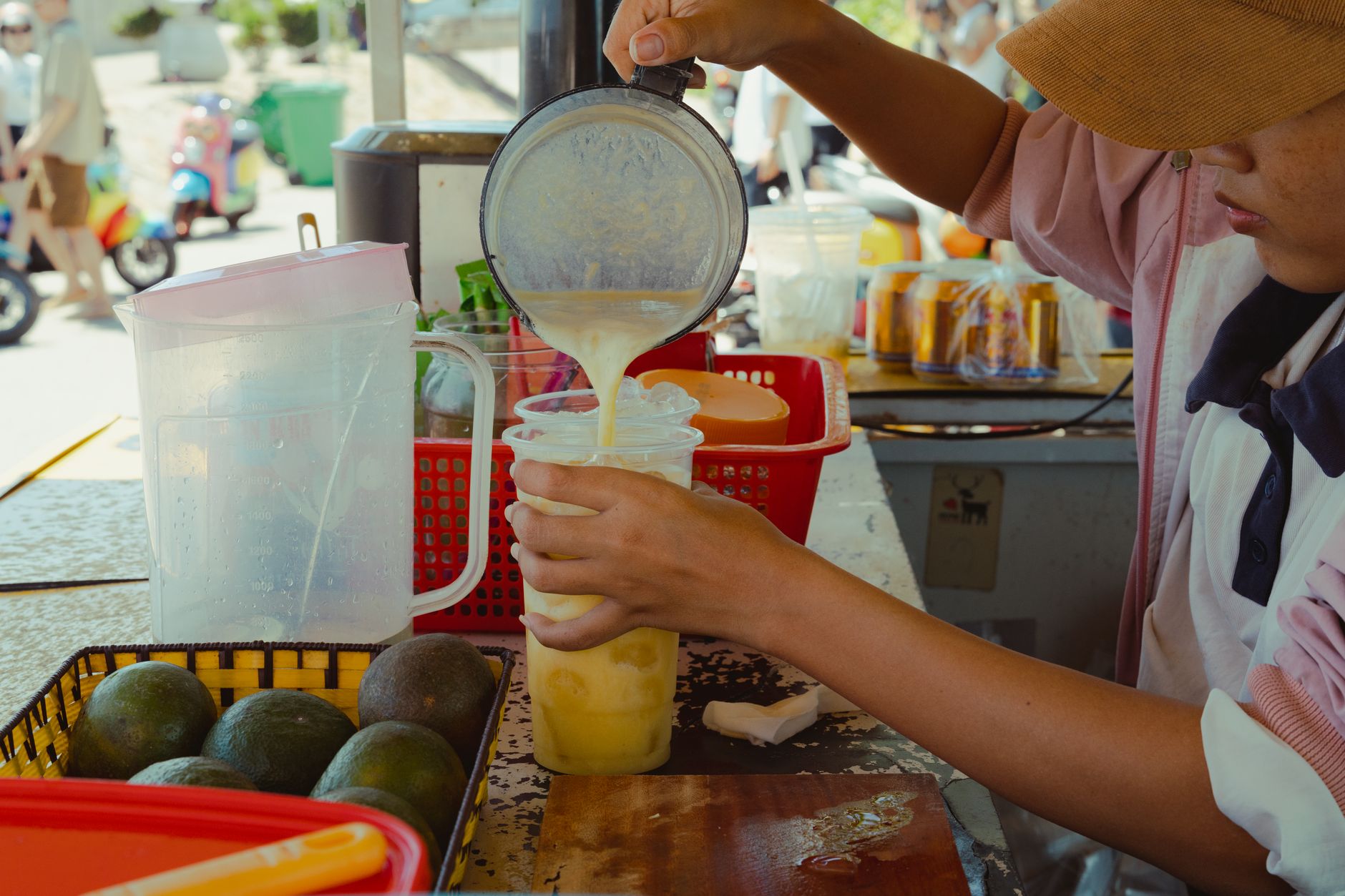
Saigon's coffee scene runs deep — from a sidewalk cup of "ca phe sua da" to a quiet bowl of "egg coffee" ordered out of curiosity — but "ca phe bo", avocado coffee, sits in its own lane entirely. It is less a drink than a small meal in a glass, and once you understand what goes into it, that makes complete sense.
What Ca Phe Bo Actually Is
Strip away the Instagram framing and the recipe is straightforward: ripe avocado blended smooth with sweetened condensed milk, poured over or layered beneath a shot of espresso or strong drip coffee, then served cold. Some shops add a scoop of ice cream on top. Others keep it strictly blended into a thick, pale-green shake. A few places serve it warm, which is a different experience — nuttier, heavier, not for everyone.
The texture is what catches people off guard. This is not a thin iced coffee with a novelty ingredient. It is dense and almost spoonable at the bottom of the glass. The bitterness of the coffee cuts through the fat of the avocado in a way that genuinely works, with the condensed milk bridging the two. If you have been drinking Vietnamese coffee (베트남 커피 / 越南咖啡 / ベトナムコーヒー) for more than a week, the flavour logic will feel familiar even if the ingredient combination does not.
Calorie count is not something to think too hard about here.
Why Da Lat Avocados Matter
The avocado is not native to Vietnam, but Da Lat's cool central highlands (중부 고원 / 中部高原 / 中部高原) climate — sitting at around 1,500 metres elevation — turned out to be well-suited for growing them. Da Lat avocados tend to be larger, fattier, and less watery than varieties grown at lower altitudes, which matters enormously in a blended drink. A thin avocado produces a thin result. The Da Lat variety gives ca phe bo its characteristic density.
Most of Saigon's better cafes source their avocados from Da Lat, and the ones that do will usually tell you — it functions as a mild quality signal. Peak season runs roughly from August through November, when prices drop and supply is consistent. Outside that window, quality can vary and some shops substitute frozen avocado pulp, which gets the job done but loses some of the fresh, grassy note that makes the drink interesting.

Photo by Sóc Năng Động on Pexels
Where to Order It in Saigon
Cafes That Do It Well
Bo De Xanh on Nguyen Thi Minh Khai in District 3 has been making ca phe bo long enough to have regulars who order nothing else. Their version leans sweet and thick, blended to order, priced around 55,000–65,000 VND. It lands somewhere between a dessert and a coffee and is best consumed slowly.
Cong Ca Phe — the chain with the military-aesthetic decor — carries avocado coffee across most of its Saigon locations and is a reasonable introduction if you want a consistent benchmark. Quality is reliable if not especially distinctive, around 65,000–75,000 VND depending on which branch you visit. The District 1 location near Ben Thanh Market is convenient after a morning at the market.
For something less commercial, the smaller independent cafes along Hoang Dieu 2 in Thu Duc and the back streets of Binh Thanh district often do ca phe bo that skews less sweet and uses noticeably better coffee as the base. Prices at these spots hover around 40,000–55,000 VND.
How to Order
In Vietnamese, ask for ca phe bo da (iced) or ca phe bo nong (hot/warm). Most menus in Saigon now include English labeling for avocado coffee, so pointing works fine too. If you want less sugar, say it duong — the condensed milk is generous by default.

Photo by Quý Nguyễn on Pexels
Ca Phe Bo vs. Other Vietnamese Coffee Drinks
If you have already worked through the standard vietnamese coffee rotation — black drip, ca phe sua da, egg coffee up in Hanoi — ca phe bo is a logical next step rather than a departure. It shares the same DNA: strong coffee, condensed milk, a secondary ingredient that transforms the texture. The difference is that avocado turns it into something closer to a smoothie than a coffee, and the caffeine hits more slowly because of everything else in the glass.
It also photographs extremely well, which has helped push it onto menus across the city over the last five years. That is not a reason to avoid it — the drink earns its place on merit — but it does mean you will occasionally encounter a version optimized for appearance over flavour. If the avocado layer looks artificially vivid green, it has probably been blended with food colouring or coloured syrup. The real thing is a muted, earthy green-grey.
Practical Notes
Ca phe bo is on menus year-round in Saigon, but if you visit between August and November you are more likely to encounter fresh Da Lat avocado rather than frozen pulp. Budget 40,000–75,000 VND depending on the cafe. It is filling enough to replace a light breakfast, so factor that in if you are planning a morning of walking — pairing it with a "banh mi" works well and keeps the total spend under 80,000 VND.
Last updated · May 29, 2026 · independently researched, never sponsored.