
Most visitors to Vietnam (베트남 / 越南 / ベトナム) have heard of "banh chung" — the square Tet cake that appears on every New Year's table. Far fewer know its cone-shaped southern cousin. "Banh u" doesn't have a famous PR campaign behind it. You find it at wet markets before sunrise, wrapped tight in dark banana leaf, steaming in a vendor's pot. That low profile is part of why it's worth knowing.
What Banh U Actually Is
Banh u is a pyramid or cone-shaped dumpling made from glutinous rice, wrapped in banana leaves and boiled for several hours until the rice is fully cooked-through and slightly translucent. The shape — a four-sided cone tapering to a point — is its most immediate identifier. Pick one up and it sits neatly in your palm, dense and warm, tied with thin strips of bamboo or dried leaf.
The outer layer is glutinous rice, sometimes tinted grey-green from the banana-leaf contact during cooking. Inside is where regional identity asserts itself: fillings range from savory mung bean paste mixed with pork fat to sweetened coconut and mung bean for dessert versions. The rice itself is often soaked in wood-ash water ("nuoc tro") before cooking, which gives it a distinctive alkaline flavor and a slightly chewy, almost gel-like texture that sets it apart from other sticky-rice preparations.
Where Banh U Comes From
The cake is most deeply associated with Hue and the broader central coast, though it turns up with regularity across the south. In Hue, banh u has historical roots tied to the lunar calendar — specifically to "Tet Doan Ngo", the fifth-day-of-the-fifth-month festival (around June in the solar calendar) when households traditionally prepare sticky-rice cakes to mark the midyear. The ash-water treatment of the rice is a technique shared across several Southeast Asian cultures and is thought to help preserve the cakes in humid heat.
In the south — particularly in the Mekong Delta (메콩 델타 / 湄公河三角洲 / メコンデルタ) and around Saigon — banh u appears more regularly year-round at markets rather than being confined to festival cycles. Southern versions tend to be slightly larger and lean toward sweeter fillings, reflecting the regional palate.
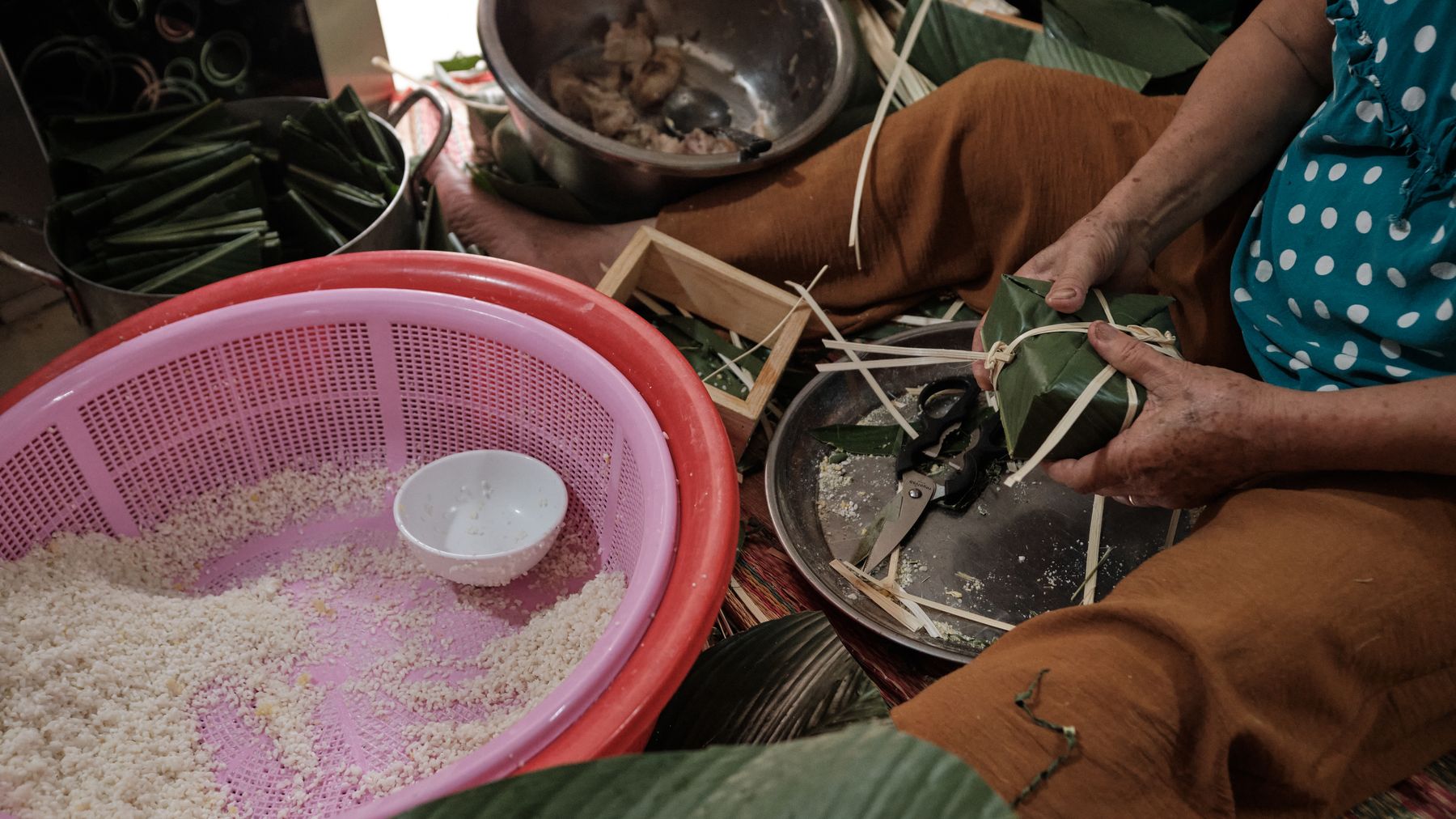
Photo by Nguyen Truong Khang on Pexels
The Main Variants
Banh U Mat Tro (Ash-Water Rice Cake)
This is the most traditional form. The glutinous rice is soaked overnight in water filtered through wood ash, which raises the pH and changes the starch structure. The result is a translucent, slightly sticky cake with a faint mineral taste. Fillings are typically minimal — sometimes just plain rice, eaten with sugar or sesame salt, or filled with a simple mung bean paste. The flavor is subtle and the texture is the whole point.
Banh U Nhan Dau Xanh (Mung Bean Filled)
The most common savory-leaning version. A core of steamed, seasoned mung bean paste — sometimes mixed with a small piece of pork belly or pork fat — sits at the center of the glutinous rice cone. The fat renders into the rice during the long boil, making the surrounding grains rich and slightly unctuous. This is the version you're most likely to encounter in Hue markets and at roadside stalls along the central coast.
Banh U Nhan Dua (Coconut Filling)
Common in the Mekong Delta. The filling combines shredded coconut, mung bean paste, and palm sugar into something closer to a dessert. The rice exterior stays the same — dense, slightly alkaline from the ash-water — but the interior is sweet enough that it's often eaten as an afternoon snack with Vietnamese coffee or "ca phe sua da".
Banh U La Chuoi (Fresh Banana Leaf, No Ash Soak)
Some vendors skip the ash-water soak entirely, using plain glutinous rice and relying solely on the banana leaf for flavor and color. These versions are milder, less chewy, and quicker to prepare. They're common at small family-run stalls in Saigon's District 4 and District 8, where they're sold in small clusters of four or five for around 5,000–10,000 VND per piece.
How to Order Banh U
Banh u is almost always sold pre-made at wet markets and street stalls rather than made to order. The standard transaction is simple: you point, ask how many ("bao nhieu cai?"), pay, and eat standing up or take them wrapped in a plastic bag.
Prices vary by filling and region. At a Hue market, expect to pay 5,000–8,000 VND for a plain or mung-bean version. Sweet coconut versions in the Delta run slightly higher at 8,000–12,000 VND. Nobody will hand you a menu. Look for the pot of simmering water with cones stacked alongside, or the banana-leaf pyramid shapes piled on a tray near the entrance of a covered market.
If you want the ash-water version specifically, ask for "banh u mat tro" — vendors who make this style usually know the term and will confirm it. The grey-green tint on the rice exterior is a visual tell.
Eat them warm if you can. Refrigerated banh u turns hard and loses the textural contrast between the chewy exterior and softer filling. If you buy a batch and have leftovers, re-steam them for ten minutes rather than microwaving.

Photo by Toàn Đỗ Công on Pexels
Where to Try Canonical Versions
Cho Dong Ba, Hue — The central covered market in Hue is the single best address for banh u in the country. The vendors in the dried-goods and fresh-cake section sell mung-bean and ash-water versions daily from around 6 a.m. Prices top out at 8,000 VND. Get here before 9 a.m. or the good batches are gone.
Cho Tan Dinh, Saigon — The market on Hai Ba Trung Street in District 1 has a steady rotation of central Vietnamese vendors who stock banh u alongside "banh cuon" and other wrapped rice preparations. The coconut-filled southern version shows up here with enough regularity that it's worth a dedicated look during a morning market walk.
Cho Con, Da Nang — Da Nang's main covered market carries banh u from vendors who source recipes from Hue, roughly 100 km north. The proximity means the central-style mung-bean version is well-represented here, often sold alongside "mi quang" and grilled rice paper at the cooked-food counters inside the market.
Practical Notes
Banh u is firmly a morning and early-afternoon food — most vendors sell out by early afternoon and don't restock. If you're traveling through Hue specifically during Tet / 越南春节 / テト) Doan Ngo (typically June), production spikes and you'll find a wider variety of fillings and sizes than at any other time of year. Outside of festival season, supply is consistent but quieter.
Last updated · May 29, 2026 · independently researched, never sponsored.




