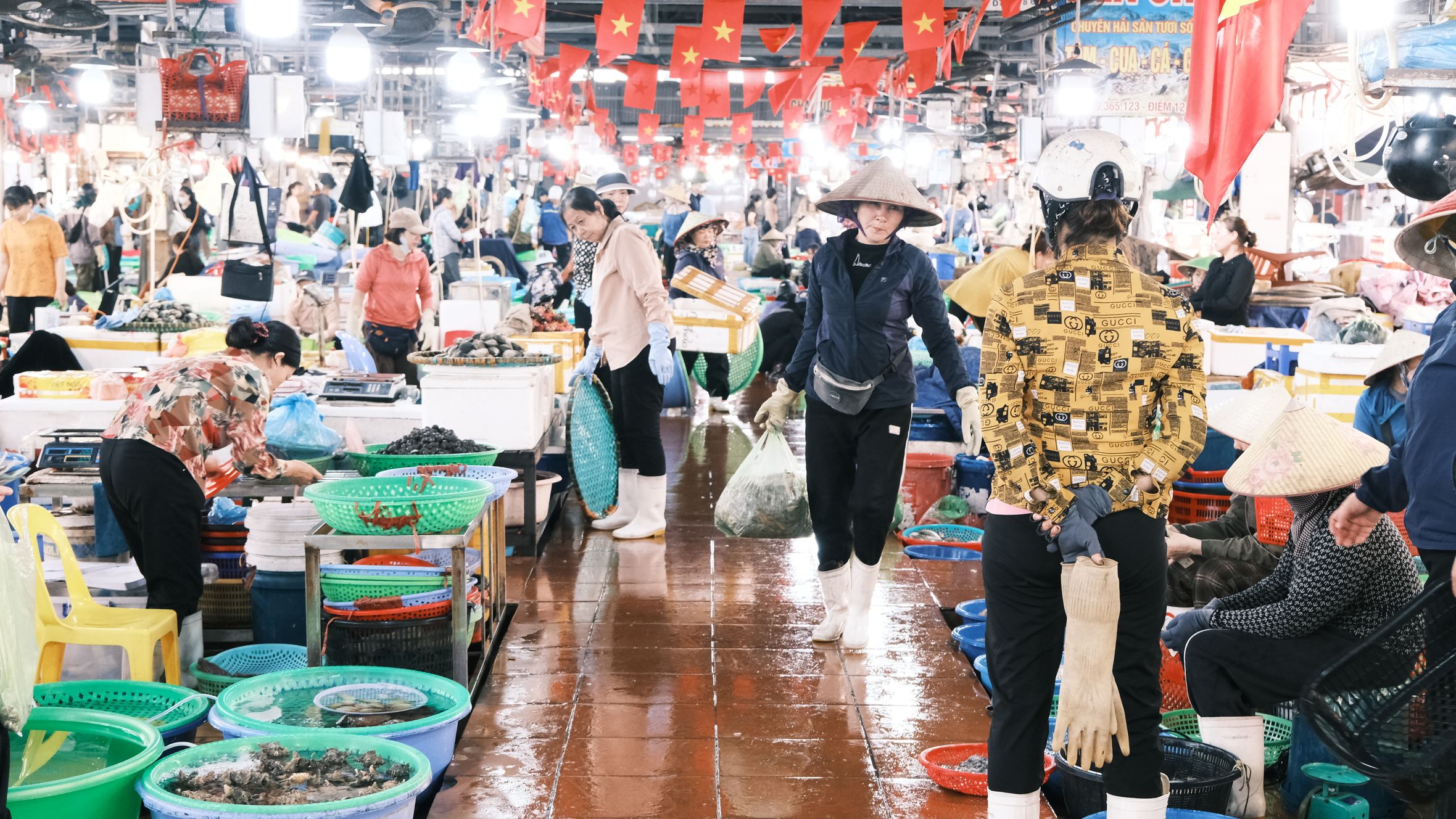
Cho Con is the market Da Nang locals actually use. While tourists sometimes default to Han Market closer to the river, Cho Con is where the city does its daily shopping, and it has been that way for decades.
What it is and how it got here
Cho Con sits on Ong Ich Khiem Street in Hai Chau District, roughly 1.5 km west of the Han River. The market has operated in some form since the 1940s, growing from an open-air trading spot into the sprawling three-story concrete structure you see today. The current building went up in 1984 and was renovated in the early 2000s. It covers about 14,000 square metres and houses around 2,000 stalls.
The name "Cho Con" literally translates to "small market" — ironic, since it's the biggest covered market in Da Nang (다낭 / 岘港 / ダナン). The name stuck from a time when it was a secondary market compared to the original riverside trading area. These days, nothing about it feels small.
With Da Nang's recent administrative changes following the merger with Quang Nam, the city has been growing fast, but Cho Con remains firmly rooted in its old-neighborhood character.
Why travelers bother
Cho Con isn't a tourist attraction in the usual sense. There's no ticket counter, no guided tour, no Instagram wall. What it offers is a genuine look at how a mid-sized Vietnamese city feeds itself. The ground floor alone is an education in Central Vietnamese ingredients — dried shrimp in every shade of orange, fermented fish paste sold by the jar, chili flakes ground fresh while you wait.
It's also one of the better places in Da Nang to buy fabric, tailored clothes, and local snacks to take home. Prices here tend to run 15-30% cheaper than at Han Market for the same goods, because the customer base is mostly local.
Best time to visit
The market opens daily from roughly 6:00 AM to 6:00 PM, though many food vendors start packing up by 5:00 PM. The sweet spot is between 7:00 and 9:00 AM, when the fresh produce section is at its peak and the food stalls are firing on all cylinders. By midday the heat inside the building gets thick, even with fans running.
Season-wise, Da Nang's dry months from March through August are most comfortable for market wandering. The rainy season (September to December) doesn't shut Cho Con down, but the surrounding streets can flood during heavy downpours, making the approach messy.
How to get there
From the Da Nang city center or the beach hotel strip along Vo Nguyen Giap, Cho Con is a short ride.
- Grab bike: 15,000-25,000 VND from most hotels along My Khe Beach, about 10 minutes.
- Grab car: 35,000-50,000 VND, same route.
- Walking from Han Market: 1.2 km west along Hung Vuong Street, roughly 15 minutes on foot.
- From Da Nang train station: less than 1 km south — you can walk it in under 10 minutes.
If you're coming from Hoi An (about 30 km south), take a Grab or local bus #1, which costs 30,000 VND and takes around 50 minutes.

Photo by Kirandeep Singh Walia on Pexels
What to do inside
Eat your way through the ground floor
The food court area on the ground floor is the real draw. Stalls serve "mi quang" — the turmeric-tinted noodle dish that defines Central Vietnamese cooking — for 30,000-40,000 VND a bowl. You'll also find "banh xeo" folded crispy and wide the way Da Nang does it, different from the Saigon version. A plate runs about 20,000-30,000 VND. One stall near the Ong Ich Khiem entrance has been making "banh canh" with crab for years; ask for "banh canh cua" and point if language is a barrier.
Buy dried goods and snacks
The second floor has rows of vendors selling dried squid, sesame candy, "nem chua" (fermented pork rolls), and various rice crackers. These make better souvenirs than fridge magnets. A bag of "banh trang" (rice paper) with sesame and coconut costs around 30,000-50,000 VND and travels well in a backpack.
Get fabric or clothes tailored
Cho Con's textile section is less tourist-oriented than Hoi An (호이안 / 会安 / ホイアン)'s tailor shops, which means the starting prices are lower. A simple cotton shirt made to measure can start around 150,000 VND. Don't expect the same English-speaking service as Hoi An — bring a photo of what you want and use a translation app.
Browse the wet market section
Even if you're not cooking, the seafood and meat aisles are worth a slow walk. The fish comes straight from Da Nang's coastal fleet, and the variety is impressive — razor clams, mantis shrimp, pomfret, barramundi, all laid out on ice by 7:00 AM.
Pick up local coffee
Several stalls sell ground Vietnamese coffee by weight. A half-kilo bag of robusta blend runs 60,000-100,000 VND depending on the roast. If you're particular about your "ca phe sua da", this is a good place to stock up before heading home.
Where to eat nearby
Right outside the market's south gate, a row of street carts sells "bun cha ca" — fish cake noodle soup that's a Da Nang specialty. A bowl costs 35,000-45,000 VND. For something more substantial, walk 5 minutes east toward the river for "com tam" plates at one of the rice shops along Hung Vuong Street — broken rice with grilled pork and a fried egg for around 40,000 VND.
If you haven't tried egg coffee yet, a few cafes on Le Duan Street (a 10-minute walk northeast) serve credible versions, though Hanoi purists may disagree.
Where to stay
Cho Con is in Hai Chau, Da Nang's central district, so accommodation options are dense.
- Budget: Hostels and guesthouses on Yen Bai or Le Duan streets, 150,000-300,000 VND/night.
- Mid-range: Hotels along Bach Dang (riverfront) run 500,000-900,000 VND/night with air conditioning and breakfast.
- Higher-end: The beach strip along Vo Nguyen Giap has rooms from 1,200,000 VND upward, but you'll be a 10-minute ride from the market.

Photo by Pew Nguyen on Pexels
Practical tips locals would tell you
- Bring cash. Almost no vendor here takes cards. ATMs are on Hung Vuong and Ong Ich Khiem streets nearby.
- Bargain gently. Prices aren't as inflated as at Han Market, but vendors still quote 10-20% above what they'll accept. A friendly counter-offer works better than aggressive haggling.
- Carry a reusable bag. Vendors default to thin plastic bags and they pile up fast.
- Leave the big backpack at your hotel. The aisles are narrow, especially on the upper floors. A crossbody bag or small daypack is all you need.
- Use your phone camera for prices. If there's a language gap, vendors will punch numbers into a calculator or your phone screen.
Common mistakes to avoid
- Going at noon. The heat, the crowds thinning out, and the food stalls winding down make midday the worst window.
- Skipping the upper floors. Most visitors stick to the ground floor. The dried goods and textiles upstairs are where locals spend real money.
- Comparing it to Ben Thanh Market. Cho Con isn't curated for tourists. That's the point. If you want air conditioning and fixed prices, this isn't it.
- Not eating before you shop. Hit the food stalls first. You'll make better decisions on a full stomach, and the "mi quang" ladies are sharpest early in the morning.
Practical notes
Cho Con is best paired with a morning walk along the Han River or an afternoon trip to the Golden Bridge at Ba Na Hills. Budget about 90 minutes for the market itself — more if you're eating. It won't be the highlight everyone talks about over dinner, but it's the kind of place that makes you feel like you actually visited Da Nang, not just its beach resorts.
Last updated · May 29, 2026 · independently researched, never sponsored.