What Chua Vam Ray Is and Why It Matters
Chua Vam Ray — sometimes written Chua Vamray or Wat Vam Ray — is a Khmer Theravada Buddhist pagoda located in Ham Giang commune, in what was formerly Tra Vinh province and is now part of the expanded Vinh Long province following a 2025 administrative merger. It's the largest Khmer pagoda in the Mekong Delta (메콩 델타 / 湄公河三角洲 / メコンデルタ) by area, spread across roughly 50,000 square meters of flat delta land about 8 km south of Tra Vinh town center.
The original pagoda on this site dates back several centuries, serving the local Khmer community that makes up a significant minority in this part of the delta. The current complex, however, is almost entirely modern — a massive reconstruction funded by a Vietnamese-Khmer businessman and completed around 2017-2019. The main worship hall alone covers about 3,000 square meters, with a tiered roof rising over 50 meters. Think of it less as an ancient ruin and more as a living statement of Khmer cultural identity in southern Vietnam (베트남 / 越南 / ベトナム), built with serious money and genuine devotion.
Why Travelers Go
Most people visit Chua Vam Ray because nothing else in the Mekong Delta looks like it. The scale is genuinely surprising — you turn off a quiet provincial road lined with coconut palms and suddenly there's this enormous gold-and-orange complex rising out of the rice paddies. The architecture pulls from Cambodian Khmer traditions: carved nagas flanking staircases, ornate gilded interiors, rows of apsara figures, and a towering central spire modeled loosely on Angkorian forms.
Beyond the visual spectacle, the pagoda is a window into the Khmer communities that have lived in the Mekong Delta for generations. Tra Vinh (now part of Vinh Long) has one of the highest concentrations of ethnic Khmer people in Vietnam, and the pagoda functions as a real community hub — not just a tourist attraction. Monks live on-site, ceremonies happen regularly, and during Khmer festivals like Chol Chnam Thmay (Khmer New Year, usually mid-April) or Sene Dolta (ancestor worship, around September-October), the grounds fill with families.
Best Time to Visit
The dry season from December through April is most comfortable. Temperatures hover around 28-33°C with little rain, and the grounds are easier to walk without dodging puddles on unpaved paths. If you want to time your visit with a Khmer festival, aim for mid-April (Chol Chnam Thmay) or late September to early October (Sene Dolta) — the pagoda comes alive with processions, food stalls, and traditional music.
Avoid July and August if you can. Afternoon downpours are near-daily and the humidity is punishing. Weekday mornings year-round tend to be quiet, which is ideal for photography and for having conversations with resident monks who often speak some English.
How to Get There
From Can Tho (the nearest major hub), Tra Vinh town is about 100 km northeast — roughly 2.5 hours by car or motorbike via QL54. A private Grab car costs around 500,000-650,000 VND one way. There's also a local bus from Can Tho's main bus station to Tra Vinh (around 80,000-100,000 VND, 3+ hours with stops).
From Saigon, it's about 200 km and 4-4.5 hours driving. Buses from Mien Tay bus station run to Tra Vinh for roughly 120,000-160,000 VND.
Once you're in Tra Vinh town, Chua Vam Ray is 8 km south along DT37. A local "xe om" (motorbike taxi) from the town center costs 30,000-50,000 VND. If you're on your own motorbike — the best way to explore the delta generally — just follow DT37 toward Ham Giang and watch for the pagoda's spire above the tree line. It's not subtle.

Photo by Nguyen Truong Khang on Pexels
What to Do
Walk the Main Worship Hall
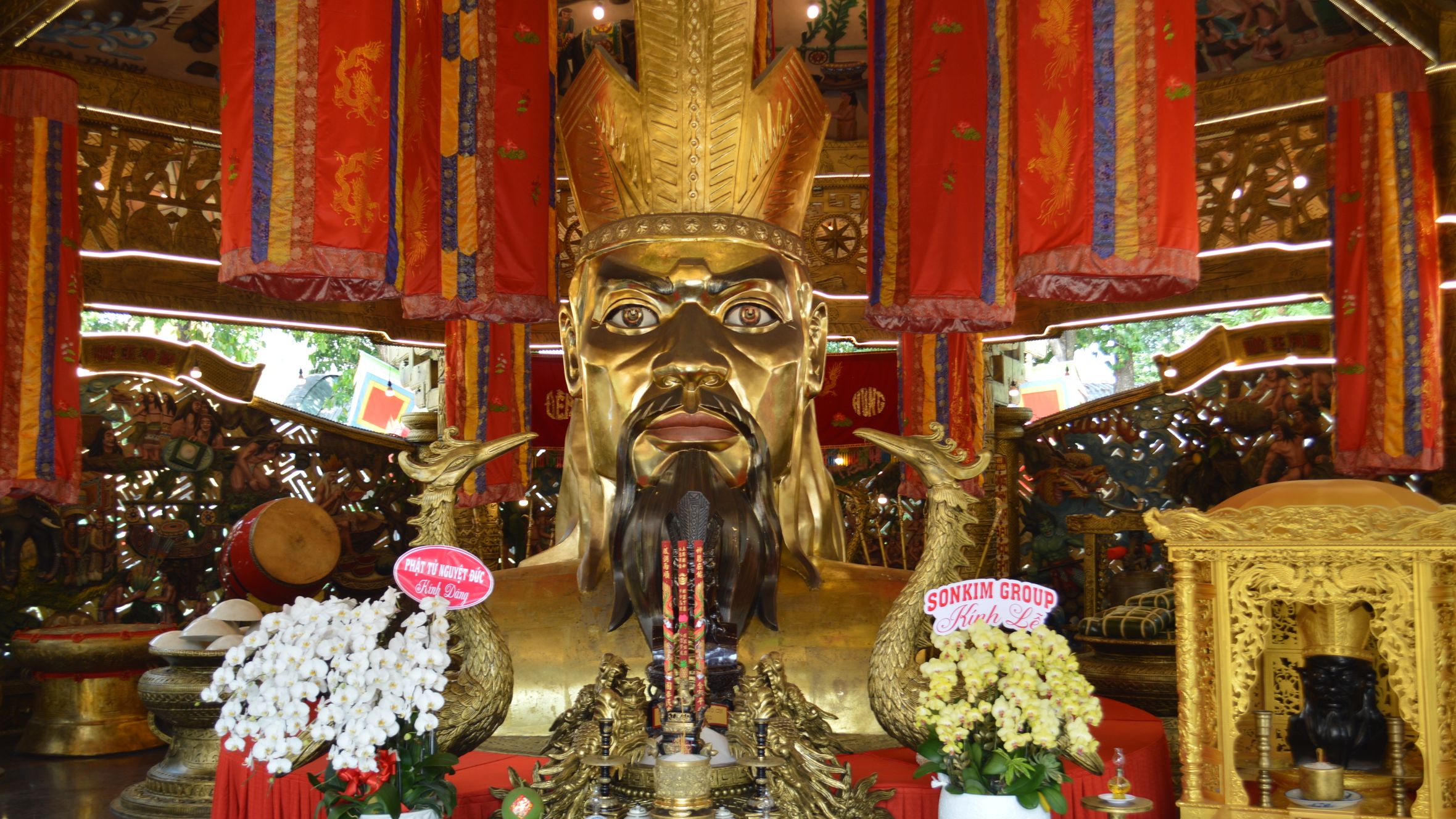
The interior is the centerpiece. Gilded columns, a large seated Buddha statue, and ceiling murals depicting scenes from the Jataka tales. Remove your shoes, dress modestly (cover shoulders and knees), and take your time. The craftsmanship in the carved details rewards close attention.
Explore the Grounds
The complex includes a monks' quarters, a community hall, gardens, and several smaller shrines. A perimeter walk takes 20-30 minutes at a slow pace. The grounds are well-maintained with frangipani trees and lotus ponds that photograph well in morning light.
Visit the Stupa Garden
Behind the main hall, a cluster of "chedis" (stupas) holds cremated remains of community members. It's a quieter, more contemplative area and a reminder that this is a functioning spiritual site, not a museum.
Talk to the Monks
Resident monks are generally approachable and happy to explain Khmer Buddhist practices. Some younger monks study English and welcome the practice. Be respectful — ask before photographing them, and don't interrupt prayer times (early morning and late afternoon).
Combine with Other Khmer Pagodas
The former Tra Vinh province has over 140 Khmer pagodas. Chua Ang, located right in town, is the most famous and has a much older, more weathered character. Visiting both gives you a contrast between centuries-old tradition and modern ambition. They're about 15 minutes apart by motorbike.
Where to Eat Nearby
Tra Vinh town is the place to eat, not the pagoda's immediate surroundings. Two things to seek out:
"Bun nuoc leo" — a Khmer-influenced noodle soup with a pungent fish-based broth, pork, and fresh herbs. It's the signature dish of Tra Vinh and tastes nothing like "pho" or "hu tieu". Look for small shops near the central market; a bowl runs 25,000-35,000 VND.
"Banh tet Tra Cuon" — a local variation of sticky rice cake stuffed with pork and mung bean, wrapped in banana leaf. It's a cousin of "banh chung" but cylindrical and distinctly southern. You'll find it at market stalls throughout town.
Where to Stay
Tra Vinh town has limited but adequate accommodation:
- Budget: Local guesthouses ("nha nghi") around the market area, 200,000-350,000 VND/night. Basic but clean enough for a night or two.
- Mid-range: A few mini-hotels along the main road offer air-conditioned rooms with Wi-Fi for 400,000-700,000 VND/night. Cong Thanh Hotel and Thanh Tra Hotel are reliable options.
- Homestays: Some families in the surrounding countryside offer homestays for 300,000-500,000 VND including breakfast. These are harder to find online — ask at the local tourist information office near the town center.
For more comfort, base yourself in Can Tho and day-trip to Chua Vam Ray.

Photo by HONG SON on Pexels
Practical Tips Locals Would Tell You
- Bring cash. There's no ATM at the pagoda and card payments don't exist here. Tra Vinh town has ATMs along the main streets.
- Wear slip-on shoes. You'll be removing them repeatedly entering different buildings.
- Sunscreen and water. The grounds have minimal shade and no drink vendors. The midday sun on the open courtyard is relentless.
- Donation boxes are placed inside the main hall. A small contribution (20,000-50,000 VND) is appreciated and goes toward maintenance and the monks' needs.
- Drones are not welcome. Don't fly one over an active religious site without explicit permission.
Common Mistakes to Avoid
- Treating it like a theme park. People pray here daily. Keep voices down inside the halls, don't pose playfully with Buddha statues, and don't climb on structures for photos.
- Only spending 20 minutes. The scale of the complex means a rushed visit misses most of it. Budget at least 1.5-2 hours.
- Skipping Tra Vinh town entirely. The town itself has a quiet, leafy charm with Khmer cultural influences visible in its architecture, food, and daily life. It deserves an afternoon of wandering, not just a drive-through.
Practical Notes
Chua Vam Ray is free to enter. The pagoda is open daily from early morning to around 5 PM. It pairs naturally with a broader Mekong Delta loop — Can Tho's floating markets, the quieter backroads around Vinh Long, or even a longer route down to Ha Tien if you're heading toward Phu Quoc. Give Tra Vinh more than a pit stop; the Khmer layer of delta culture here is something you won't find in Saigon or the more touristed parts of the south.
Last updated · May 29, 2026 · independently researched, never sponsored.