Before Hanoi was anything more than a riverside outpost, Hoa Lu was where Vietnam's first independent dynasties held court. Tucked into the karst valleys of Ninh Binh (닌빈 / 宁平 / ニンビン), this compact site rewards visitors who push past the surface — the temples are genuinely old, the setting is dramatic, and the crowds are lighter than anything you'll find in the north's more famous spots.
Why Hoa Lu Was the Capital
In 968 CE, Dinh Bo Linh unified a fragmented Vietnam (베트남 / 越南 / ベトナム) after decades of civil war and established Hoa Lu as the capital of Dai Co Viet — the first fully independent Vietnamese state after a millennium of Chinese rule. The location was deliberate. Hoa Lu sits inside a natural fortress: limestone mountains rise on every side, rivers cut off approaches, and the narrow passes were easy to defend. Hanoi (then called Thang Long) only became the capital in 1010, when Emperor Ly Thai To decided the country had stabilized enough to move to more open, agriculturally productive ground.
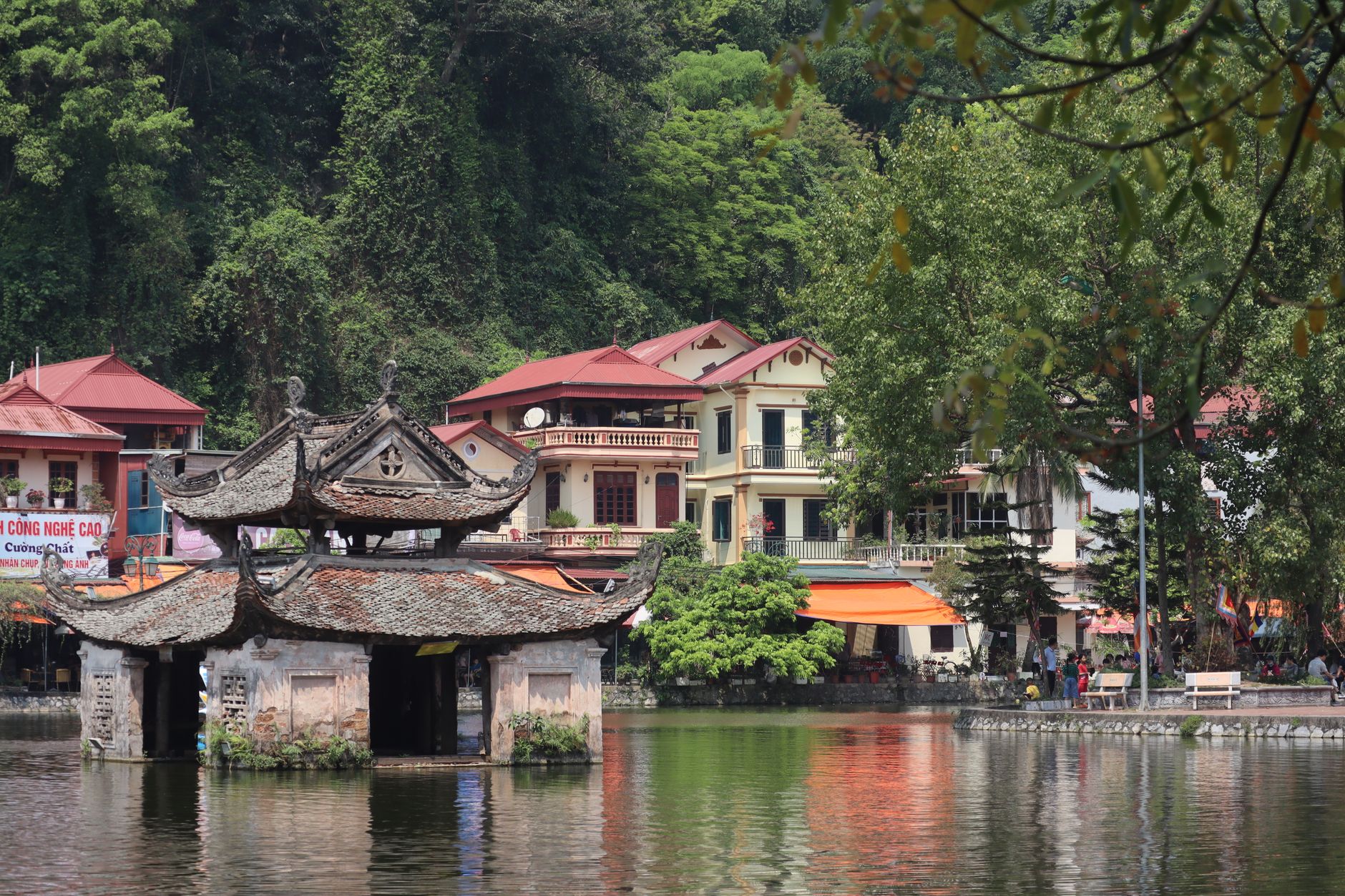
What's left today is a small fraction of the original royal city, which once covered roughly 300 hectares. Two temple complexes — dedicated to the Dinh and the Early Le dynasties — survive and have been rebuilt and restored over the centuries. Expect ornate ceremonial architecture, stone dragons, and incense smoke, not royal ruins.
The Dinh Dynasty Temple
The temple of Dinh Tien Hoang sits at the northern end of the compound, fronted by a stone courtyard and a pair of stone dragons that date to the 17th-century restoration. Inside, the main altar holds a gilded statue of Dinh Bo Linh flanked by his three sons. The atmosphere is quiet and genuinely devotional — locals come here to pray, not just photograph.
Behind the main hall, a short climb through bamboo leads to the mountain shrine where Dinh Bo Linh is said to have meditated as a boy. It's a 10-minute walk up stone steps. Worth doing for the views across the valley floor.
The Early Le Dynasty Temple
A few hundred meters south, the temple of Le Hoan (founder of the Early Le dynasty, r. 980–1005) follows a similar layout but feels slightly more intimate. Le Hoan is a complicated historical figure — he took the throne after the Dinh king was assassinated, and married the widowed queen. Vietnamese history tends to treat him charitably because he successfully repelled a Song Chinese invasion in 981. The temple reflects that rehabilitation.
The carved wooden panels inside both temples are the architectural highlight — detailed scenes of court life and battle, darkened with age and incense.

Photo by Bid on Pexels
Getting There From Ninh Binh Town
Hoa Lu is 12 km northwest of Ninh Binh town. A xe om (motorbike taxi) will run you around 80,000–100,000 VND each way. Most guesthouses on Luong Van Tuy street rent motorbikes for 120,000–150,000 VND per day, which makes more sense if you're combining Hoa Lu with Tam Coc or Trang An in the same trip. The temple complex entrance fee is 20,000 VND per person.
Opening hours are roughly 7am–5pm daily. Aim for before 9am or after 3pm to avoid tour groups.
Pairing Hoa Lu With Tam Coc
Tam Coc is 9 km south of Hoa Lu, and the obvious pairing. The boat ride through the rice paddies and cave tunnels of Tam Coc is one of the more genuinely scenic things in the north — the karst scenery that made Hoa Lu strategically valuable is what makes Tam Coc beautiful. Same geology, different experience.
A standard itinerary: arrive Hoa Lu at 7:30am, spend 90 minutes at the temples, ride south to Tam Coc for a 10am boat departure (book at the jetty, 200,000 VND per boat, one rower, maximum two passengers), eat lunch at one of the com bui places on Ngo Dong street — rice, braised pork, morning glory, 60,000 VND — and be back in Ninh Binh town by 2pm.
If you have a full day, add Bai Dinh pagoda (7 km west of Hoa Lu), Vietnam's largest Buddhist complex by area. It's not ancient — construction started in 2003 — but the scale is genuinely impressive and the hilltop views over the valley are good.
Photo by Bid on Pexels
What to Eat Before or After
Ninh Binh has its own culinary identity. "Com chay" (scorched rice) is the dish to try — crispy rice cakes served with braised goat or pork and mushroom sauce. The best spots cluster around the market area on Tran Hung Dao street in town, and most charge 80,000–120,000 VND for a full portion. Goat meat (thit de) is also a local specialty, often grilled and served with "la sung" (fig leaves) — look for the roadside restaurants on the road between Hoa Lu and Tam Coc.
For breakfast before the temples, the stalls near Ninh Binh train station sell "banh cuon" (steamed rice rolls) from around 6am, 25,000–35,000 VND a plate.
Practical Notes
Hoa Lu is 93 km south of Hanoi — two hours by bus from My Dinh station (90,000–110,000 VND), or 1.5 hours by train to Ninh Binh station. Most visitors do it as a day trip from Hanoi, but an overnight in Ninh Binh town gives you the mornings, when the light through the karst is worth the extra night's accommodation.
Last updated · May 29, 2026 · independently researched, never sponsored.