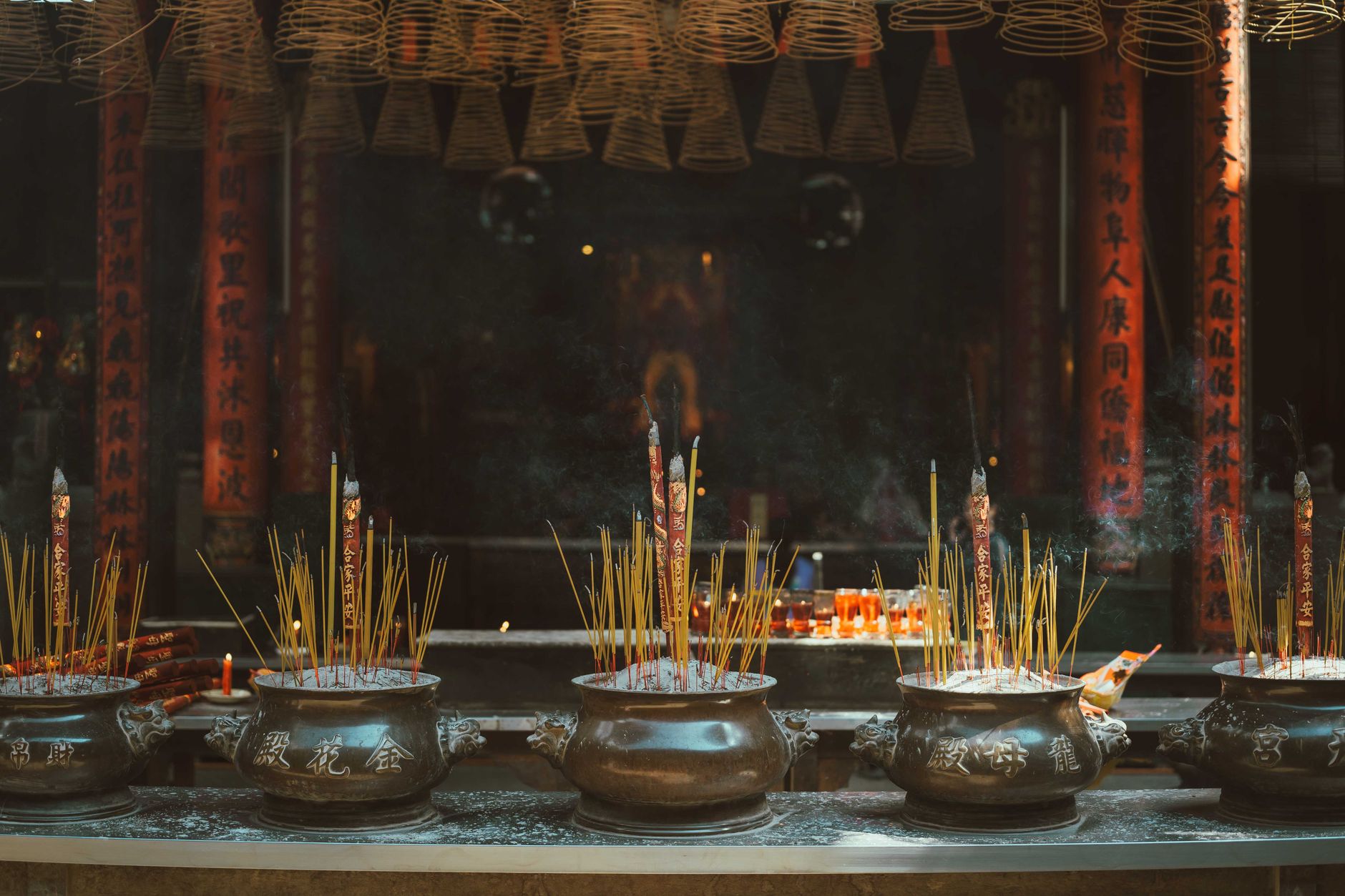
What temples actually require
Most Vietnamese temples don't have a dress code posted at the gate. But there is an unspoken standard: cover your shoulders and knees. That's it. You don't need a full-length dress or a headscarf. You won't be turned away for wearing capris or a short-sleeved shirt. But walking in wearing a tank top or shorts that end mid-thigh will draw stares from other worshippers and monks—and you'll stand out as someone who didn't bother to think about where they were going.
The rule applies equally to men and women. A guy in a sleeveless shirt is as conspicuous as a woman in a sundress.
What to wear
Bottoms: Lightweight pants, loose-fitting trousers, or a knee-length skirt or sarong work best. Linen and cotton breathe in Vietnam (베트남 / 越南 / ベトナム)'s heat. If you own a ""sarong"" or lightweight wrap, bring it—many people throw one on in their backpack and tie it over shorts when temple-hopping. Dark colors (navy, black, olive) hide sweat better than white.
Tops: A t-shirt, a long-sleeved linen shirt rolled up, or a blouse with cap sleeves. Loose fit is better than tight. If you're wearing a sleeveless top, bring a thin button-up or a cardigan to slip on.
Footwear: Wear slip-on shoes or flip-flops. You'll remove them before entering the main prayer hall or inner sanctum at most temples, so don't arrive in lace-up boots. Sandals are fine. (Some very strict temples ask you to remove shoes even in outer courtyards; these are rare and usually marked with signs.)
Head covering: Not required for women. Monks won't ask you to cover your hair.
What to avoid
Don't wear:
- Shorts above the knee (or very short shorts at all)
- Tank tops, spaghetti straps, or cutout tops
- Sundresses or strapless dresses
- See-through clothing without a layer underneath
- Athletic leggings as pants (they read as underwear)
- Hats or caps inside buildings (you can wear them in courtyards)
Avoid bright neon colors and logos if you want to be inconspicuous—not because temples forbid it, but because it signals "tourist" and can attract scammers in busy temple areas like Tran Quoc Pagoda in Hanoi or temples in Hoi An.
When to be stricter
Fully covered dress is expected only at a few specific moments:
Major festivals. During ""Tet"" (Vietnamese New Year) or the Hung Kings Festival, more people wear formal or traditional dress. Wearing ""ao dai"" (the long Vietnamese tunic) is elegant and respectful, but a neat outfit of pants + covered-shoulder top is fine too.
Funerals and religious ceremonies. If you're invited to a temple funeral or a prayer service, ask the person who invited you what to wear. Generally: dark, subdued, fully covered. This rarely happens to tourists.
Very conservative temples. A handful of temples in rural areas or mountain regions are stricter. Before entering, look at other worshippers inside. If everyone is fully covered, match that level.

Photo by Vietnam Hidden Light on Pexels
Practical layering strategy
Bring a lightweight long-sleeved shirt (linen or cotton) that you can button up or tie around your waist. In Hanoi (하노이 / 河内 / ハノイ), Hue, or Ho Chi Minh City, you'll visit 2–3 temples per day often. Peeling on or off a layer takes 10 seconds and saves you having to buy a souvenir wrap at the temple shop (which costs 50,000–150,000 VND/$2–6 USD).
If you're staying in one city for several days, consider renting or buying a cheap sarong at a night market. In Hanoi's Dong Xuan Market or Saigon's Ben Thanh Market, a cotton wrap costs 30,000–80,000 VND ($1.30–3.50 USD). You'll use it for temples, beaches, and casual coverage.
Gender-specific notes
Women: Bra straps shouldn't be visible. If your tank top is sleeveless, a camisole or thin sports bra underneath is not the same as wearing a proper top layer. Leggings alone are not pants. Long skirts are respectful but not required—knee-length is the floor.
Men: Chest hair showing is fine. A t-shirt is appropriate. Shorts that come to the knee are borderline; above the knee is disrespectful.
Cost expectations
You don't need to buy temple clothes. If you travel with a carry-on and can't fit extra layers, buy a wrap at a night market (30,000–100,000 VND) or a cheap long-sleeved shirt at a street vendor stall (80,000–200,000 VND / $3.50–8 USD). Goodwill Vietnam shops in major cities sell clean secondhand clothing cheaply.
If you're caught unprepared and a temple shop tries to sell you a shawl for 200,000–300,000 VND ($8–12 USD), that's a tourist markup. Negotiate down or walk back to the town entrance and buy something.

Photo by Jordan Coleman on Pexels
Common pitfalls
Pitfall 1: Wearing a sheer blouse without a cami underneath. You look covered to yourself; locals see skin.
Pitfall 2: Assuming one sarong will cover your legs and shoulders at the same time. It won't. Wear a top that covers shoulders; the wrap is for legs.
Pitfall 3: Showing up in white linen pants that are practically see-through when wet. Test your outfit in sunlight before the temple visit.
Pitfall 4: Wearing platform sandals or heeled flip-flops. You'll trip on temple steps and look odd in photos. Flat slip-ons only.
Pitfall 5: Ignoring shoe removal. If you see a pile of shoes outside a doorway, remove yours. If you see a sign or a monk gesturing, take your shoes off immediately. Don't ask. Just do it.
Insider note on respect
Vietnamese people aren't offended by foreigners in casual clothes at temples—they expect it. What they notice is effort. If you show up clearly trying to be respectful (covered shoulders, knees, clean clothes), monks and worshippers will smile at you. If you show up in a bikini top or gym shorts, you'll be treated as someone who either didn't know better or didn't care. The difference in how you're treated is measurable.
Bottom line
Temple dress in Vietnam is practical, not strict. Cover shoulders and knees, wear clean clothes, and you're fine. A lightweight linen shirt and loose pants packed in your bag solve 90% of temple visits across the country. Skip the souvenir wraps, bring your own layer, and don't overthink it.
Last updated · May 29, 2026 · independently researched, never sponsored.