The basic order: milk or no milk
Every "vietnamese coffee" order starts with one question: do you want milk? Everything else branches from there.
Ca phe sua da (연유커피 / 越南冰咖啡 / ベトナムアイスコーヒー) (iced coffee with condensed milk) is the default. You'll see it everywhere—a glass filled with a thick brown liquid, a plastic straw, and ice. The milk sits at the bottom as sludge until you stir it. It costs 15,000–25,000 VND depending on the city and stall quality.
Ca phe da (iced coffee, no milk) is the alternative. Stronger, thinner, more bitter. Same price range. Locals often order this when they want coffee fast, or when they're ordering multiple rounds and don't want the sugar crash.
Ca phe nong sua (hot coffee with milk) exists but is rare in summer. In Hanoi or Da Lat in winter, you'll see it. Much less common than the iced versions.
Ca phe nong (hot, black) is what you get if you ask for just that. It's not really ordered as a standalone—mostly you see it in rural areas or at breakfast.
The ritual: patience is key
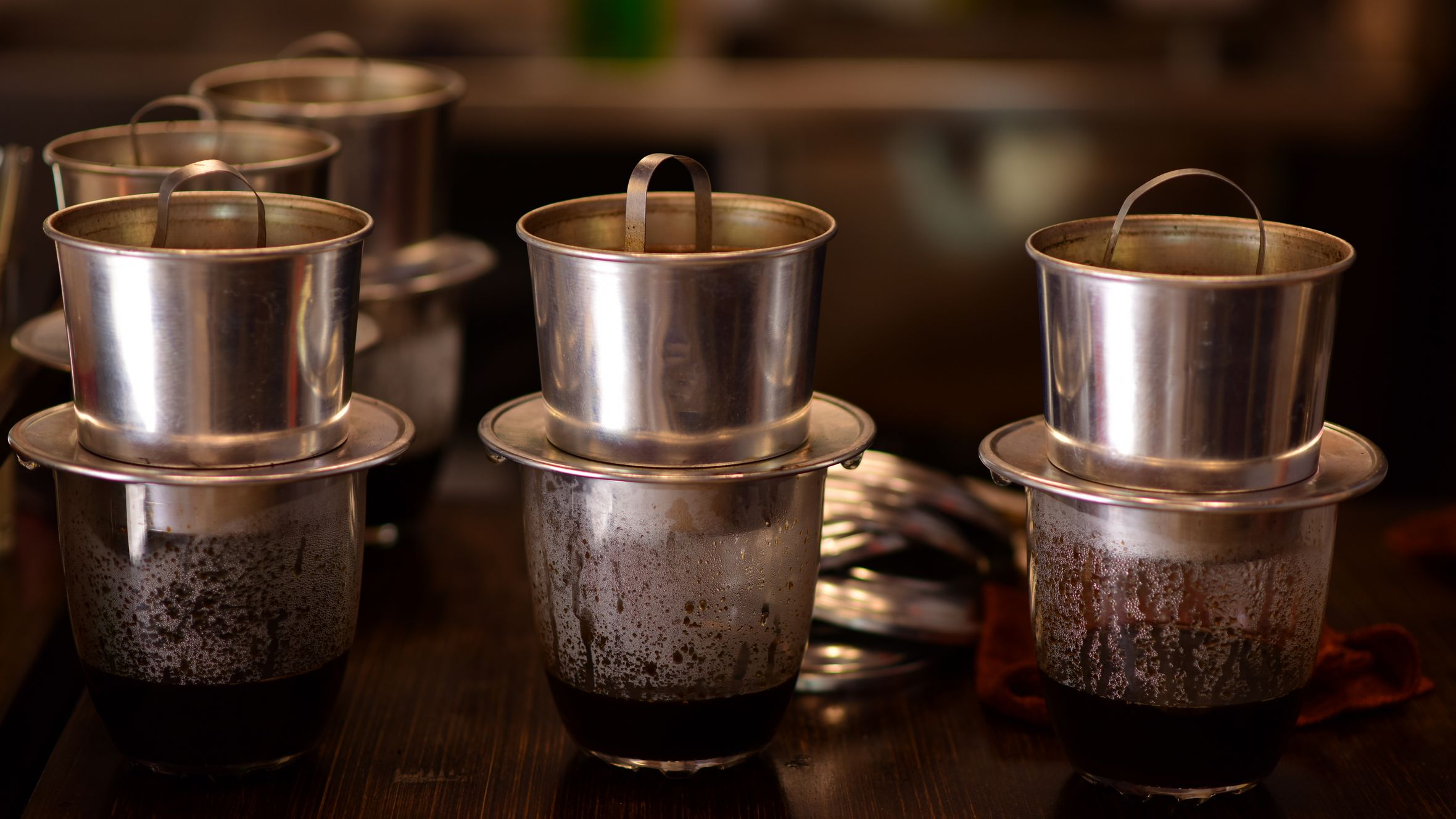
Vietnamese coffee (베트남 커피 / 越南咖啡 / ベトナムコーヒー) is made with a small metal drip filter called a "phin." It sits on top of your glass. The process takes 3–5 minutes. If you order at a busy stall, you'll wait.
Here's what happens:
- The vendor fills the phin with finely ground robusta coffee (robusta is stronger, more bitter, and cheaper than arabica—this is deliberate).
- They pour hot water in. A lot.
- They place a metal disc on top to press gently.
- You wait. Most stalls will hand you the glass mid-drip and let you watch the rest.
- If you ordered milk, the vendor has already put 2–3 tablespoons of sweetened condensed milk in the bottom of the glass.
- Once the drip finishes, you stir, add ice (if not already iced), and drink.
Don't rush this. Rushing a phin coffee is like rushing an espresso—it defeats the point. Locals sit, chat, or check their phones for 5 minutes. Plan accordingly.
What to say at a stall
Standard order: "Mot ca phe sua da" (one iced coffee with milk). Literally: "one coffee milk iced."
That's it. You don't need anything else. The vendor will handle the rest.
If you want variations:
- Less milk: "Ca phe sua da, it sua" (coffee with milk iced, less milk). They'll use half the usual condensed milk.
- No sugar: "Ca phe da" (coffee iced, no milk). Though robusta is bitter enough that nobody really orders it for "health reasons." They order it because they want less sweet or they're in a hurry.
- Extra coffee: "Ca phe sua da, nhieu ca phe" (coffee with milk iced, a lot of coffee). The phin will get a heavier dose of grounds.
- Hot version: "Ca phe nong sua" (hot coffee with milk). Rare, but doable.
Price? Just hand over 20,000 VND and you're fine. Most stalls won't argue. Change is a few thousand back.

Photo by Vietnam Hidden Light on Pexels
Where to order: stalls vs. cafes
Vietnamese coffee culture splits into two tiers, and they're very different.
Street stalls (quan cua hang nho, literally "small shop") are the backbone. A plastic chair, a small table, maybe a neighbor's stall two feet away. The coffee is strong, cheap (15,000–20,000 VND), and ready in 5 minutes. These places are social. Old men sit for 2 hours nursing one coffee and reading the newspaper. You're expected to stay a bit, even if just 10 minutes. Common in Hanoi's Old Quarter, around Hoan Kiem Lake, and in every neighborhood alley (hem). No WiFi. No Instagram moments. This is how most Vietnamese drink coffee daily.
Modern cafes (quán cà phê, or just "cafe") are the newer trend. Wifi, tables, air conditioning, barista training, sometimes latte art. Coffee costs 35,000–60,000 VND. You see a lot of arabica here, not robusta. These places cater to young professionals, students, and tourists. Found in Saigon's District 1, Hanoi's Tay Ho, Da Lat, Hoi An—everywhere with foot traffic. This is where you'll see "egg coffee" (ca phe trung) and experimental Vietnamese coffee drinks.
If you want to taste real Vietnamese coffee culture, spend time at a street stall. If you want comfort and WiFi, go to a cafe. Both are legitimate.
Common mistakes
Asking for a cappuccino or flat white. Vietnamese coffee is not espresso-based. If you want microfoam milk, you're not going to get it at a street stall. Modern cafes will do it, but that defeats the point. Just order the coffee as offered.
Complaining about the wait. The drip is slow. That's the whole thing. If you need instant caffeine, go to a convenience store and grab a Nescafe instant packet. But that's not Vietnamese coffee.
Forgetting to stir. The condensed milk sits at the bottom. If you don't stir, the first sip is thick and sweet, the last is bitter. Mix it first. It takes 10 seconds.
Ordering robusta expecting arabica smoothness. Robusta is aggressive. It's higher in caffeine, lower in acidity, and tastes like dark chocolate and leather. If you hate bitter coffee, order a cafe au lait at a modern cafe instead, or ask for "it sua" (less milk).
Going to a stall during rush hour expecting quiet time. Morning (6–8 AM) and late afternoon (4–6 PM) are packed. Vendors are fast but gruff. Mid-morning (10–11 AM) or early evening (7–8 PM) is calmer.
Photo by Vietnam Hidden Light on Pexels
Cost expectations
- Street stall, ca phe sua da: 15,000–25,000 VND ($0.75–$1.25 USD).
- Street stall, specialty (less milk, extra coffee, etc.): same price; vendor doesn't charge for tweaks.
- Modern cafe, ca phe sua da: 35,000–50,000 VND ($1.50–$2.50 USD).
- Modern cafe, with specialty additions (oat milk, extra shot, etc.): 50,000–80,000 VND ($2.50–$4 USD).
- Tourist-heavy areas (Hoi An, Old Town Hanoi): add 10,000–15,000 VND to everything.
Pay cash. Most street stalls don't take cards.
Timing and ritual
Vietnamese don't drink coffee like Americans drink coffee—fast, while rushing to a meeting. They drink it slow, socially, in the morning or late afternoon.
Morning coffee (khoang 6–9 AM) is with breakfast, often a banh mi or sticky rice. It's the kickstart.
Afternoon coffee (around 3–4 PM) is the wind-down. Locals sit, chat with neighbors, watch the street. This is peak stall time.
Evening coffee (after 7 PM) is less common but happens in cities. Night owls and students.
Night coffee (after 10 PM) is rare and usually at cafes, not stalls.
If you order at a stall, assume you're staying 10–15 minutes. Sit, drink slowly, watch the neighborhood. That's the experience.
Bottom line
Vietnamese coffee ordering isn't complicated—it's just different from what you're used to. One decision (milk or no milk), one or two words, 5 minutes of waiting, and a strong, cheap coffee. The ritual matters as much as the taste. Learn "ca phe sua da" and "ca phe da," find a stall near your hotel, and spend a morning like a local does.
Last updated · May 29, 2026 · independently researched, never sponsored.