Thuy Xuan incense village sits about 7 km southwest of Hue's city center, right along the road to the Tomb of Tu Duc. It's one of the few craft villages in central Vietnam (베트남 / 越南 / ベトナム) where the production is real, daily, and not staged for tour groups — though plenty of tour groups do show up.
What it is
Lang Huong Thuy Xuan is a working incense-making village where families have been hand-rolling incense sticks for generations — some households claim lineages going back over a century. The village supplies incense to pagodas and homes across the region, and the craft here is tied directly to Hue (후에 / 顺化 / フエ)'s deep Buddhist and ancestor-worship traditions.
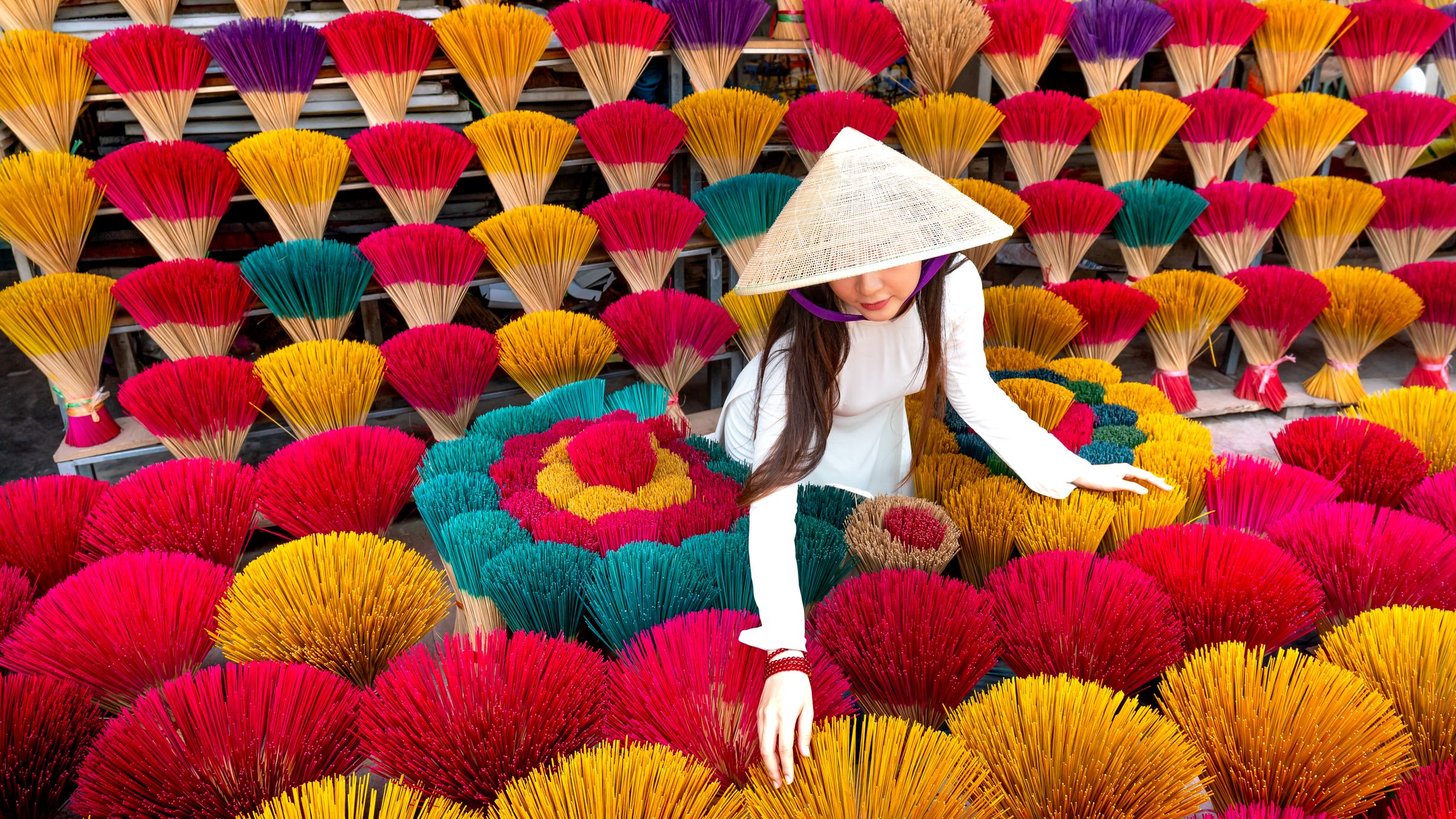
What you'll see: bundles of incense sticks drying in the sun, fanned out in bright circles of yellow, red, and pink. The families split bamboo, mix aromatic powders (cinnamon bark, star anise, clove), and roll each stick by hand. The whole neighborhood smells like a temple.
The village became a photography destination around 2015-2016 when images of the colorful incense bundles went viral. Since then, visitor numbers have grown, but the production hasn't changed much. These families aren't performing — they're working. That distinction matters.
Why travelers go
Two reasons. First, the visuals are genuinely striking — the radial patterns of drying incense against weathered concrete courtyards photograph well, and the natural light in the late afternoon turns the whole scene warm. Second, it's a craft you can actually watch and understand in about 20 minutes. There's no museum, no ticket booth, no audio guide. You walk in, watch people work, ask questions if they're open to it, and leave with a bundle of incense that cost you 20,000-50,000 VND.
It also happens to be on the same road as several of the royal tombs, so combining a stop here with a tomb visit makes logistical sense.
Best time to visit
The incense dries outdoors, so you want dry weather. February through August is the production sweet spot — families work longer hours and lay out bigger batches. The rainy season (September through January) slows things down, and you'll see fewer of those iconic colorful spreads.
Time of day matters more than month, though. Go between 8:00-10:00 AM or 3:00-4:30 PM. Midday sun washes out the colors, and by 5 PM most families have packed everything inside. Morning light is softer; afternoon light is warmer. Both work.
Avoid showing up at lunch — around 11:30 to 1:30 — when most families take a break.
How to get there from Hue
Thuy Xuan village is on Huyen Tran Cong Chua street, about 7 km from the Hue city center heading southwest.
- Grab bike: 25,000-35,000 VND one way, 15-20 minutes. Easiest option.
- Motorbike rental: 120,000-150,000 VND/day from most guesthouses. The road is straightforward — follow Huyen Tran Cong Chua south from the Perfume River. You'll pass the Tomb of Tu Duc turnoff about 1 km past the village.
- Bicycle: Doable if you're staying near the south bank. About 30-40 minutes, mostly flat. Hot in summer.
- Organized tour: Many half-day Hue tours bundle this with the Tomb of Tu Duc and the Tomb of Khai Dinh. Prices run 250,000-400,000 VND per person for a group tour, more for private.
There's no entrance fee to the village itself.
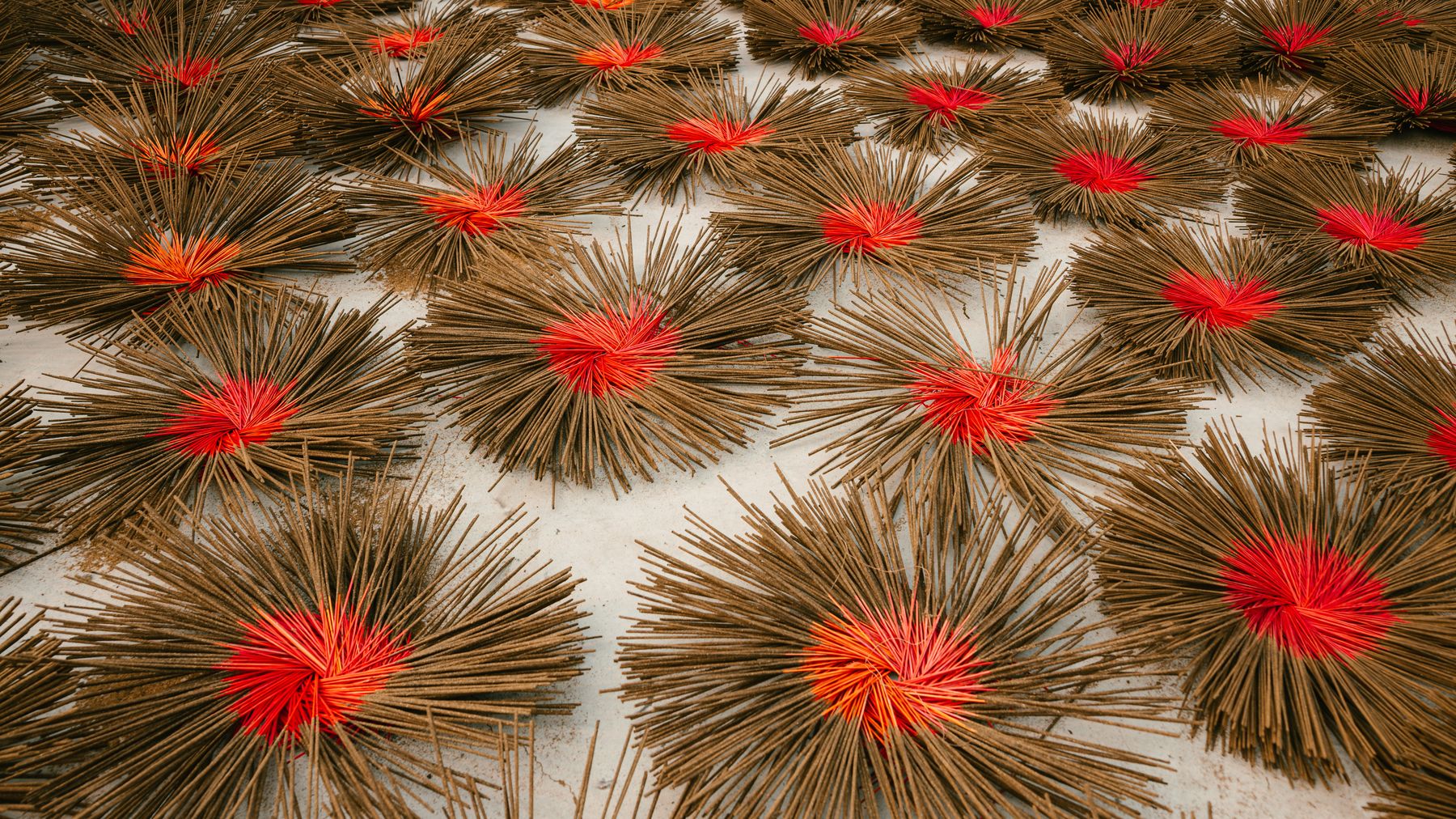
Photo by HONG SON on Pexels
What to do
Watch the rolling process up close
Find a household that's actively working — you'll spot them by the drying racks outside. Most families are fine with visitors watching, but ask with a nod or a "Xin chao" before you walk into their workspace. The rolling technique is fast and precise: they coat the bamboo stick with adhesive, then roll it through colored aromatic powder in one smooth motion. Kids in the family often help with sorting and bundling.
Try rolling a stick yourself
Some households will let you try. You'll be bad at it — the powder falls off, the coating is uneven, the stick bends. That's the point. It gives you a sense of the skill involved. No charge for this, but buying a bundle afterward is the polite move.
Photograph the drying racks
The signature shot is the overhead or eye-level view of incense bundles fanned into circles. Bring a wide-angle lens if you have one. The best compositions come when multiple colors are drying side by side. Ask before photographing people directly — some workers prefer not to be in the frame.
Buy incense to bring home
Bundles range from 20,000 to 100,000 VND depending on size and fragrance blend. Sandalwood-based sticks cost more. These pack flat and make genuinely useful souvenirs — unlike a fridge magnet, you'll actually use them. They're light enough to fit in carry-on luggage.
Combine with the royal tombs
The Tomb of Tu Duc is about 1 km further down the same road. The Tomb of Khai Dinh is another 3 km beyond that. A morning route of incense village → Tu Duc → Khai Dinh → lunch back in town is a solid half-day.
Where to eat nearby
The village itself has no restaurants worth recommending, but Hue's food scene is 15 minutes away.
- "Bun bo Hue" is the city's signature dish — a spicy, lemongrass-heavy beef noodle soup. Ba Roi on Nguyen Du street does a reliable bowl for about 35,000 VND. It's northeast of the village, back toward the city center.
- "Banh canh" — thick tapioca noodles in a pork-and-crab broth — is another Hue staple worth tracking down. Look for small shops along Pham Hong Thai street.
If you're heading back to the city center after the tombs, stop at any "com" (rice) shop along Le Ngo Cat street for a cheap, filling lunch plate around 30,000-40,000 VND.
Where to stay
Stay in Hue's city center — there's nothing in Thuy Xuan village itself.
- Budget: Guesthouses along Pham Ngu Lao or Le Loi streets run 200,000-400,000 VND/night.
- Mid-range: Boutique hotels near the south bank of the Perfume River go for 600,000-1,200,000 VND/night, often with breakfast included.
- High-end: A few riverside resorts west of the citadel charge 2,000,000+ VND/night.

Photo by Quang Nguyen Vinh on Pexels
Practical tips locals would tell you
- Bring small bills. Families making incense don't carry change for 500,000 VND notes. Have 10,000-50,000 VND bills ready.
- Wear closed shoes. The ground around drying areas has bamboo splinters and powder dust. Sandals work but you'll regret them.
- Don't move the incense. Seriously. Don't rearrange sticks for a better photo. These are products, not props. Disrupting a drying rack means someone has to redo work.
- Tip if someone spends time showing you the process. 20,000-50,000 VND is appropriate. Or just buy their incense.
- The village is small. You'll see everything in 30-45 minutes. Don't expect a half-day activity — plan it as a stop, not a destination.
Common mistakes to avoid
- Arriving at noon. The light is harsh, the families are resting, and most incense is already stored. You'll see empty courtyards.
- Coming only for photos. The village tolerates photographers but respects buyers. If every visitor just takes pictures and leaves, the goodwill dries up. Spend something.
- Skipping the tombs. You're already on the road. Not combining Thuy Xuan with at least one royal tomb is a wasted trip logistically.
- Visiting during heavy rain. No outdoor drying means nothing to see. Check the weather before you go.
Practical notes
Thuy Xuan works best as a 30-45 minute stop on the way to Hue's royal tombs. Go in the morning, bring small cash, don't touch the merchandise, and buy a bundle on your way out. It's one of the more honest craft village experiences in central Vietnam — no ticket counter, no souvenir shop, just families doing what they've done for decades.
Last updated · Jun 5, 2026 · independently researched, never sponsored.