What Nui Langbiang is and why it matters
Nui Langbiang is the highest accessible peak in the Da Lat area, sitting at 2,167 meters above sea level about 12 km north of the city center. It anchors the southern end of the Truong Son range and has been a landmark for the K'Ho and Lat ethnic minority communities long before the French built their hill station below.
The mountain takes its name from a local legend — a love story between a Lat woman named Lang and a K'Ho man named Biang. You'll see statues and references to the couple at the base. The peak itself is part of Bidoup Nui Ba National Park, though the Langbiang hiking area operates as a separate tourist zone with its own ticketing.
Note for trip planning: Lam Dong province recently merged with Dak Nong and Binh Thuan under Vietnam (베트남 / 越南 / ベトナム)'s 2025 administrative restructuring. For travelers, this changes nothing on the ground — Da Lat is still Da Lat, the mountain hasn't moved, and all existing transport routes remain the same.
Why travelers go
Langbiang isn't a technical climb. People come for the wide plateau views over Da Lat's pine valleys, the cooler-than-cool-already temperatures at the summit, and the chance to get above the tourist circuit for a few hours. On a clear morning you can see the patchwork of flower farms and coffee plantations stretching toward the horizon. It's one of the few places near Da Lat where you feel the scale of the Central Highlands (중부 고원 / 中部高原 / 中部高原).
It's also just a good half-day activity if you've already done the Da Lat market circuit, visited Xuan Huong Lake, and need something physical to break up the cafe-hopping.
Best time to visit
The dry season — November through March — is your best window. Mornings are crisp, skies tend to clear by 8 AM, and the trail isn't a mud chute. December and January mornings can dip to 10-12°C at the base, colder at the summit, so bring a proper jacket.
Avoid June through September if you can. Afternoon storms roll in fast, visibility drops to nothing, and the dirt road to the Radar Peak turns slick. If you're visiting in the wet season, start before 7 AM and plan to be down by noon.
How to get there from Da Lat
From central Da Lat, Langbiang is a straight 12 km shot north on Highway 723 (Lac Duong road). Your options:
- Motorbike rental: The most common choice. Rentals in Da Lat run 120,000-180,000 VND/day for a semi-auto. The ride takes about 25 minutes. Road is paved the whole way.
- Grab/taxi: Around 100,000-150,000 VND one way. Arrange a return pickup or you'll be stuck negotiating with jeep drivers at the base.
- Organized tour: Most Da Lat tour operators bundle Langbiang with other stops for 250,000-400,000 VND per person. You'll spend less time on the mountain and more time in a van.
Entrance fee at the gate is 40,000 VND for adults.

Photo by Dongdilac on Pexels
What to do
Hike the main trail to Lang Peak (2,167 m)
The main hiking trail runs about 3 km from the ticket gate to the summit of Lang Peak. It's a wide, well-worn dirt path through pine forest — no scrambling, no ropes, no guide required. Budget 1.5 to 2 hours up, about an hour down. The last 500 meters steepens but nothing that requires fitness beyond "can walk uphill for a while."
Take a jeep to Radar Peak
If hiking isn't your thing, jeeps shuttle visitors from the base to Radar Peak (the lower summit at around 1,950 m) for 60,000 VND per person round trip. The ride is bumpy, loud, and takes about 15 minutes. From Radar Peak there's a paved viewing platform. Honestly, the views from here are decent but noticeably less impressive than from the true summit.
Walk the grassland plateau
Between the two peaks, there's an open grassland area that feels more like Scotland than Southeast Asia. It's a good spot to sit, eat whatever you packed, and watch clouds move through the valley. Early mornings here, when mist is still burning off, are genuinely worth the alarm clock.
Visit a K'Ho village
A few K'Ho communities sit along the road between Da Lat and Langbiang. Some operate small homestays and sell "ruou can" (rice wine drunk through bamboo straws). It's low-key, not a theme park. Ask at your guesthouse in Da Lat for a current recommendation — these change often.
Trail running
Langbiang has become a trail running destination. The Da Lat Ultra Trail event uses routes on and around the mountain each year. If you're a runner, the main trail plus connecting forest paths offer 10-15 km of runnable terrain.
Where to eat nearby
The base area has a handful of food stalls selling standard Vietnamese fare — rice plates, instant noodles, grilled corn. Nothing remarkable.
Better plan: eat in Da Lat before or after. The city's food scene is the real draw. Look for "banh mi" stalls on Nguyen Van Troi street, or warm up with a bowl of "pho" from the cluster of shops near the central market. Da Lat also does its own thing with avocado ice cream and strawberry-everything, but for something more grounded, try "banh canh" — thick tapioca noodle soup — at the small shops along Phan Dinh Phung street. A bowl runs 35,000-50,000 VND.
Don't leave Da Lat without trying "egg coffee" at one of the local cafes that have adopted the Hanoi original. It pairs well with a cold morning after an early summit attempt.
Where to stay
Most people stay in Da Lat and visit Langbiang as a half-day trip. Accommodation options in Da Lat are deep:
- Budget: Hostels and guesthouses around the market area, 150,000-300,000 VND/night.
- Mid-range: Boutique hotels in the Phan Dinh Phung / Bui Thi Xuan area, 500,000-1,000,000 VND/night.
- Splurge: Resort properties on the outskirts toward Tuyen Lam Lake, 1,500,000-3,500,000 VND/night.
There are a couple of homestays in Lac Duong town (3 km from Langbiang's gate) if you want an early start without the drive. Basic rooms for around 200,000-350,000 VND.
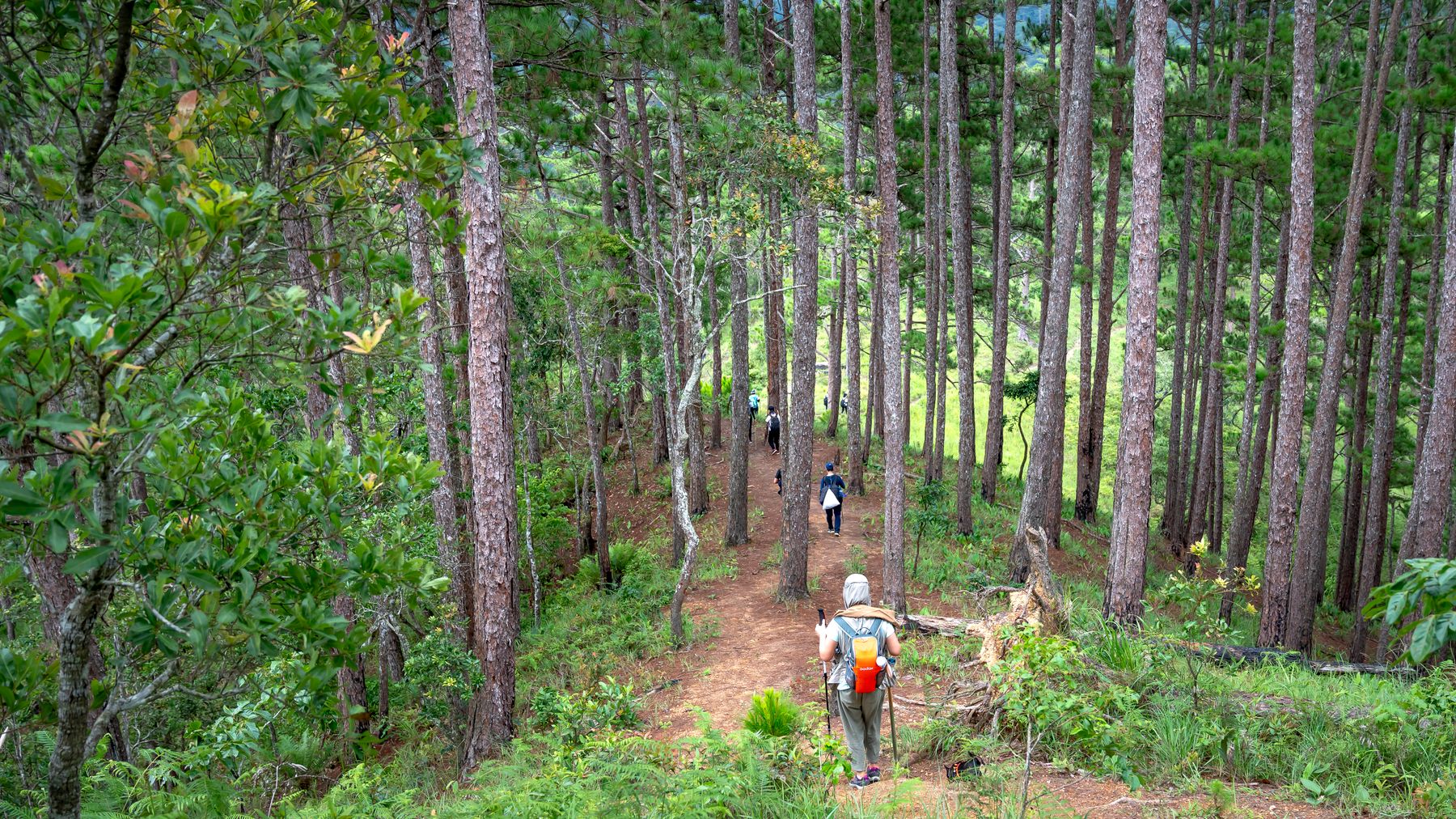
Photo by Quang Nguyen Vinh on Pexels
Practical tips locals would tell you
- Start early. By 10 AM the jeep tours arrive and the trail gets noisy. A 6:30 AM start means you'll have the summit mostly to yourself.
- Bring layers. The temperature difference between the base and the summit is real, especially in the morning. Wind picks up at the top.
- Carry water and snacks. There's nothing to buy once you pass the gate area.
- Wear proper shoes. Trail runners or light hiking shoes. Sandals work on the jeep road but not on the summit trail, especially after rain.
- Cash only at the entrance and for jeeps. No card payments.
Common mistakes to avoid
- Taking the jeep when you could hike. The hike is the experience. The jeep drops you at an inferior viewpoint and you miss the forest entirely.
- Going in the afternoon. Cloud cover builds after noon most days. Morning light is better in every way.
- Skipping sunscreen. At 2,000+ meters the UV is no joke, even when it feels cool. Da Lat's pleasant temperature tricks people into burning.
- Over-planning. Langbiang is a half-day activity, not a full-day expedition. Pair it with a Da Lat afternoon — the night market, a Vietnamese coffee session, or a drive out to Elephant Falls.
Practical notes
Langbiang is open daily from roughly 6 AM to 5 PM. No permit needed beyond the entrance ticket. The mountain is straightforward enough that you don't need a guide, though local guides are available at the gate for around 200,000 VND if you want context on the flora and K'Ho history. Give it a morning, then head back to Da Lat and eat well.
Last updated · May 29, 2026 · independently researched, never sponsored.