Tra Su is one of those places that looks digitally enhanced in photos but is somehow more vivid in person. The cajuput trees rise straight out of still water blanketed in duckweed, the surface so uniformly green it looks like a lawn you could walk across — until a flat-bottomed rowboat parts it ahead of you.
Why the Photos Look Like That
The viral green-carpet aesthetic is entirely natural and entirely seasonal. Tra Su Cajuput Forest sits about 25 km southwest of Chau Doc, covering 845 hectares of seasonally flooded wetland in the Plain of Reeds. During flood season, the Mekong backs up into the forest floor, raising water levels and creating the mirror-still channels the boats navigate. The duckweed — tiny floating aquatic plants — colonizes the surface, turning it that unreal shade of lime green. Pair that with straight rows of pale cajuput trunks and filtered light, and you have a scene that doesn't need any filter.
The forest is also a registered bird sanctuary. Herons, cormorants, and storks nest here in large numbers; the resident bat colony is enormous and worth seeing at dusk when they stream out of the canopy in long, looping columns.
When to Go
Flooded-peak season runs roughly September through November, when water levels are highest and the duckweed coverage is most complete. This is also wet season in the south, so expect humidity and the odd afternoon shower — neither ruins the trip.
By December, water levels drop and the forest floor starts to reappear. The scenery is still interesting outside flood season, but the iconic green-water-channel photos require the September–November window. If you're planning a trip to the Mekong Delta (메콩 델타 / 湄公河三角洲 / メコンデルタ) specifically for Tra Su, time it accordingly.
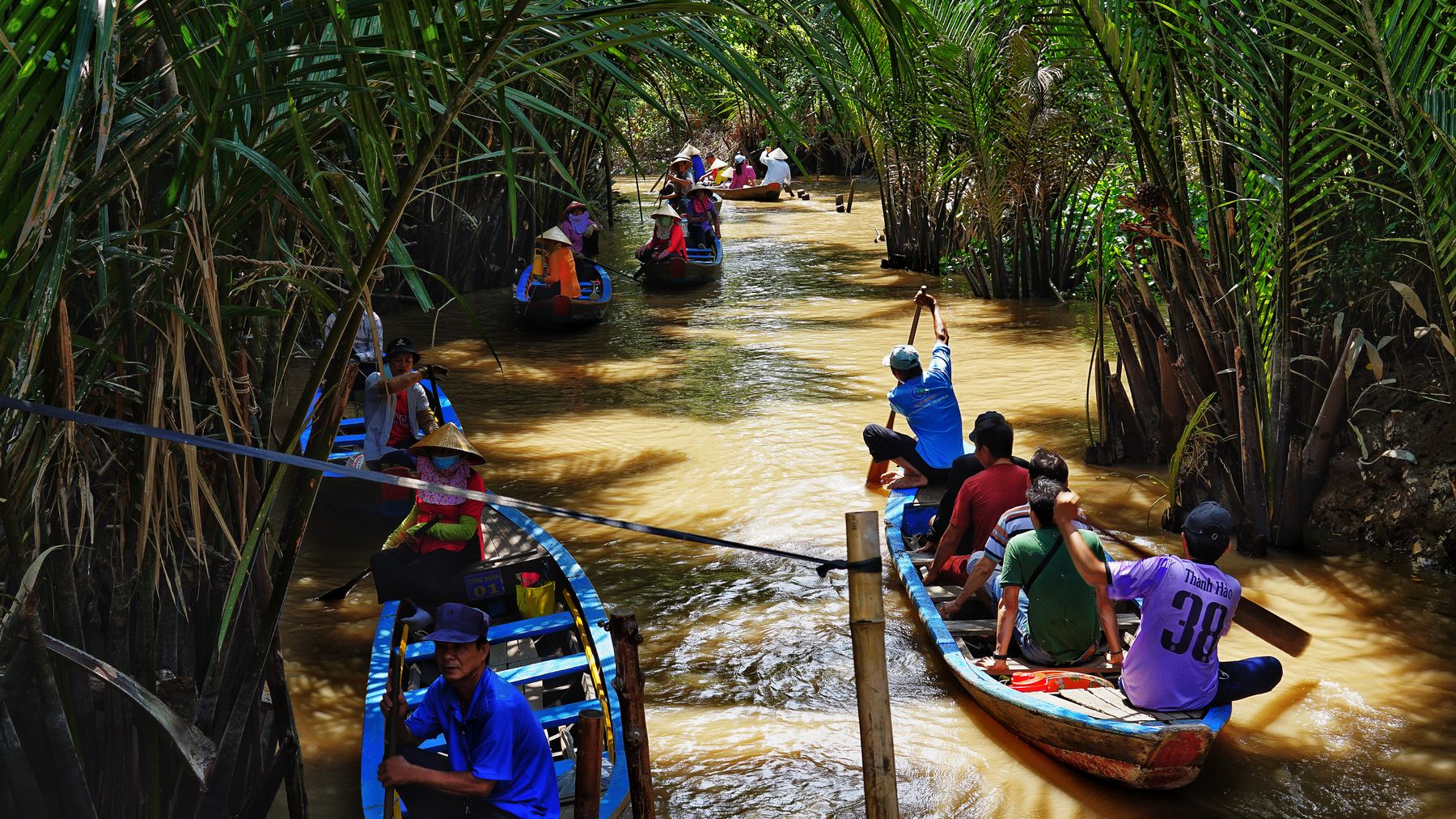
Photo by Noel Nicolas on Pexels
The Boat Tour
Entry is through a ticket gate on the eastern edge of the forest. The standard package includes a flat-bottomed rowboat with a local boatwoman (almost always women from nearby villages) who poles and paddles you through the narrow canals for 45–60 minutes. The channels twist through dense cajuput stands, occasionally opening into wider flooded clearings where the whole green-surface effect hits hardest.
At the center of the route is a watchtower — a basic bamboo-and-wood structure rising about four stories above the canopy. Climbing it gives you the only aerial perspective available: the cajuput forest stretching flat to every horizon, ribboned by dark waterways. It's the payoff shot if you're here with a camera.
After the boat loop, most visitors take a second ride on a motorized sampan back to the main pier, which is faster and covers a longer stretch of open water where you're more likely to spot birds in the reeds.
Cost breakdown (approximate, 2024):
- Entrance + rowboat: around 100,000–120,000 VND per person
- Motorized sampan return leg: sometimes included, sometimes 20,000–30,000 VND extra
- Whole thing is rarely more than 150,000 VND per person
The site is managed by a state forestry company; pricing is posted at the ticket window and is non-negotiable, which is actually a relief.
Combining with Chau Doc and Sam Mountain
Tra Su works naturally as a half-day add-on to Chau Doc, which is the main transport hub for this corner of An Giang — and a worthwhile destination on its own. Chau Doc sits at the junction of the Hau River and is the primary overland crossing point into Cambodia, which means it has decent guesthouses and a lively floating market. The town's Muslim Cham community gives it a different texture from anywhere else in the Delta; there are mosques alongside Buddhist pagodas, and the local food market reflects both traditions.
Sam Mountain (Nui Sam) is 5 km west of Chau Doc town and easy to combine with a Tra Su visit. The mountain rises abruptly from flat paddy land — the whole Mekong plain visible from the summit on clear days. At its base is the Ba Chua Xu Temple, one of the most-visited pilgrimage sites in southern Vietnam (베트남 / 越南 / ベトナム), busy with incense and worshippers year-round. It's worth an hour.
A practical loop from Chau Doc: rent a motorbike or hire a xe om driver, head to Tra Su in the morning (cooler, better light), return through Sam Mountain in the early afternoon. Total distance is around 60 km round-trip from Chau Doc.

Photo by ㅤ quang vinh ㅤ on Pexels
Getting to Chau Doc
From Can Tho, buses and minivans run to Chau Doc in roughly 2.5 hours; from Saigon it's about 5 hours by road or you can take a fast boat up the Mekong (scenic, longer). Chau Doc is a natural stop on the overland route between Vietnam and Phnom Penh — many travelers come through here on a cross-border trip rather than doubling back.
From Chau Doc to Tra Su, motorbike taxis ask around 150,000–200,000 VND for a return trip with waiting time. Some guesthouses arrange day tours that bundle Sam Mountain and Tra Su together for around 250,000–350,000 VND per person.
Practical Notes
Bring insect repellent — the forest edge at dawn and dusk earns it. Mornings give you softer light and fewer visitors; tour groups from Can Tho tend to arrive between 9 and 11 am. The site has a basic canteen serving standard Delta dishes near the main pier, including "hu tieu" and fresh-caught fish, which is worth stopping at before the return ride.
Last updated · May 29, 2026 · independently researched, never sponsored.