Van Mieu Tran Bien sits on a low hill in Bien Hoa city, about 30 km northeast of Saigon. If you've visited the Temple of Literature in Hanoi, think of this as its southern counterpart — less famous, far less crowded, and surrounded by fruit orchards instead of souvenir shops.
What it is and how it got here
The original Van Mieu Tran Bien was built in 1715 under the Nguyen Lords to promote Confucian scholarship in the southern frontier territories. For context, that's decades before modern Saigon (사이공 / 西贡 / サイゴン) even existed as a significant settlement. The temple served as a place to honor scholars, hold examinations, and anchor Vietnamese cultural identity in what was then a remote region.
The original structure deteriorated over centuries, and the complex you see today is a reconstruction completed in 2002 on a 15-hectare site in Buu Long ward, Bien Hoa. It's not an ancient ruin — it's a modern rebuild designed to honor the historical site. That distinction matters. You're visiting for the cultural meaning and the architecture, not for crumbling 300-year-old stone.
The complex follows traditional Confucian temple layout: a main gate, courtyards, stele houses, and a central hall dedicated to Confucius and Vietnamese scholars. The grounds also include a large lake, manicured gardens, and a museum wing focused on the educational history of southern Vietnam (베트남 / 越南 / ベトナム).
Why travelers go
Most foreign visitors never hear about this place, which is part of the appeal. Van Mieu Tran Bien draws Vietnamese families, school groups, and the occasional history-minded traveler who wants to understand how Confucian culture took root in the south. The grounds are genuinely peaceful on weekdays — wide courtyards, shade trees, and almost nobody around.
It's also a useful pairing with other Dong Nai stops. Buu Long Mountain and its surrounding pagodas are a five-minute drive away, and the Dong Nai river waterfront in Bien Hoa has a few decent local restaurants.
Best time to visit
Dong Nai has two seasons: wet (May–November) and dry (December–April). The dry months are more comfortable for walking the open courtyards, but even in the wet season, rain usually comes in sharp afternoon bursts — visit in the morning and you'll likely stay dry.
The complex is particularly lively during Tet, when locals come to pray for academic success. If you're in the area in late January or February, expect decorated grounds and incense smoke but also bigger crowds. Weekday mornings year-round are the quietest.
How to get there from Saigon
By motorbike or car: Take National Highway 1A or the newer Saigon–Long Thanh–Dau Giay expressway toward Bien Hoa. The expressway route takes about 40 minutes without traffic; Highway 1A can stretch to 90 minutes during rush hour. Expressway toll is around 52,000 VND for a car.
By bus: Catch bus route D1 from Saigon's Mien Dong bus station to Bien Hoa (roughly 15,000–20,000 VND). From Bien Hoa bus station, a Grab bike to Van Mieu Tran Bien costs about 25,000–35,000 VND — it's around 5 km.
By Grab car from Saigon: Expect 250,000–350,000 VND one way depending on traffic and time of day. Not the cheapest option, but straightforward if you don't ride motorbikes.
The complex is at 74 Phan Boi Chau Street, Buu Long ward, Bien Hoa city. Parking is free.
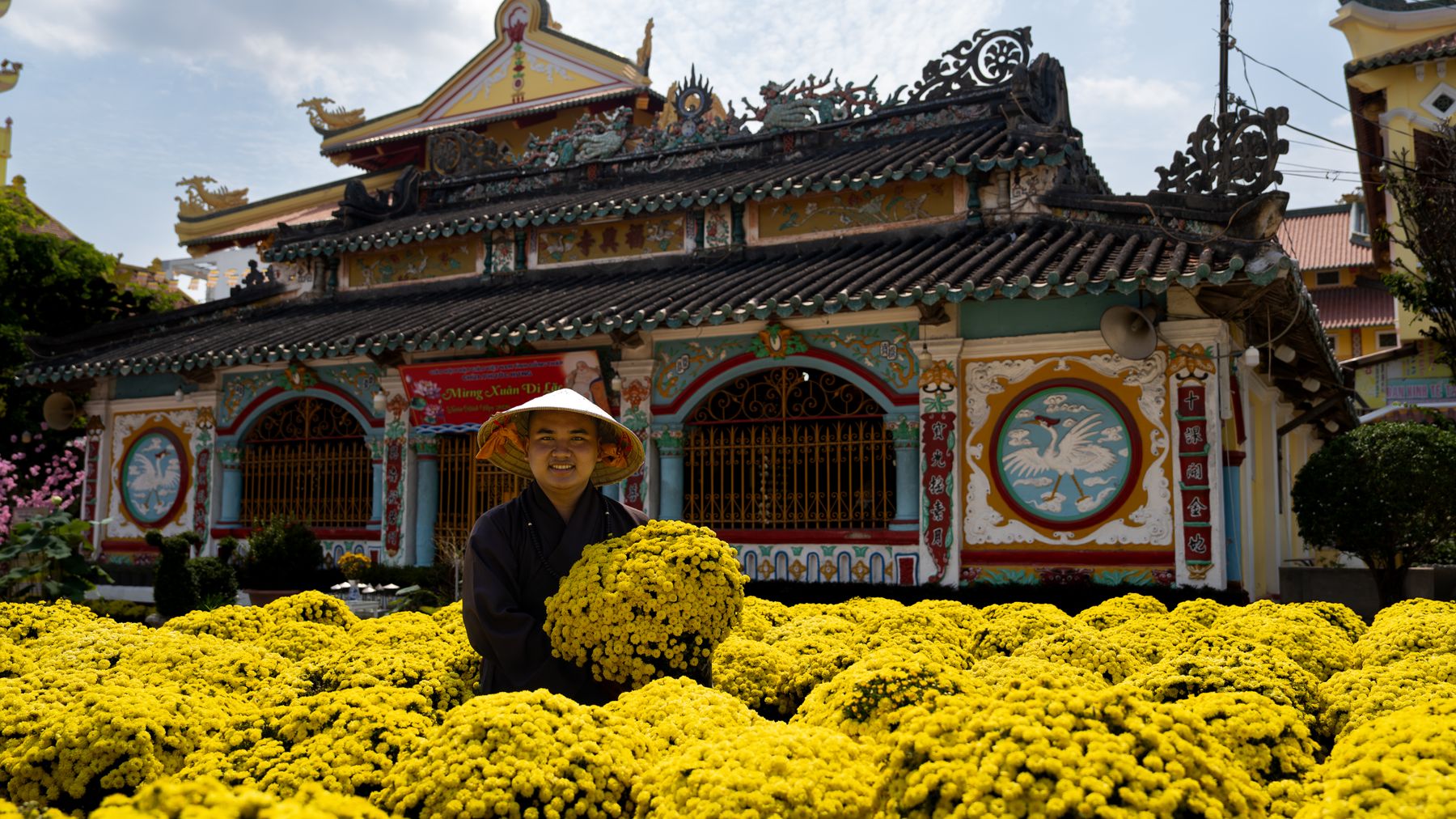
Photo by Felix Schickel on Pexels
What to do once you're there
Walk the central axis
The complex is laid out symmetrically along a north-south axis. Start at the main gate (Dai Thanh Mon), pass through the stele courtyard, and work your way to the main worship hall at the back. The stone steles list historical scholars from the southern region — Vietnamese-language inscriptions, but the layout itself tells the story.
Visit the exhibition house
A side building houses rotating exhibits on southern Vietnamese educational traditions, calligraphy, and Confucian philosophy. Signage is mostly in Vietnamese, but the artifacts — old exam papers, woodblock prints, scholar's tools — are interesting even without full translation.
Sit by the Tinh Hoa lake
The artificial lake on the grounds has a small island with a pavilion connected by a stone bridge. It's a good place to sit for 20 minutes and let the visit settle. Locals bring "ca phe sua da" from nearby shops and just hang out here.
Combine with Buu Long Mountain
Buu Long tourist area is barely 2 km away. The granite hills, pagodas, and a lake surrounded by rock formations make for a solid add-on. Entry is around 30,000 VND. Between the two sites, you have a full half-day.
Catch calligraphy events during Tet
If you visit during Tet / 越南春节 / テト) season, calligraphers set up along the courtyards and write personalized scrolls in Chinese characters or Vietnamese script. A scroll costs 50,000–150,000 VND depending on complexity. It's one of the more genuine Tet traditions you can participate in as a visitor.
Where to eat nearby
Bien Hoa isn't a food-tourism destination on par with Saigon or Hue, but it has local character. Look for "banh canh" — thick tapioca noodle soup — which Dong Nai does well. Stalls along Pham Van Thuong Street in Bien Hoa serve bowls for 35,000–50,000 VND.
For something more substantial, Dong Nai is known for freshwater fish from the river. Restaurants along the Dong Nai riverfront in Bien Hoa serve grilled snakehead fish and hot pots. A meal for two runs about 200,000–350,000 VND. Nothing fancy — plastic chairs, river views, cold beer.
If you're heading back toward Saigon and craving something familiar, the "com tam" places along Highway 1A near the Thu Duc interchange are reliably good.
Where to stay
Most travelers visit Van Mieu Tran Bien as a day trip from Saigon, and that's the practical move. But if you want to overnight in Bien Hoa:
- Budget: Local guesthouses ("nha nghi") around Bien Hoa center run 200,000–350,000 VND/night. Basic but functional.
- Mid-range: A few branded hotels near the Dong Nai provincial government area offer rooms for 500,000–900,000 VND/night with air conditioning, Wi-Fi, and breakfast.
- Comfortable: The Novotel Long Thanh, about 20 minutes south on the expressway, is the nearest international-standard hotel at roughly 1,200,000–1,800,000 VND/night.

Photo by Hồng Quang Official on Pexels
Practical tips locals would tell you
- Dress modestly. It's a Confucian temple — shorts and tank tops won't get you turned away, but you'll feel out of place. Knees and shoulders covered is the move.
- Bring water. There's limited shade in the main courtyards, and the nearest convenience store is a short walk outside the gate.
- Allow 60–90 minutes. The complex is large but not dense. An hour is plenty unless you're photographing everything or visiting during a festival.
- Vietnamese language helps. Almost no English signage inside. Download Google Translate's Vietnamese offline pack before you go — the camera translation feature works decently on exhibition text.
Common mistakes to avoid
- Expecting ancient ruins. This is a 2002 reconstruction. If you arrive expecting weathered stone and centuries of patina, you'll be disappointed. Come for the cultural context, not the archaeology.
- Visiting on weekends during school exam season. Vietnamese families flock here to pray for their children's exam success, especially in May and June. Weekday mornings are dramatically quieter.
- Skipping Buu Long. Going all the way to Bien Hoa and only seeing the temple is a missed opportunity. The two sites together justify the trip.
Practical notes
Van Mieu Tran Bien is open daily from 7:00 to 17:00. Entry is free. The complex is wheelchair-accessible on the main paths, though some side areas have steps. If you're combining this with a broader southern Vietnam itinerary — heading to Saigon, Vung Tau, or Can Tho — Bien Hoa slots in easily as a half-day stop without requiring a detour.
Last updated · May 29, 2026 · independently researched, never sponsored.