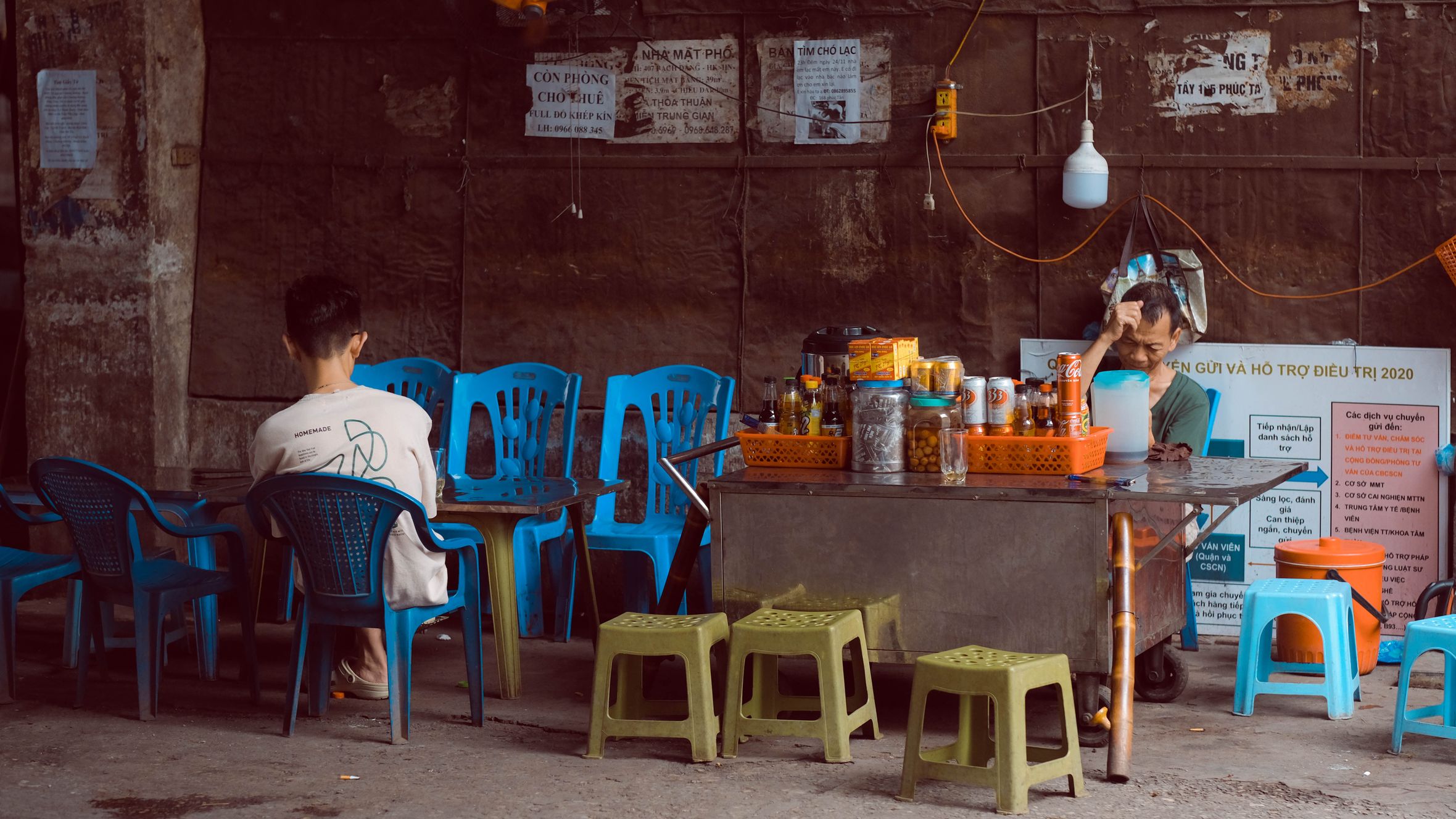
Spend enough mornings in Vietnam (베트남 / 越南 / ベトナム) and you'll notice that the coffee schedule doesn't match what you're used to back home. It's not a cappuccino grabbed on the way to work, and it's rarely sipped slowly after a full meal. The rhythm here is its own thing, shaped by heat, habit, and the particular culture around sitting still.
Coffee First, Then Food — or Instead of It
In Hanoi, the classic morning move is a glass of "ca phe sua da" — iced coffee with sweetened condensed milk — before any food arrives. Locals pull up a plastic stool at a sidewalk stall around 6 or 7am, order a drip coffee in a small glass set over ice, and wait. The drip filter takes a few minutes. That wait is part of it.
For a lot of people, especially older men in the north, coffee is breakfast. A "ca phe trung" — egg coffee (에그커피 / 蛋咖啡 / エッグコーヒー) — at a narrow shophouse in Hanoi's Old Quarter counts as a meal in itself: dense, sweet, vaguely custard-like on top. You don't eat alongside it. You sit, you drink, you watch the street.
In Saigon, the pattern shifts slightly. The city moves faster and the heat hits earlier. "Ca phe sua da" at a grab-and-go stall is common, but so is sitting down with a full breakfast of "banh mi" or "com tam" and drinking coffee alongside the food rather than before it. The meal and the coffee coexist on the same small table, eaten in no particular order.
Why the Timing Is Different
A few things explain the gap between Western coffee habits and the Vietnamese approach.
First, the coffee itself. Vietnamese robusta is strong — considerably higher caffeine content than most arabica blends used in Western espresso. A small cup of Vietnamese drip hits harder than it looks. Drinking it on an empty stomach is intentional for some people; it's a jolt, not a comfort drink. Others prefer to eat a little first for exactly that reason.
Second, the heat. By 8am in Da Nang or Saigon, it can already be 30°C. A hot drink before food makes sense when you're sitting in shade and the temperature is still manageable. By mid-morning, iced coffee dominates. Hot "ca phe den" — black drip, no milk — tends to be a northern preference and a cooler-season thing.
Third, the social function. Coffee in Vietnam is rarely rushed. The stall, the plastic stool, the 15 minutes watching motorbikes — that's the point. It's the transitional ritual between sleep and the day's obligations. Eating is often secondary to that pause.

Photo by 🇻🇳🇻🇳Nguyễn Tiến Thịnh 🇻🇳🇻🇳 on Pexels
The Mid-Morning Coffee Stop
One pattern that surprises a lot of visitors: the second coffee. Around 9 or 10am, after the breakfast rush has settled, you'll see offices empty out briefly and workers drift to the nearest coffee shop. This isn't a Western-style coffee break — it's more of a social reset. The second coffee of the day is often slower, sometimes at a proper cafe rather than a street stall, and frequently accompanied by conversation rather than food.
This is when you'll see younger Vietnamese drinking "bac xiu" — a milkier, lighter coffee with very little actual coffee in it, more popular in the south — or sitting in air-conditioned shops in Hoi An and Da Lat nursing a cold brew or a coconut coffee. The breakfast moment has passed; this is leisure.
After Dinner? Rarely
Here's what Vietnam largely doesn't do: coffee after dinner. This is a hard habit in Italy and France, but it barely registers in Vietnamese culture. Dinner ends with tea — often "lotus tea" in Hanoi, or plain green tea in smaller towns — or sometimes nothing. The idea of drinking a strong coffee at 8pm to cap off a meal is foreign to most locals.
There are exceptions. Younger urban crowds in Saigon and Hanoi have adopted some of this, especially in specialty coffee culture. Cafes in Tay Ho or District 3 stay busy late. But this is a generational shift, not a traditional rhythm.

Photo by Theodore Nguyen on Pexels
How to Drink Coffee Like a Local
If you want to fall into the actual Vietnamese pattern, keep it simple:
- Early morning (6–8am): Find a sidewalk stall, order a drip coffee black or with condensed milk, and sit. If you're hungry, eat "banh cuon" or "pho" alongside it or just before.
- Mid-morning (9–10am): If you want a second coffee, this is the right time. Find a proper cafe, slow down.
- Afternoon: Iced coffee only. "Ca phe sua da" or a fruit-blended ca phe if you find it. Skip hot drinks unless you're in the mountains.
- Evening: Follow the local lead and switch to tea. Or a "bia hoi" if the day warrants it.
The underlying logic isn't complicated. Coffee here is a morning anchor and a mid-day ritual, not a digestif. Once you accept that, the rhythm of the Vietnamese day starts to make a lot more sense.
Practical Notes
A street-stall ca phe sua da costs 15,000–25,000 VND in most cities. Specialty cafes in Hanoi or Saigon run 45,000–70,000 VND for something more curated. If you're buying coffee to go, most stalls will pack it in a plastic bag with a straw — perfectly normal, slightly alarming the first time you see it.
Last updated · May 29, 2026 · independently researched, never sponsored.




